Joint pain is common, and it is not always wear and tear. At Modal Pain Management, 369 Lexington Avenue in Midtown Manhattan, Dr. Alex Movshis works out which joint, or which structure next to it, is the source, then matches the treatment to it: exercise and weight management first for arthritis, image-guided injections when a flare or a specific structure needs them, and nerve-targeted procedures for knee pain that keeps coming back. Joint pain that is left alone tends to make people move less, and the weakness that follows can make the joint feel worse.
Types of Joint Pain We Treat
Osteoarthritis is the most common joint disease. It affects the knees and hips most often, along with the hands and other joints. For knee and hip arthritis, the treatments with the strongest support in the 2019 American College of Rheumatology guideline are exercise and, for people carrying extra weight, weight loss (Kolasinski 2020), and the OARSI guideline puts them at the core of care too (Bannuru 2019). An image-guided cortisone injection helps a knee flare, with the benefit largest in the first one to six weeks and gone by six months (Jüni 2015). Gel (hyaluronic acid) gave only a small benefit over sham injections in the best-controlled knee trials (Rutjes 2012). The American College of Rheumatology strongly recommends against PRP for knee and hip osteoarthritis (Kolasinski 2020). For knee pain that keeps returning, genicular nerve radiofrequency ablation is an option. In an industry-sponsored trial of people who had responded to a test block, 74% had at least half their pain gone six months after cooled RFA, against 16% after one cortisone injection (Davis 2018). The knee osteoarthritis page has the full evidence for each option.
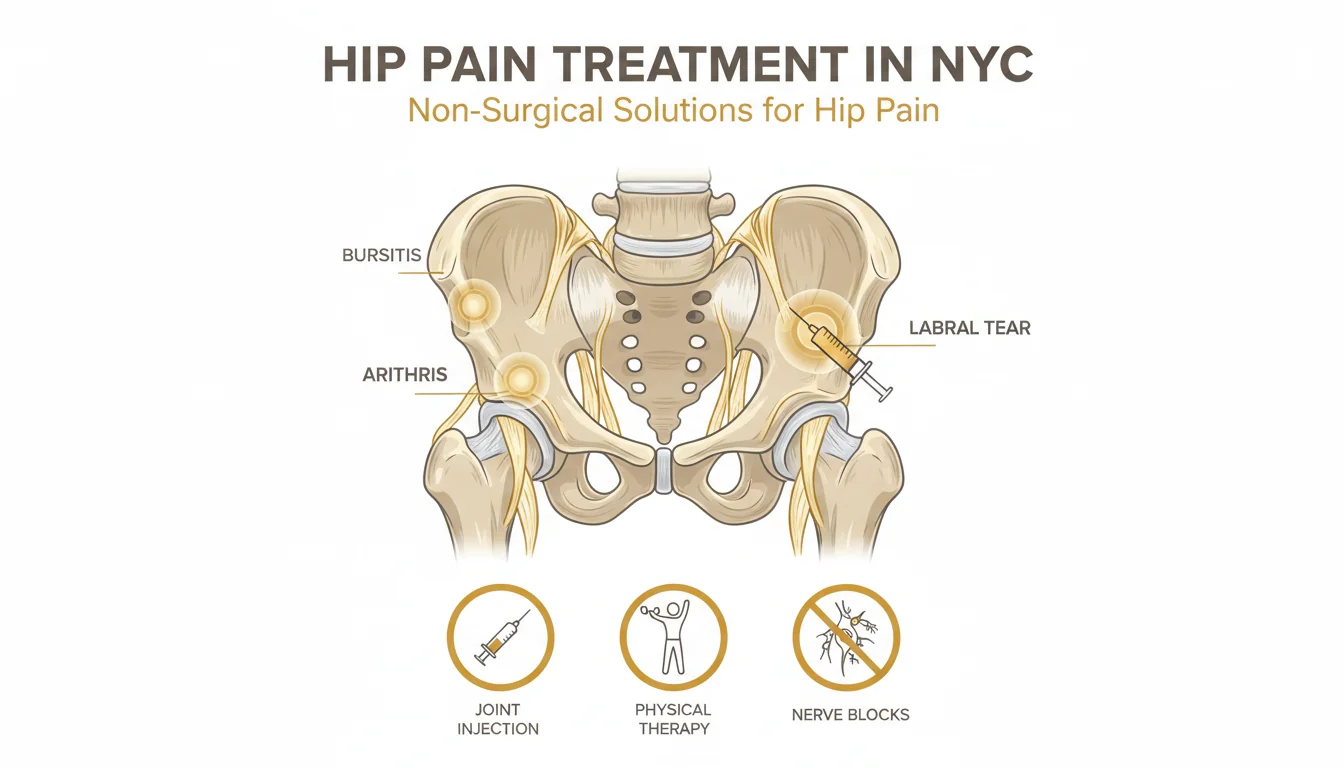
Hip osteoarthritis usually hurts in the groin and front of the thigh rather than on the outside of the hip (Murphy 2016). Image-guided cortisone into the joint has the most evidence. See hip osteoarthritis. In younger active adults, the cause is often femoroacetabular impingement and a labral tear. In the UK FASHIoN trial, both hip arthroscopy and a physiotherapist-led program improved symptoms, and arthroscopy came out ahead at 12 months by a small but clinically meaningful margin (Griffin 2018).
Shoulder pain has its own sorting problem. Frozen shoulder, rotator cuff problems, nerve entrapment and pain referred from the neck can feel alike, and our shoulder pain page covers how they are told apart.
Inflammatory arthritis, such as rheumatoid arthritis, is an immune attack on the joint lining. It needs a rheumatologist and disease-modifying treatment. A cortisone injection can calm one stubborn joint alongside that care.
Bursitis is irritation of the small fluid sacs near a joint. Common forms are knee bursitis, hip bursitis (greater trochanteric pain syndrome), and shoulder bursitis (subacromial bursitis and rotator cuff tendinopathy), all treated with load changes first and, when needed, an ultrasound-guided injection.
The sacroiliac (SI) joint can cause one-sided low back and buttock pain that is easy to mistake for a disc problem. Image-guided SI joint injection and lateral branch radiofrequency ablation are options when the exam and a diagnostic block point to it.
Tendon problems near a joint, such as tennis elbow (lateral epicondylitis) and plantar fasciitis, are not true joint disease. Cortisone tends to give short-lived relief in tendon problems (Coombes 2010). PRP has stronger trial support in plantar fasciitis than in tennis elbow.
Pain after joint surgery is checked for infection, loosening and nerve causes before any procedure is offered.
When to See a Joint Pain Specialist
Consider an evaluation if joint pain has lasted more than a few weeks, morning stiffness takes longer than thirty minutes to ease, the joint is swollen or warm, you are losing range of motion, or pain is interrupting sleep. It also makes sense if over-the-counter medication and physical therapy have not been enough, or if you have been told you need surgery and want to understand the nonsurgical options first. A hot, red, swollen joint with fever is an emergency. Call 911 or go to the nearest emergency room.
Diagnosis and Assessment
Diagnosis starts with the history and exam: where the pain is, when it started, what makes it better or worse, and what it stops you doing. X-rays show arthritis and bone changes. Ultrasound shows fluid, tendons and bursae and guides injections. MRI is ordered when a tear, bone stress or another problem inside the joint is likely. The goal is to treat the structure that is actually causing the pain, which is often not the one that looks worst on an X-ray.
Treatment Options
Exercise-based physical therapy builds the strength and control around the joint, and the American College of Rheumatology strongly recommends it for knee and hip arthritis (Kolasinski 2020). Injections are added when a flare or a specific structure needs them. Cortisone calms a flare for a few weeks (Jüni 2015). Gel (hyaluronic acid) is used in the knee and works more slowly. Placing injections under ultrasound made them less painful and gave more responders at two weeks in a randomized trial (Sibbitt 2009). Nerve blocks numb the small nerves that carry pain from a joint and are mainly used to test whether radiofrequency ablation is likely to help. Modal’s in-house physical therapy team, on the same floor, works alongside any procedure.
What to Expect
Injections are placed under ultrasound or fluoroscopic guidance, without sedation in most cases. Most people walk out and return to normal activity the next day. Cortisone usually shows what it will do by about two weeks, and gel takes 8 to 12 weeks. The cortisone and gel injection aftercare page has the day-by-day instructions.
Long-Term Joint Health
Injections buy time and comfort. The things that change the long-term course are strength, activity and weight. Follow-up visits check whether a treatment actually helped before anything is repeated, and Dr. Movshis does not repeat an injection that did not help. When a joint has reached the point where surgery is the better answer, he says so and refers you to an orthopedic surgeon.
References
- Kolasinski SL, Neogi T, Hochberg MC, et al. 2019 American College of Rheumatology/Arthritis Foundation Guideline for the Management of Osteoarthritis of the Hand, Hip, and Knee. Arthritis Rheumatol. 2020;72(2):220–233. doi:10.1002/art.41142 · PubMed
- Bannuru RR, Osani MC, Vaysbrot EE, et al. OARSI guidelines for the non-surgical management of knee, hip, and polyarticular osteoarthritis. Osteoarthritis Cartilage. 2019;27(11):1578–1589. doi:10.1016/j.joca.2019.06.011 · PubMed
- Jüni P, Hari R, Rutjes AW, et al. Intra-articular corticosteroid for knee osteoarthritis. Cochrane Database Syst Rev. 2015;2015(10):CD005328. doi:10.1002/14651858.CD005328.pub3 · PubMed
- Rutjes AW, Jüni P, da Costa BR, Trelle S, Nüesch E, Reichenbach S. Viscosupplementation for osteoarthritis of the knee: a systematic review and meta-analysis. Ann Intern Med. 2012;157(3):180–91. doi:10.7326/0003-4819-157-3-201208070-00473 · PubMed
- Davis T, Loudermilk E, DePalma M, et al. Prospective, Multicenter, Randomized, Crossover Clinical Trial Comparing the Safety and Effectiveness of Cooled Radiofrequency Ablation With Corticosteroid Injection in the Management of Knee Pain From Osteoarthritis. Reg Anesth Pain Med. 2018;43(1):84–91. doi:10.1097/AAP.0000000000000690 · PubMed
- Griffin DR, Dickenson EJ, Wall PDH, et al. Hip arthroscopy versus best conservative care for the treatment of femoroacetabular impingement syndrome (UK FASHIoN): a multicentre randomised controlled trial. Lancet. 2018;391(10136):2225–2235. doi:10.1016/S0140-6736(18)31202-9 · PubMed
- Murphy NJ, Eyles JP, Hunter DJ. Hip Osteoarthritis: Etiopathogenesis and Implications for Management. Adv Ther. 2016;33(11):1921–1946. doi:10.1007/s12325-016-0409-3 · PubMed
- Sibbitt WL Jr, Peisajovich A, Michael AA, et al. Does sonographic needle guidance affect the clinical outcome of intraarticular injections? J Rheumatol. 2009;36(9):1892–902. doi:10.3899/jrheum.090013 · PubMed
- Coombes BK, Bisset L, Vicenzino B. Efficacy and safety of corticosteroid injections and other injections for management of tendinopathy: a systematic review of randomised controlled trials. Lancet. 2010;376(9754):1751–67. doi:10.1016/S0140-6736(10)61160-9 · PubMed