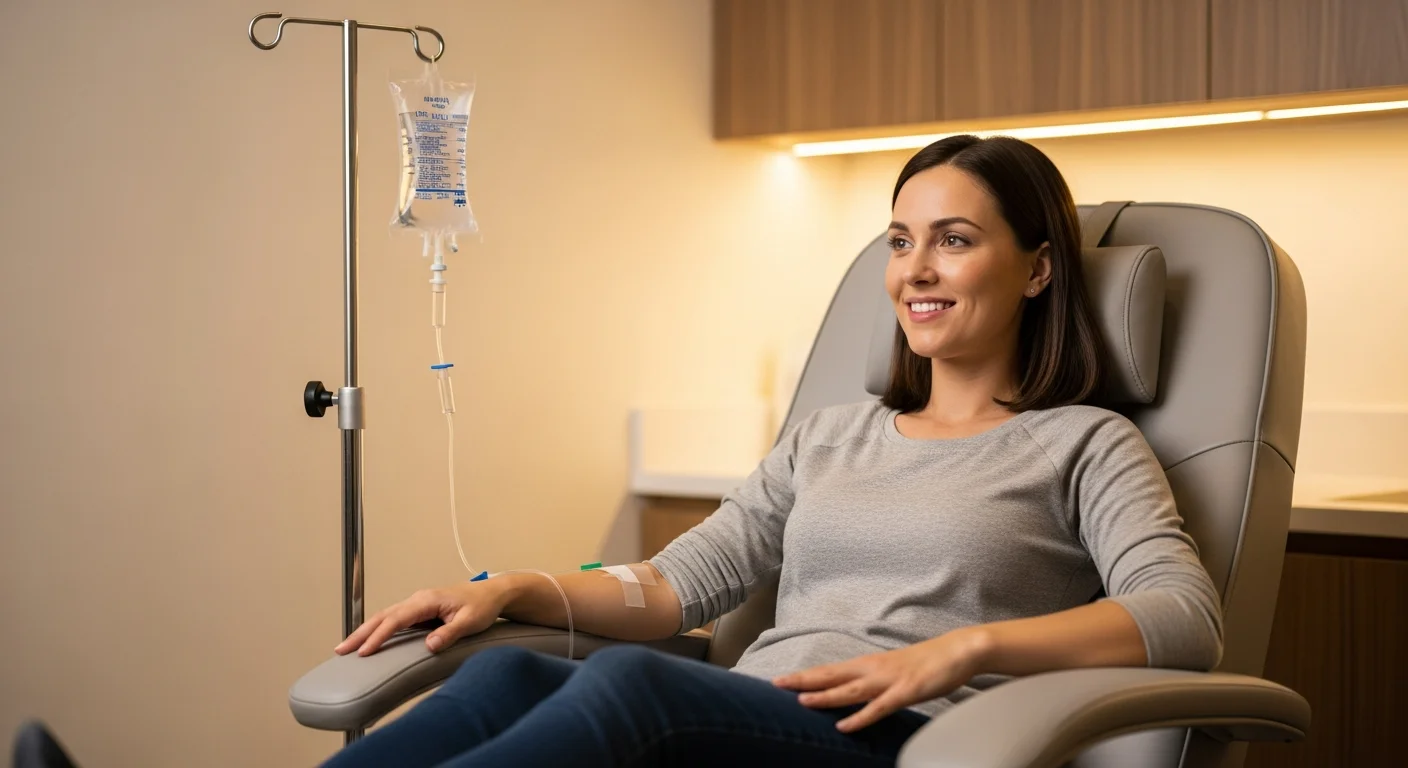
NAD+ (nicotinamide adenine dinucleotide) IV therapy at Modal Pain Management is a physician-administered infusion of a coenzyme that supports cellular energy production, DNA repair, and a family of stress-response proteins called sirtuins. A 250 mg infusion is $400 at our Midtown Manhattan clinic. A 500 mg infusion is $500. Sessions take 90–120 minutes depending on dose. The infusion is administered off-label and is supervised by Dr. Alex Movshis, who is dual board-certified in Pain Medicine and Anesthesiology — a level of clinical oversight not provided by IV bars, mobile services, or wellness lounges.
For full clinical detail on the protocol — dosing rationale, contraindications, and what the infusion is designed to accomplish — see the NAD+ IV therapy product page. This article focuses on the questions patients ask most often: what the therapy actually does, what it costs, what to expect during a session, and what the evidence does and does not show.
Quick summary
- Doses available: 250 mg ($400) or 500 mg ($500) per session.
- Session duration: 90 minutes (250 mg) or 120 minutes (500 mg). Rate is slow on purpose.
- Setting: Private treatment room at 369 Lexington Avenue, Floor 25, NYC 10017.
- Supervision: Dr. Movshis prescribes, monitors, and adjusts the rate during infusion.
- Status: Administered off-label. Not FDA-approved as a drug for any specific indication.
- Insurance: Typically not covered. HSA/FSA funds may apply with a physician’s order.
What NAD+ Does at the Cellular Level
NAD+ is a coenzyme present in every cell of the body. It participates in three biological processes that are directly relevant to pain medicine and recovery:
- Mitochondrial ATP production. NAD+ is the electron carrier for oxidative phosphorylation. Without sufficient NAD+, mitochondria cannot efficiently convert nutrients to ATP, the energy currency cells use for every active process — including nerve signaling, immune response, and tissue repair.
- DNA repair through PARP. Poly(ADP-ribose) polymerase (PARP) is a NAD+-dependent enzyme that repairs single- and double-strand breaks in DNA. Chronic inflammation, oxidative stress, aging, and certain pain states all increase DNA damage and consume NAD+ via PARP. When NAD+ is low, repair slows and unrepaired damage accumulates.
- Sirtuin activation. Sirtuins (SIRT1–SIRT7) are NAD+-dependent proteins that regulate stress response, mitochondrial biogenesis, inflammatory signaling, and cellular metabolism. Sirtuin activity falls when NAD+ falls.
NAD+ levels decline with age, chronic illness, and sustained physical or neurological stress. Whether and how much exogenous NAD+ raises intracellular NAD+ in humans is an active research area; the available evidence shows IV administration produces measurable increases in plasma NAD+ and downstream metabolites, with effects on energy and well-being reported in case series and small clinical trials. Large randomized outcome trials in chronic pain are not yet available.
What the Evidence Does and Does Not Show
Honest framing matters. Here is the current state of the literature, in plain language:
- Cellular biology and animal models: Strong. NAD+ restoration improves mitochondrial function, reduces inflammatory signaling, and extends healthspan in multiple animal models.
- Human studies of oral NAD+ precursors (NMN, NR): Mixed but mostly positive on biomarkers — these supplements raise systemic NAD+ levels modestly and have been generally well-tolerated in trials of weeks to months.
- Human studies of IV NAD+ at therapeutic doses (250 mg+): Limited. The literature is largely case series and open-label experience. Reports describe improvements in energy, cognitive symptoms, and post-acute recovery, particularly in addiction-recovery medicine where IV NAD+ has the longest history.
- Chronic pain outcomes specifically: Anecdotal and emerging. There are no large randomized controlled trials demonstrating NAD+ IV therapy as a primary treatment for chronic pain.
We use NAD+ IV therapy at Modal Pain Management as an adjunctive option in selected patients — not as a primary treatment for chronic pain. The interventional procedures Dr. Movshis is board-certified to perform (epidural steroid injections, medial branch blocks, radiofrequency ablation, BOTOX for chronic migraine) have substantially stronger evidence bases. NAD+ is a complement, not a substitute.
Clinical Applications We Use NAD+ IV For
The clinical contexts in which NAD+ IV is reasonable to consider, based on current evidence and our experience:
- Adjunct in chronic neuropathic pain. When mitochondrial dysfunction in sensory neurons is part of the pain mechanism, NAD+ may support energy availability for nerve repair. Used alongside, not instead of, evidence-based interventional and pharmacologic management.
- Post-procedural recovery. After radiofrequency ablation, epidural steroid injections, or peripheral nerve procedures, NAD+ may support tissue repair pathways. Some patients report less post-procedural fatigue.
- Persistent fatigue without identified cause. When standard work-up has excluded common causes (thyroid, anemia, sleep disorder, depression), NAD+ is one of several adjunctive options.
- Cognitive complaints in chronic pain patients. Brain fog, concentration difficulties, and memory complaints common in chronic pain populations. NAD+ is one of several options; sleep optimization and pain control remain primary.
- Addiction-recovery support, as adjunct. NAD+ has been used in addiction medicine for decades, particularly during opioid taper. Evidence is mixed; we use it selectively and only as part of a broader recovery plan.
NAD+ IV Therapy Side Effects: What to Expect
NAD+ IV is generally well-tolerated when administered slowly and with physician supervision, but it is not a benign infusion. The following side effects are common and dose-related:
- Flushing — facial and neck redness within 5–15 minutes of starting. Resolves within 30–60 minutes. This is vasodilation, not allergy.
- Nausea — affects roughly 20–30% of first-time patients. Dose-related and reduced by slowing the infusion rate or pre-medicating with ondansetron.
- Warm sensation throughout the body — common and expected.
- Chest tightness or pressure — uncommon, typically musculoskeletal rather than cardiac. Resolves with rate adjustment. Patients with active cardiac concerns are screened out before infusion.
- Mild headache or anxiety — occasional, usually self-limited.
We minimize side effects by titrating dose upward across sessions, infusing slowly (90–120 minutes rather than 30 minutes), administering anti-nausea medication when warranted, and ensuring good hydration before and after. Vital signs are monitored throughout.
Why physician supervision matters. The difference between NAD+ IV at a clinic and NAD+ at a wellness lounge is the ability to recognize and manage adverse reactions in real time, screen for cardiovascular contraindications before the first dose, and adjust the protocol based on the patient’s specific clinical picture. This is not a service that should be administered without a physician on-site.
NAD+ IV Therapy Cost
Pricing at Modal Pain Management is transparent:
- 250 mg session: $400. The standard clinical dose.
- 500 mg session: $500. The high-dose protocol for patients seeking maximum effect with appropriate prior tolerance.
- Series and package pricing: Discussed at consultation. Loading-phase patients typically receive 4 sessions in the first 4 weeks at a discounted package rate.
What affects cost. Dose, infusion duration, and any combination therapies (added B vitamins, glutathione, hydration) modify the per-session price. Series prepayment offers a meaningful discount.
Insurance. NAD+ IV therapy is administered off-label and is generally not covered by commercial insurance. Patients with HSA or FSA accounts can typically use those funds when there is a documented clinical indication and a physician’s order — your benefits administrator can confirm. For full insurance and verification information, see the insurance and billing page.
What to Expect During a Session
A typical NAD+ IV appointment runs 90–120 minutes plus 15–20 minutes for intake and post-infusion monitoring. The flow:
Before arrival (24 hours). Hydrate. Eat a light meal 2 hours before. Avoid heavy caffeine. Wear comfortable clothing.
Intake (15 minutes). Check-in, brief health questionnaire, vital signs (BP, HR, SpO2). Review of any side effects from prior infusions.
Pre-infusion review (10 minutes). Dr. Movshis or the supervising clinician reviews dose selection, recent medications, and goals. Anti-nausea medication is administered if warranted. IV access is established (peripheral, in arm or hand).
Infusion (90–120 minutes). NAD+ infuses slowly and steadily. Vital signs are checked every 15 minutes. Patients can read, work, or rest. The rate is adjusted if flushing, nausea, or chest awareness develops.
Recovery (15 minutes). IV is removed. Vital signs are rechecked. Hydration guidance is given. Most patients drive home and return to normal activity the same day.
Loading Protocol and Maintenance
Most patients begin with a loading phase to bring intracellular NAD+ to therapeutic levels and assess clinical response:
- Conservative loading: 250 mg weekly for 4 weeks (4 sessions).
- Standard loading: 250 mg twice weekly for 2 weeks, then weekly for 2 weeks (6 sessions).
- High-dose loading: 500 mg weekly for 4 weeks (4 sessions).
After the loading phase, patients transition to maintenance — most commonly 250 mg or 500 mg every 4 to 8 weeks based on clinical response. We adjust dose and frequency at each follow-up. NAD+ does not cause physiologic dependence; the maintenance schedule is an empirical question of how long the effect lasts in the individual patient.
Who Should Not Receive NAD+ IV Therapy
NAD+ IV therapy is not appropriate for patients with any of the following:
- Active malignancy.
- Uncontrolled hypertension (>160/100 mmHg) at the time of infusion.
- Recent acute coronary syndrome or unstable angina.
- Severe liver disease.
- Pregnancy or breastfeeding (insufficient safety data).
- Known hypersensitivity to NAD+ or B vitamins.
- Use of medications affecting mitochondrial function, until reviewed.
Patients are screened at consultation. If you have any of the above, we will not proceed with NAD+ IV and will discuss alternative approaches.
NAD+ IV vs. Oral NAD+ Precursors
Oral NAD+ precursor supplements — nicotinamide riboside (NR) and nicotinamide mononucleotide (NMN) — are widely available and have a growing evidence base. Practical comparison:
- Oral NMN/NR: Modest increases in plasma NAD+ in human studies. Generally well-tolerated. Convenient. Lower per-day cost. Effects accumulate over weeks of consistent dosing.
- IV NAD+: Higher plasma exposure in a single session. Faster onset of subjective effects when present. Requires a clinic visit. Higher per-session cost. Used for specific clinical indications rather than general wellness.
Neither is universally better. Oral precursors are reasonable for general healthspan support in healthy adults. IV NAD+ is used when faster or higher-dose plasma exposure is the goal — most often in pain medicine, post-procedural recovery, or addiction medicine.
Choosing a Provider in NYC
If you are searching for NAD+ IV therapy in New York, four things matter when evaluating providers:
- Physician oversight. NAD+ infusions should be prescribed and overseen by a licensed physician, with monitoring during the infusion. Mobile services and wellness lounges that administer NAD+ without physician supervision are practicing medicine inappropriately.
- Clinical screening before the first infusion. A reputable provider takes a focused medical history, screens for contraindications, and reviews medications.
- Vital-sign monitoring during infusion. BP, HR, and SpO2 should be checked every 15 minutes. Rate adjustment based on response is essential.
- Transparent pricing. Per-session cost in writing. No locked-in packages before a trial infusion.
At Modal Pain Management, NAD+ IV is one tool among many that Dr. Movshis uses in chronic pain management. The full credential record is on the credentials & verification page, including dual ABA board certification in Anesthesiology and Pain Medicine, ACGME-accredited fellowship at the Icahn School of Medicine at Mount Sinai, and NPI 1942741160.
Common Questions
How quickly will I notice an effect? Some patients report improved energy within 24–48 hours of the first infusion. Cognitive effects, when present, are typically reported by the third to fifth session.
Will NAD+ IV interact with my medications? NAD+ has no widely recognized dangerous drug interactions. Disclose your full medication list at intake. Some blood-pressure medications can amplify infusion-related flushing.
Is NAD+ FDA-approved? No. NAD+ is a naturally occurring molecule administered off-label. Off-label use of approved compounds is legal and routine in medicine when a physician determines clinical benefit — many established pain procedures are similarly off-label.
Can I combine NAD+ with other IV therapies? Yes. Combinations with B vitamins, glutathione, or hydration protocols are common when clinically indicated.
Is NAD+ IV safe for older adults? Yes — older adults often have the lowest baseline NAD+ levels and may be among the patients most likely to notice an effect. We typically dose 250 mg in older or frailer patients.
What if I have an autoimmune condition? NAD+ IV has not been associated with autoimmune flares in the case series and clinical reports available. Clinical decision-making is individualized at consultation.
Bottom Line
NAD+ IV therapy is a physician-administered, off-label infusion that supports cellular energy production, DNA repair, and stress-response signaling. Evidence is strongest in cellular biology, growing in human biomarker studies, and emerging in clinical pain and recovery contexts. We use it as an adjunct to evidence-based interventional pain procedures, not as a replacement for them. Cost is $400 (250 mg) or $500 (500 mg) per session. Insurance typically does not cover it.
If you are a chronic-pain patient considering NAD+ IV, the right next step is a consultation. Dr. Movshis will review your clinical picture, screen for contraindications, and tell you honestly whether NAD+ IV is reasonable to try in your situation — or whether other interventions would have a better expected return.
Schedule a consultation by booking online or calling (646) 290-6660.
References
This article is reviewed against the peer-reviewed literature. Citations retrieved from PubMed.
- Yoshino J, Baur JA, Imai SI. NAD(+) Intermediates: The Biology and Therapeutic Potential of NMN and NR. Cell Metabolism. 2018. doi:10.1016/j.cmet.2017.11.002 · PubMed
- Rajman L, Chwalek K, Sinclair DA. Therapeutic Potential of NAD-Boosting Molecules: The In Vivo Evidence. Cell Metabolism. 2018. doi:10.1016/j.cmet.2018.02.011 · PubMed
- Grant R, Berg J, Mestayer R, et al. A Pilot Study Investigating Changes in the Human Plasma and Urine NAD+ Metabolome During a 6 Hour Intravenous Infusion of NAD. Frontiers in Aging Neuroscience. 2019. doi:10.3389/fnagi.2019.00257 · PubMed
- Yi L, Maier AB, Tao R, et al. The efficacy and safety of β-nicotinamide mononucleotide (NMN) supplementation in healthy middle-aged adults: a randomized, multicenter, double-blind, placebo-controlled, parallel-group, dose-dependent clinical trial. GeroScience. 2023. doi:10.1007/s11357-022-00705-1 · PubMed
- Gallagher C, Emmanuel OO. NAD⁺ supplementation for anti-aging and wellness: A PRISMA-guided systematic review of preclinical and clinical evidence. Ageing Research Reviews. 2026. doi:10.1016/j.arr.2026.103057 · PubMed
Frequently Asked Questions
NAD IV therapy at Modal Pain Management is $400 for a 250 mg infusion and $500 for a 500 mg infusion. Series and package pricing is available at consultation. Insurance typically does not cover NAD+ IV therapy because it is administered off-label; some patients use HSA or FSA funds when prescribed for a specific clinical indication. Self-pay rates are quoted in writing before the first session.
Patients commonly report improved energy, mental clarity, and a sense of recovery from sustained physical or neurological stress. Mechanistically, NAD+ supports mitochondrial ATP production, DNA repair via PARP, and sirtuin-mediated stress response. Clinical evidence for NAD+ IV in chronic pain, post-procedural recovery, and addiction-recovery support is emerging but limited; published trial data is more extensive in cellular biology and animal models than in human pain outcomes.
The most common side effects are flushing, mild nausea, and a warm sensation during infusion — these are dose-related and resolve when the infusion rate is slowed. Less common: chest tightness or pressure (typically musculoskeletal, not cardiac), brief headache, transient anxiety. Physician supervision allows immediate rate adjustment and management of any reaction.
A 250 mg session takes approximately 90 minutes. A 500 mg session takes approximately 120 minutes. The infusion rate is slow on purpose — rapid administration causes substantial discomfort. Plan on roughly 2 hours from arrival to departure including intake, vitals, and post-infusion monitoring.
Most protocols start with a loading phase of 2–4 sessions over 2–4 weeks, followed by monthly or every-6-to-8-week maintenance depending on clinical response. The schedule is adjusted at follow-up based on the indication, side-effect tolerance, and observed effect duration.
IV NAD+ achieves higher plasma concentrations more quickly than oral NAD+, NMN, or NR supplements, which face significant first-pass metabolism in the gut and liver. Oral precursor supplements (NMN, NR) do raise systemic NAD+ levels in some studies but to a lesser degree than IV administration. The right choice depends on the goal: oral supplementation is appropriate for general wellness in healthy adults; IV NAD+ is used clinically when faster, higher-dose plasma exposure is the objective.
Candidates include chronic pain patients with neuropathic or post-procedural pain, patients recovering from significant physical stress, and patients with persistent fatigue or cognitive complaints not explained by another diagnosis. Patients are screened at consultation. NAD+ IV is not appropriate for active malignancy, uncontrolled hypertension, recent acute coronary events, severe liver disease, pregnancy, breastfeeding, or known hypersensitivity.
NAD+ IV therapy should be administered by a licensed physician or under direct physician supervision in a clinical setting, with cardiac monitoring during infusion. Modal Pain Management in Midtown Manhattan (369 Lexington Ave, Floor 25) offers physician-supervised NAD+ IV infusions with Dr. Alex Movshis, board-certified in Pain Medicine and Anesthesiology. Avoid mobile services, IV bars, and wellness lounges that administer NAD+ without physician oversight or vital-sign monitoring.