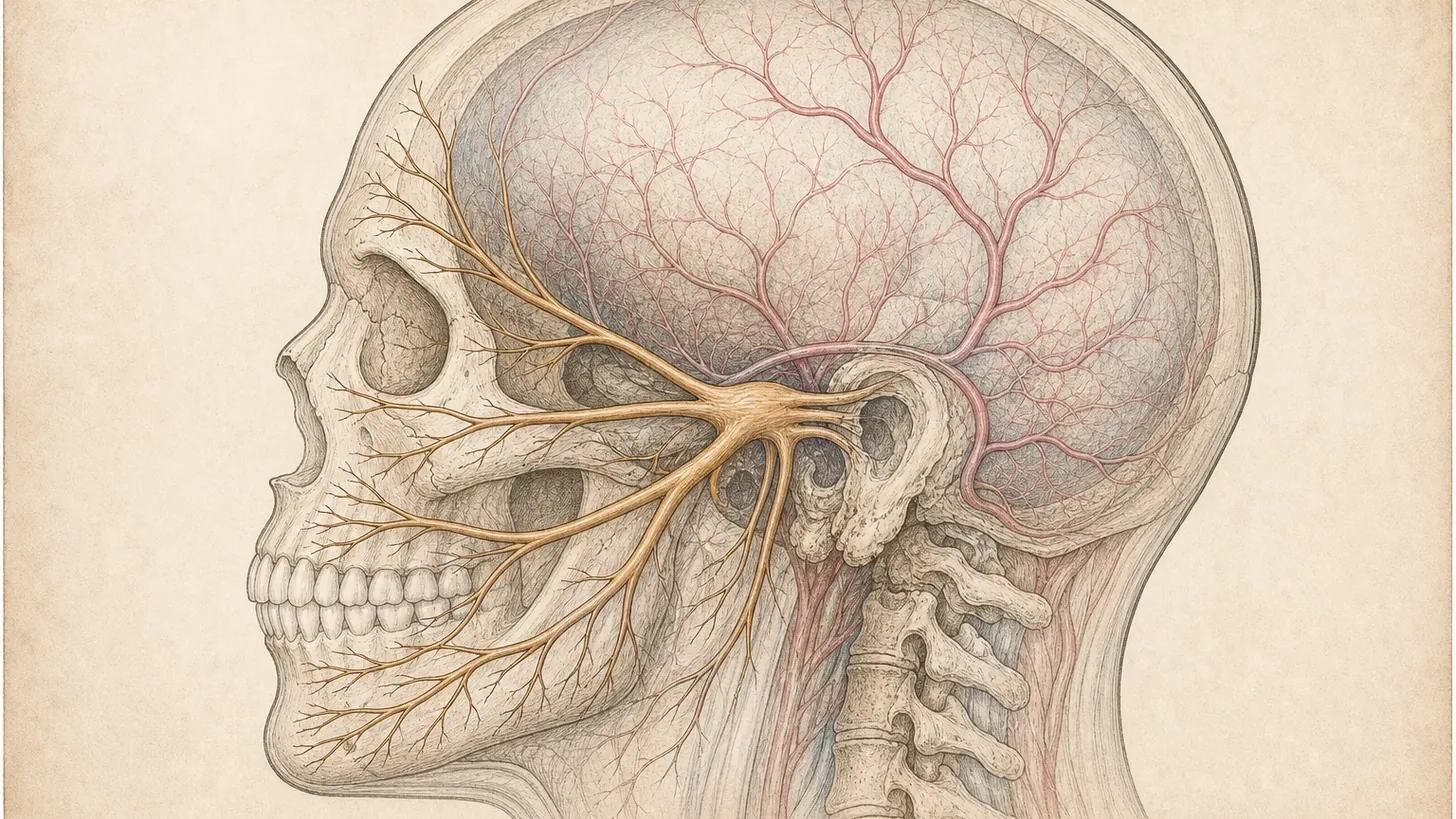
A migraine attack involves activation of the trigeminal nerve and inflammation around pain-sensitive blood vessels of the brain’s coverings, and in migraine with aura, a slow wave of altered brain activity called cortical spreading depression. During an attack the stomach often empties slowly and nausea is common, which is one reason oral medicines can let you down. Our migraine cocktail gives prescription medications directly into a vein, so they do not depend on your stomach.
This is not a generic “hydration drip with vitamins.” The two drugs at its core have guideline support for treating a migraine attack, magnesium and fluids are add-ons with weaker evidence, and the whole infusion is prescribed by Dr. Movshis and given under physician supervision at our Midtown Manhattan clinic.
What is in a migraine cocktail?
“Migraine cocktail” is emergency-room shorthand, not a fixed recipe. Most versions are built around a dopamine-blocking drug, either metoclopramide (Reglan) or prochlorperazine (Compazine), which treats the nausea and the headache itself. IV ketorolac (Toradol) and fluids are common additions. Some hospitals also add diphenhydramine (Benadryl) or a single dose of dexamethasone.
Those extras have been tested. In a trial of 208 emergency patients, adding IV diphenhydramine to metoclopramide did not improve relief: 40% had sustained relief at 48 hours with it and 37% without it (Friedman et al., 2016). Dexamethasone does a different job. It does not stop the attack in front of you, but in a pooled analysis of 7 trials with 742 patients it lowered the chance of a moderate or severe headache coming back within 24 to 72 hours, by about 1 patient in 10 (Singh et al., 2008). The 2025 American Headache Society guideline lists it as a treatment that “may be offered.”
Our cocktail is Toradol, Reglan, magnesium and fluids. Here is what each part does and how strong the evidence is.
Clinical Protocol
- Toradol (Ketorolac) IV — A prescription NSAID that blocks prostaglandin production. Its pain-relieving effect usually begins within about 30 minutes of an IV dose. The 2025 American Headache Society emergency-department guideline lists IV ketorolac among the treatments that should be offered for a migraine attack. It requires a prescription and screening for kidney, stomach and bleeding risks.
- Reglan (Metoclopramide) IV — A dopamine D2-receptor antagonist that does two jobs at once: it stops migraine-associated nausea and vomiting, and it directly interrupts the attack itself. Metoclopramide is one of the most-studied acute migraine treatments in emergency-department research. In a randomized trial of 78 patients, IV metoclopramide relieved headache about as well as an injected triptan (sumatriptan) at 2 and 24 hours (Friedman et al., 2005). We infuse it slowly over the course of your drip to keep you comfortable and reduce the restlessness a rapid dose can cause. That dual action, treating the headache and not just the nausea, is why it belongs in a physician-built protocol.
- Magnesium Sulfate IV — Magnesium acts on nerve and muscle function and blocks NMDA receptors. Some studies report lower magnesium levels in people with migraine, and IV magnesium is added as an adjunct that may help some patients, particularly with migraine with aura, though the controlled evidence is mixed and a meta-analysis found no reliable benefit for acute migraine overall.
- Normal Saline IV — Patients often name dehydration as a trigger, and vomiting during an attack makes it worse. IV fluid replaces what you have lost. The 2025 guideline found too little evidence to rate saline on its own as a migraine treatment.
Reglan or prochlorperazine?
Patients sometimes ask whether prochlorperazine works better. Two small trials from the 1990s, with 70 and 86 patients, favored it over a 10 mg dose of metoclopramide (Coppola et al., 1995 and Jones et al., 1996). A later double-blind trial gave 77 emergency patients either prochlorperazine 10 mg or metoclopramide 20 mg, and pain fell almost equally at 1 hour, 5.5 and 5.2 points on a 0 to 10 scale. Side effects were reported by 46% and 32%, a gap that could have been chance (Friedman et al., 2008). Raising the metoclopramide dose past 10 mg did not add relief in a dose-finding trial of 356 patients either (Friedman et al., 2011). Prochlorperazine’s top rating in the 2025 guideline comes from the number of high-quality placebo-controlled trials behind it, not from beating Reglan head to head.
Who a Migraine Cocktail Is For
This infusion is designed for patients with a recognizable migraine attack, a flare of chronic migraine, or an attack that has lasted longer than 72 hours (status migrainosus) once red flags have been ruled out. It is most useful for patients who cannot keep oral medications down because of nausea, those whose usual triptan has not worked for this attack, and those who want an alternative to the emergency department for a familiar headache. Some patients call as soon as they recognize their usual warning signs.
How It Differs From Wellness IV Drips
Many IV lounges offer “migraine” drips of saline, B vitamins, and magnesium. Those ingredients may help with hydration, but they have weak evidence for treating the attack itself. Our protocol is built around two prescription medications (Toradol and Reglan) that require a prescription and screening, with magnesium and fluids as add-ons. It is a clinical treatment, not a wellness service.
What to Expect
When you arrive during an active migraine, we prioritize your comfort immediately — dimmed lighting, a quiet treatment room, and minimal wait time. Dr. Movshis will briefly assess your symptoms, review any medications you’ve already taken, and confirm the infusion protocol. The IV is placed and the infusion runs over approximately 45-60 minutes. Many patients feel the headache and nausea start to ease within the first hour. You’ll rest while the full infusion completes, and our team will monitor you throughout. If the headache has not improved by the end, Dr. Movshis will talk through next steps with you.
Adding an Occipital Nerve Block
The 2025 guideline gives its strongest rating, “must offer,” to two treatments for a migraine attack: IV prochlorperazine and a greater occipital nerve block (Robblee et al., 2025). Dr. Movshis performs occipital nerve blocks in the office and decides case by case whether to add one at the cocktail visit. Where the pain sits, how the attack is behaving and how you have responded to blocks before all go into that call. If you would like one considered, say so when you book.
Integrating With Your Migraine Treatment Plan
The migraine cocktail works as both a standalone acute treatment and as part of a broader migraine management strategy. For patients with frequent migraines, Dr. Movshis may recommend preventive treatments including nerve blocks, Botox (neuromodulator) therapy, or trigger point injections with the cocktail kept for breakthrough attacks. Prevention is what reduces how often you need rescue care, so it is part of the conversation for anyone who books this IV more than occasionally.
Important Considerations
This infusion contains prescription medications and requires medical screening before administration. Because of the Toradol, patients with NSAID allergies, active GI bleeding, or significant renal impairment should tell our team first. Because of the Reglan, we also screen for Parkinson’s disease, a history of seizures, bowel obstruction, and certain rare adrenal tumors, since dopamine-blocking medication isn’t safe in those situations. A few patients feel brief restlessness during or after the infusion. Infusing slowly keeps this to a minimum, and it passes. Dr. Movshis reviews your medical history and current medications before every infusion to confirm the protocol is right for you.
What the evidence shows
The drug components of this infusion are the part with real backing for acute migraine. The 2025 American Headache Society guideline on emergency-department migraine treatment rates IV ketorolac (Toradol) and IV metoclopramide (Reglan) as treatments that should be offered to eligible patients, a level B recommendation (Robblee et al., 2025). That is the evidence we lean on, and it is why these two medications anchor the protocol. The same guideline gives its strongest rating to IV prochlorperazine and greater occipital nerve blocks. Prochlorperazine has not clearly beaten Reglan head to head (see above), and an occipital nerve block can be added at the same visit when it fits. The guideline was written for emergency departments, and we apply it to an office setting for patients whose attacks match their usual pattern.
Magnesium is the honest exception. We add it as an adjunct and some patients seem to benefit, but a meta-analysis of randomized trials did not find IV magnesium reliably relieved acute migraine, and side effects were more common with it (Choi & Parmar, 2014). One more thing to be clear about: this is an acute, in-office rescue treatment given off-label, not a substitute for migraine prevention. For frequent migraines, Dr. Movshis discusses preventive options at your visit.