Modal Pain’s approach to the stellate ganglion block
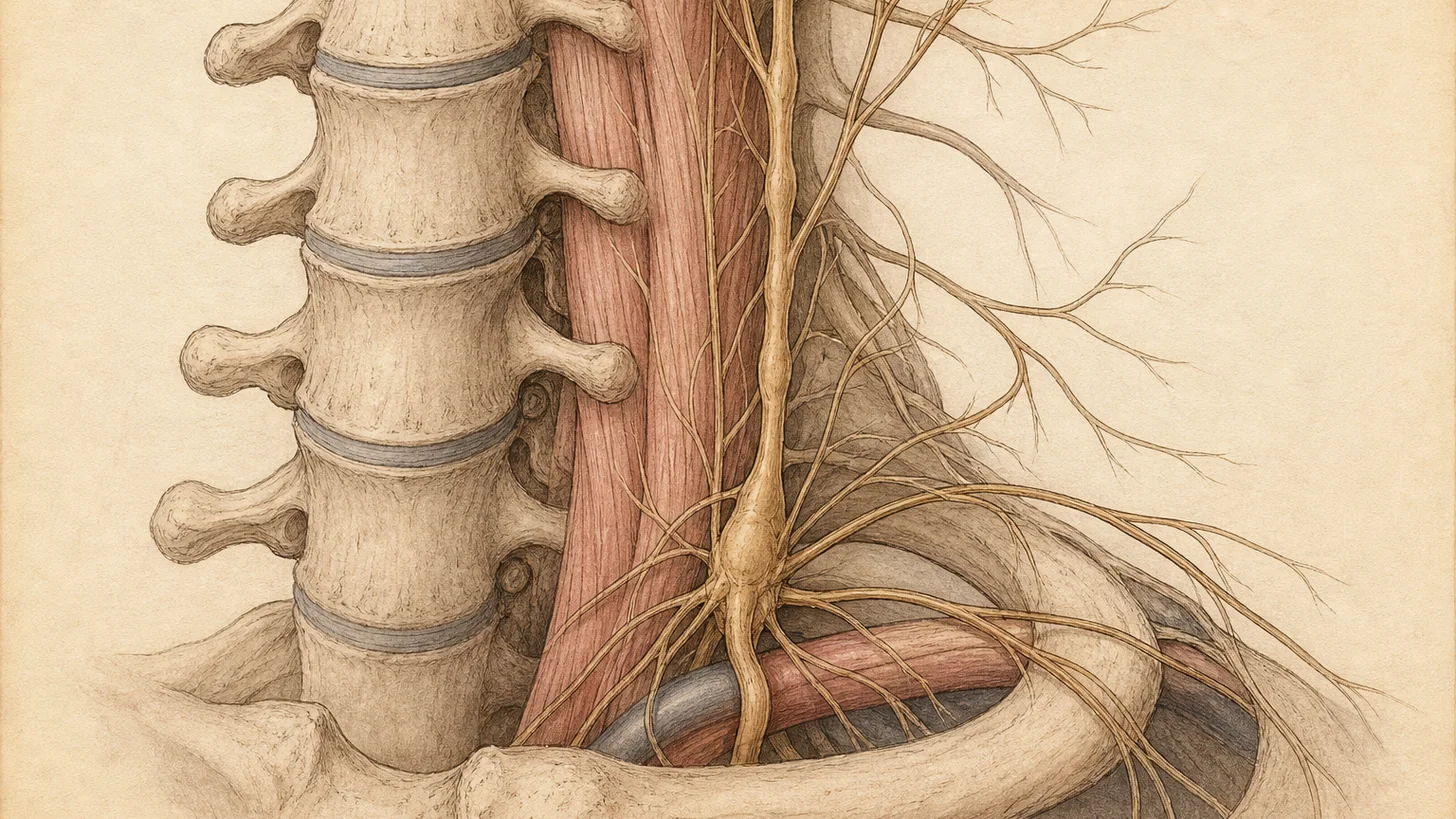
The stellate ganglion is a small collection of sympathetic nerves low in the front of the neck, near the C6–C7 vertebrae. It relays “fight-or-flight” signals to the head, neck, and arm. A stellate ganglion block (SGB) places local anesthetic around that bundle to switch the signaling off for a while. Dr. Alex Movshis performs every block personally, at the C6–C7 level, using ultrasound and fluoroscopic guidance to work safely around the carotid and vertebral arteries, the thyroid, and the airway.
This page does something most clinic pages won’t: it separates the two very different reasons patients get this block. Some uses are well-established and covered by insurance. Others — including the ones that bring people in after reading about them online — are off-label, where the science is genuinely early. We’ll tell you which is which.
How the block works
The sympathetic nervous system controls things you don’t think about — blood-vessel tone, sweating, the “alarm” response. When that system is stuck in overdrive in one region (a painful, swollen, color-changing arm in CRPS; a hyper-aroused nervous system in PTSD), temporarily interrupting it can break the loop. The anesthetic wears off in hours, but the reset sometimes outlasts the drug, which is the rationale behind using the block for conditions far beyond ordinary pain.
A successful block produces Horner’s syndrome on the treated side — a drooping eyelid, a smaller pupil, a stuffy nostril, and a warm hand. That’s expected and temporary; it’s how we confirm the right nerves were reached.
Insurance-covered (on-label) uses
These are the established indications. Most commercial PPO plans cover the block for them, and we verify your benefits before scheduling. One honest caveat worth stating up front: even for these accepted uses, the highest-tier evidence is thinner than most patients assume. A 2023 Cochrane overview found no high-certainty evidence for any CRPS treatment (Ferraro et al., 2023). SGB is widely used and reasonable here because of its mechanism, long clinical track record, and smaller trials — not because a large modern trial settled the question.
- Complex regional pain syndrome (CRPS) and sympathetically-maintained pain. The classic indication. A 2024 meta-analysis of 12 randomized trials found SGB reduced pain intensity in CRPS versus controls, with few side effects, while calling for larger studies (Tian et al., 2024). We use it both to diagnose (does turning off the sympathetic supply relieve the pain?) and to treat.
- Shingles pain and postherpetic neuralgia (PHN). Used for pain control during acute shingles of the head, neck, or arm and for established PHN. Be aware that for preventing PHN, the evidence favors epidural and paravertebral blocks over SGB (Kim et al., 2017), so we’re honest that this is for pain control, not prevention.
- Raynaud’s and upper-limb circulation problems. Blocking the sympathetic supply opens up blood vessels, which can improve perfusion and serves as a test before more durable treatments. The supporting evidence here is case-level (Singh & Rajarathinam, 2023).
- Palmar hyperhidrosis (excessive hand sweating). A reversible, non-surgical option; reported relief lasts weeks per block (Heinig et al., 2016).
- Refractory angina. A palliative, last-resort option for chest pain that hasn’t responded to medication or revascularization, supported by case-level evidence and offering temporary relief (Singh & Rajarathinam, 2023).
Off-label uses (self-pay)
These are the uses people increasingly ask about. They are off-label — not an FDA-labeled indication — and not covered by insurance, so they’re billed as a $1,000 self-pay procedure. We’re willing to perform them for appropriately selected patients, and we’re equally willing to tell you what the evidence does and doesn’t show.
Long COVID
Patients sometimes come in for an off-label SGB for long-COVID symptoms — lingering fatigue, brain fog, racing heart, or a distorted sense of smell — often after their neurologist or primary doctor raises it. The theory is that long COVID involves a dysregulated, over-firing sympathetic nervous system, and that the block may help reset it.
Here’s the honest state of the evidence. There is no randomized, sham-controlled trial. What exists is small and uncontrolled: a 20-patient open-label pilot reported meaningful improvements in autonomic symptoms, pain, sleep, and fatigue at four weeks (Wang et al., 2025); a single-practice retrospective review reported that most of 41 patients felt better afterward (Pearson et al., 2023); and there are case reports of recovered smell and energy. Against that, at least one published case describes the block simply not working, with the patient only improving after a different treatment (Butler, 2024). Without a control group, some of the reported benefit could be placebo or the natural, gradual recovery long COVID often follows. So we offer it as a reasonable thing to try for the right patient — not a proven cure — and we’d rather you go in clear-eyed.
Post-traumatic stress (PTSD)
This is the most-studied off-label use, and the trials disagree. A multisite randomized trial in service members found two SGBs reduced PTSD symptoms more than a sham injection (Rae Olmsted et al., 2020); an earlier randomized sham-controlled trial found no significant difference (Hanling et al., 2016). A 2025 meta-analysis pooled a modest benefit while emphasizing how few trials exist (Yang et al., 2025), and a definitive trial is in progress. The fair summary: a promising, fast-acting, off-label adjunct that helps some people — most studied in military populations — best used alongside trauma-focused therapy rather than instead of it.
Menopausal hot flashes
Of the three off-label uses, this one has the strongest dedicated trial. A randomized, sham-controlled study found SGB significantly reduced moderate-to-severe hot flashes and objectively measured flashes, even though it didn’t change total flash count (Walega et al., 2014); the original pilot work in breast-cancer survivors who couldn’t take hormones was striking (Lipov et al., 2008). It’s a reasonable non-hormonal option to discuss for severe symptoms — still off-label, still a small evidence base.
Safety
A stellate ganglion block is generally safe in trained hands with image guidance. The expected, temporary effects — drooping eyelid, smaller pupil, red eye, stuffy nose, warm hand, hoarseness, a lump-in-the-throat feeling — are signs the block worked and resolve as the anesthetic wears off. Rare but serious risks, which ultrasound and fluoroscopy are specifically used to prevent, include intravascular injection (especially into the vertebral artery, which can cause a seizure), temporary weakness of the breathing muscle, a collapsed lung, or a neck hematoma. Because a single block’s benefit is often short-lived, repeat blocks are common, and each carries the same risk profile — a reason we reassess rather than reflexively repeat a block that didn’t help.
If a stellate ganglion block is something you or your referring physician are considering — for a covered pain condition or an off-label reason — book a consultation or call (646) 290-6660, and we’ll give you a straight read on whether it makes sense for you.