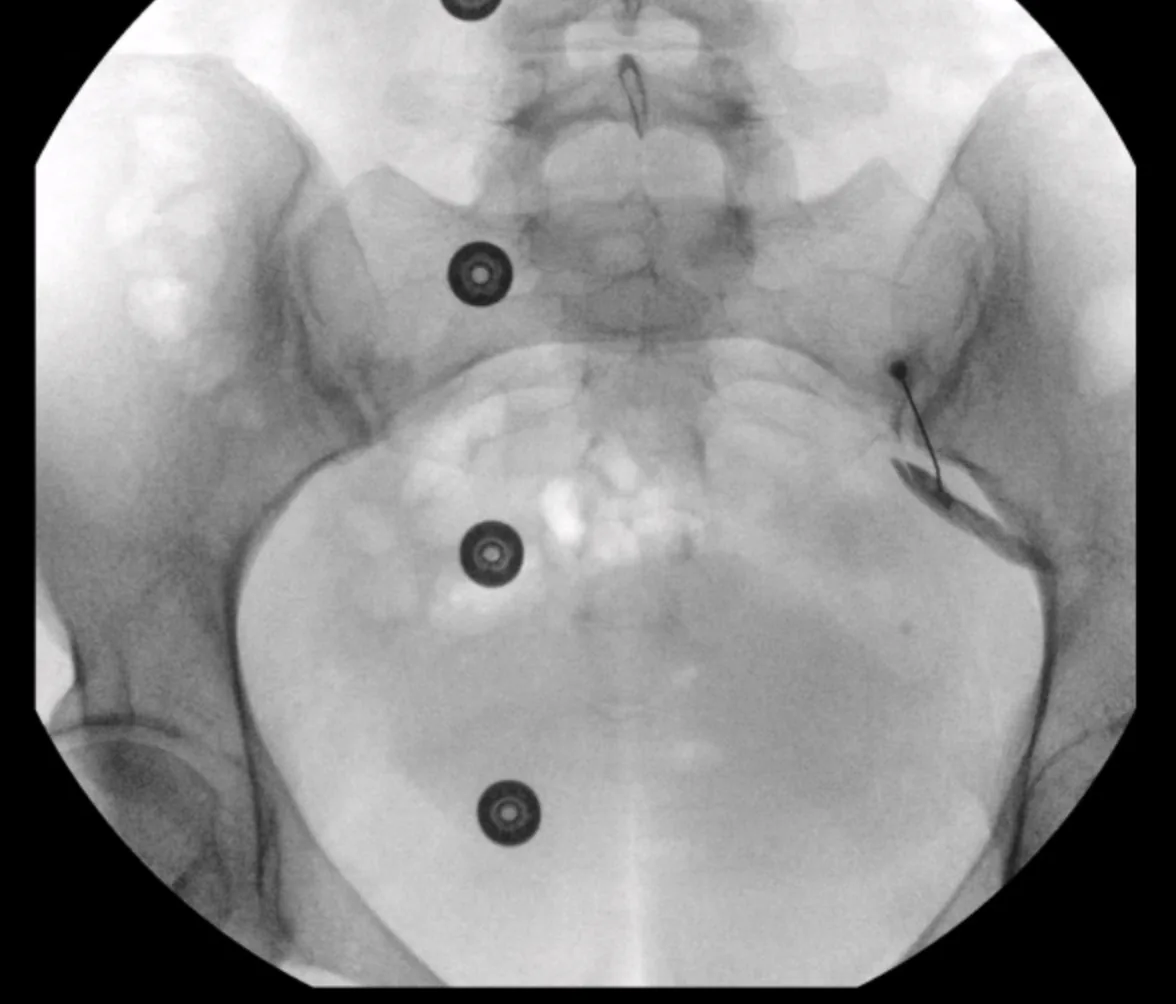
Piriformis syndrome is buttock pain, often running down the leg, from the sciatic nerve being irritated where it passes the piriformis muscle. It is often treated as ordinary lumbar sciatica before anyone examines the buttock. At Modal Pain Management in Midtown Manhattan, Dr. Alex Movshis separates it from spinal sciatica with a focused exam and imaging when needed, and treats it with targeted physical therapy and, when pain blocks progress, an ultrasound-guided injection.
Prefer to watch? A 74-second narrated animation of how the piriformis compresses the sciatic nerve — with the full transcript and PubMed-verified references.
This page covers what the piriformis muscle is, why it can compress the sciatic nerve, how piriformis syndrome differs from spinal sciatica, the clinical exam findings that point to the diagnosis, and the evidence-based treatment ladder we use to get patients back to sitting, walking, running, and sleeping without pain.
What Is the Piriformis Muscle?
The piriformis is a small, flat, pear-shaped muscle deep in the buttock. It originates on the front of the sacrum (the triangular bone at the base of the spine) and inserts on the greater trochanter (the bony bump on the outside of the hip). Its primary job is to externally rotate the hip when the leg is straight and to abduct the hip when the leg is bent — the motion you make when stepping out of a car or pivoting in soccer. The piriformis is one of six deep external rotators of the hip and sits directly above the sciatic nerve as it leaves the pelvis through the greater sciatic foramen.
In most people the sciatic nerve passes underneath the piriformis. In a pooled analysis of 6,062 cadavers, about 17% had a variant in which part or all of the nerve passes through or above the muscle, the pattern Beaton and Anson classified in 1937. The variant was just as common in people operated on for piriformis syndrome, which suggests it matters less than once thought (Smoll 2010).
Piriformis Syndrome vs. Spinal Sciatica
Sciatica — pain, numbness, or weakness following the sciatic nerve distribution from the buttock down the back of the leg — is a symptom, not a diagnosis. It is common, although prevalence estimates vary widely between studies (Konstantinou 2008). The most common cause is irritation of the L4, L5, or S1 nerve root in the lumbar spine by a herniated disc or by stenosis. Piriformis syndrome is a distinct cause: compression of the sciatic nerve in the buttock by the piriformis muscle itself, downstream of the spine. The two conditions look similar on the surface but require entirely different treatment.
Features that point toward piriformis syndrome rather than spinal sciatica:
- Tenderness deep in the buttock, near the sciatic notch (midway between the upper outer corner of the sacrum and the greater trochanter), that reproduces the pain.
- Pain made worse by sitting.
- Pain with maneuvers that tense the piriformis, such as the FAIR test (flexion, adduction, internal rotation).
- Little or no low back pain, and no numbness or weakness in a nerve-root pattern.
- A lumbar MRI that does not explain the symptoms (a degenerated disc on imaging is not the same as a symptomatic disc).
A systematic review found the first three, together with buttock pain itself, to be the features most often reported. It also found that the accuracy of these signs has not been established, and that a positive straight-leg raise does not rule piriformis syndrome out (Hopayian 2018). When the picture is mixed, an ultrasound-guided injection of local anesthetic into the piriformis helps. If the familiar pain goes quiet while the anesthetic works, the piriformis is a likely source. It is not proof, because the anesthetic can also reach the sciatic nerve beside the muscle.
The Deep Gluteal Syndrome Differential
Orthopedic and pain literature increasingly uses the broader term “deep gluteal syndrome” (DGS) for sciatic nerve entrapment in the buttock from any cause, not just the piriformis (Martin 2015). At Modal Pain Management we evaluate every suspected piriformis case for the full DGS differential before committing to a treatment plan:
- Piriformis syndrome.
- Proximal hamstring tendinopathy with sciatic nerve irritation — pain near the ischial tuberosity, worsened by sitting on hard surfaces and by hip flexion against resistance. Our proximal hamstring tendinopathy page covers that diagnosis in depth.
- Ischiofemoral impingement — narrowing of the space between the ischium and the lesser trochanter pinches the quadratus femoris and the sciatic nerve, especially in long-strided runners.
- Obturator internus or gemelli muscle entrapment — less common, often missed on standard MRI.
- Sciatic nerve anatomical variants — the roughly one in six people in whom part of the nerve passes through or above the piriformis (Smoll 2010).
- Hip joint pathology referring pain into the buttock — labral tear, osteoarthritis, femoroacetabular impingement.
- Sacroiliac joint pain with secondary piriformis tightness. The SI joint pain pattern can mimic piriformis but responds to a different injection target. See SI joint pain.
Each of these has a different optimal treatment, which is why a careful exam and high-resolution MRI matter as much as the injection itself.
Diagnosis at Modal Pain Management
Evaluation for suspected piriformis syndrome includes:
- Focused history — onset (acute trauma vs. insidious), provocative and relieving factors, occupational and athletic exposures, prior treatments and their effect, and any neurological symptoms.
- Physical examination — gait observation, lumbar range of motion, straight-leg raise, deep buttock palpation, and the four piriformis-specific tests (FAIR, Pace, Beatty, Freiberg).
- Ultrasound when needed — a look at the piriformis, the surrounding deep gluteal anatomy and the sciatic nerve, including asymmetric thickening, scarring, or an anatomical variant.
- Review of prior imaging — lumbar spine and pelvis MRI if you already have one. If not, a targeted MRI is ordered when the differential calls for it.
- Diagnostic-therapeutic injection — when suspicion is high, an ultrasound-guided injection into the piriformis tests the diagnosis and starts treatment.
Having the exam, ultrasound and injection in one office saves patients with long-standing buttock pain a chain of separate referrals.
Image-Guided Treatment
The main interventional treatment for piriformis syndrome is the ultrasound-guided piriformis injection. In a short office procedure, local anesthetic, usually with a corticosteroid, is placed into the piriformis muscle under real-time ultrasound. Guidance matters because the muscle is deep and the sciatic nerve sits right next to it. In a cadaver study, 19 of 20 ultrasound-guided injections reached the piriformis, while 14 of 20 fluoroscopically guided injections missed it, most landing in the gluteus maximus and one in the sciatic nerve (Finnoff 2008). Across published studies, local anesthetic plus steroid gave the largest pain reductions, but most of those studies were small and not randomized (Hilal 2022).
For chronic, recurrent piriformis syndrome that has not durably responded to two appropriately performed corticosteroid injections, the next-line image-guided options include:
- Botulinum toxin (Botox) injection into the piriformis — used off-label and decided case by case. It relaxes the muscle for a period of weeks to months while physical therapy continues. A systematic review of seven studies with 152 patients found fair-quality evidence that it reduces pain and is safe, but could not say by how much (Koh 2022). Coverage varies by plan, and the office checks your plan first.
- Trigger point injections in the surrounding gluteal and lumbopelvic muscles when secondary myofascial pain has developed. See trigger point injections.
Physical Therapy and Self-Care
An injection can calm the pain, but lasting recovery depends on the mechanics and habits that made the piriformis symptomatic in the first place. A targeted physical therapy program for piriformis syndrome typically includes:
- Piriformis-specific stretching — the supine figure-4 stretch held about 30 seconds, a few times a day. Pigeon pose is added gradually as pain allows.
- Hip external-rotator and abductor strengthening — clamshells, side-lying hip abduction, monster walks with a resistance band — to re-balance the deep external rotators around the joint.
- Lumbopelvic stabilization — dead bug, bird dog, glute bridge progression — to reduce piriformis overuse from compensating for weak gluteals or core.
- Gait and posture retraining — for runners, addressing overstriding, cadence, and foot strike pattern. For office workers, a look at the workstation and a standing-desk schedule.
- Self-care — alternating ice and heat, foam rolling the surrounding gluteals (not directly on the inflamed piriformis early in treatment), and a piriformis-relief seat cushion for sustained sitting.
Most people notice progress over several weeks of a structured program.
When to Seek Specialist Care
See a pain specialist for evaluation if any of the following apply:
- Buttock pain radiating down the leg that has not improved with 2–3 weeks of rest, ice, NSAIDs, and gentle stretching.
- Symptoms that have been treated as “sciatica” for more than 6 weeks without significant improvement, particularly when MRI of the lumbar spine does not show a clear cause.
- Pain that is consistently worse with sitting and better with walking — a pattern that points away from spinal sciatica.
- A previous episode that resolved and has now recurred.
- Coexisting hip, sacroiliac, or proximal hamstring pain that has been difficult to differentiate.
Red-flag symptoms, such as progressive leg weakness, foot drop, loss of bowel or bladder control, or numbness in the saddle area, suggest a different and more urgent problem (cauda equina syndrome or severe nerve root compression). Call 911 or go to the nearest emergency room.
Why Modal Pain Management for Piriformis Syndrome in NYC
Modal Pain Management is a focused, physician-owned interventional pain practice in Midtown Manhattan. Dr. Alex Movshis is dual board-certified in Anesthesiology and Pain Medicine and completed an ACGME-accredited interventional pain medicine fellowship at the Icahn School of Medicine at Mount Sinai. NPI 1942741160 — see our evidence and credentials page and the physician bio for full verification.
Three things differentiate piriformis syndrome care at Modal Pain Management:
- Exam, imaging and injection under one roof. Ultrasound is in the office suite, so a diagnostic injection does not mean another referral.
- Real-time ultrasound for every injection. Without guidance, injections often miss this deep muscle (Finnoff 2008), and the sciatic nerve lies right beside it. Every piriformis injection at Modal Pain is done under direct ultrasound visualization.
- Coordinated medical, interventional, and physical therapy plan. Modal’s in-house physical therapists, on the same floor, work on deep gluteal pathology and coordinate care with Dr. Movshis so that injection benefits are converted into durable recovery.
Office: 369 Lexington Avenue, Floor 25, New York, NY 10017. Same-week appointments available. Modal Pain Management accepts most commercial PPO plans, including Aetna, Anthem Blue Cross Blue Shield, Cigna, Empire Blue Cross Blue Shield, the Empire Plan, Oscar, Oxford, UMR and UnitedHealthcare, and does not accept Medicare, Medicaid, HMO plans, or workers’ compensation. Verify your benefits before your visit, or call (646) 290-6660 and our team will check coverage for you.
References
- Hopayian K, Danielyan A. Four symptoms define the piriformis syndrome: an updated systematic review of its clinical features. Eur J Orthop Surg Traumatol. 2018;28(2):155–164. doi:10.1007/s00590-017-2031-8 · PubMed
- Fishman LM, Dombi GW, Michaelsen C, et al. Piriformis syndrome: diagnosis, treatment, and outcome — a 10-year study. Arch Phys Med Rehabil. 2002;83(3):295–301. doi:10.1053/apmr.2002.30622 · PubMed
- Martin HD, Reddy M, Gómez-Hoyos J. Deep gluteal syndrome. J Hip Preserv Surg. 2015;2(2):99–107. doi:10.1093/jhps/hnv029 · PubMed
- Smoll NR. Variations of the piriformis and sciatic nerve with clinical consequence: a review. Clin Anat. 2010;23(1):8–17. doi:10.1002/ca.20893 · PubMed
- Finnoff JT, Hurdle MF, Smith J. Accuracy of ultrasound-guided versus fluoroscopically guided contrast-controlled piriformis injections: a cadaveric study. J Ultrasound Med. 2008;27(8):1157–63. doi:10.7863/jum.2008.27.8.1157 · PubMed
- Hopayian K, Mirzaei M, Shamsi M, Arab-Zozani M. A systematic review of conservative and surgical treatments for deep gluteal syndrome. J Bodyw Mov Ther. 2023;36:244–250. doi:10.1016/j.jbmt.2022.12.003 · PubMed
- Hilal FM, Bashawyah A, Allam AE, et al. Efficacy of Botulinum Toxin, Local Anesthetics, and Corticosteroids in Patients With Piriformis Syndrome: A Systematic Review and Meta-analysis. Pain Physician. 2022;25(5):325–337. PubMed
- Koh MM, Tan YL. Use of botulinum neurotoxin in the treatment of piriformis syndrome: A systematic review. J Clin Orthop Trauma. 2022;31:101951. doi:10.1016/j.jcot.2022.101951 · PubMed
- Konstantinou K, Dunn KM. Sciatica: review of epidemiological studies and prevalence estimates. Spine (Phila Pa 1976). 2008;33(22):2464–72. doi:10.1097/BRS.0b013e318183a4a2 · PubMed