Modal Pain’s approach to occipital nerve blocks
At Modal Pain Management, Dr. Alex Movshis performs every occipital nerve block personally — using either careful landmark technique at the superior nuchal line or ultrasound guidance. This page explains the anatomy that matters, the conditions that respond, the real-world duration of relief, and when an occipital nerve block is the right first step versus when a different procedure is more appropriate.
The relevant anatomy
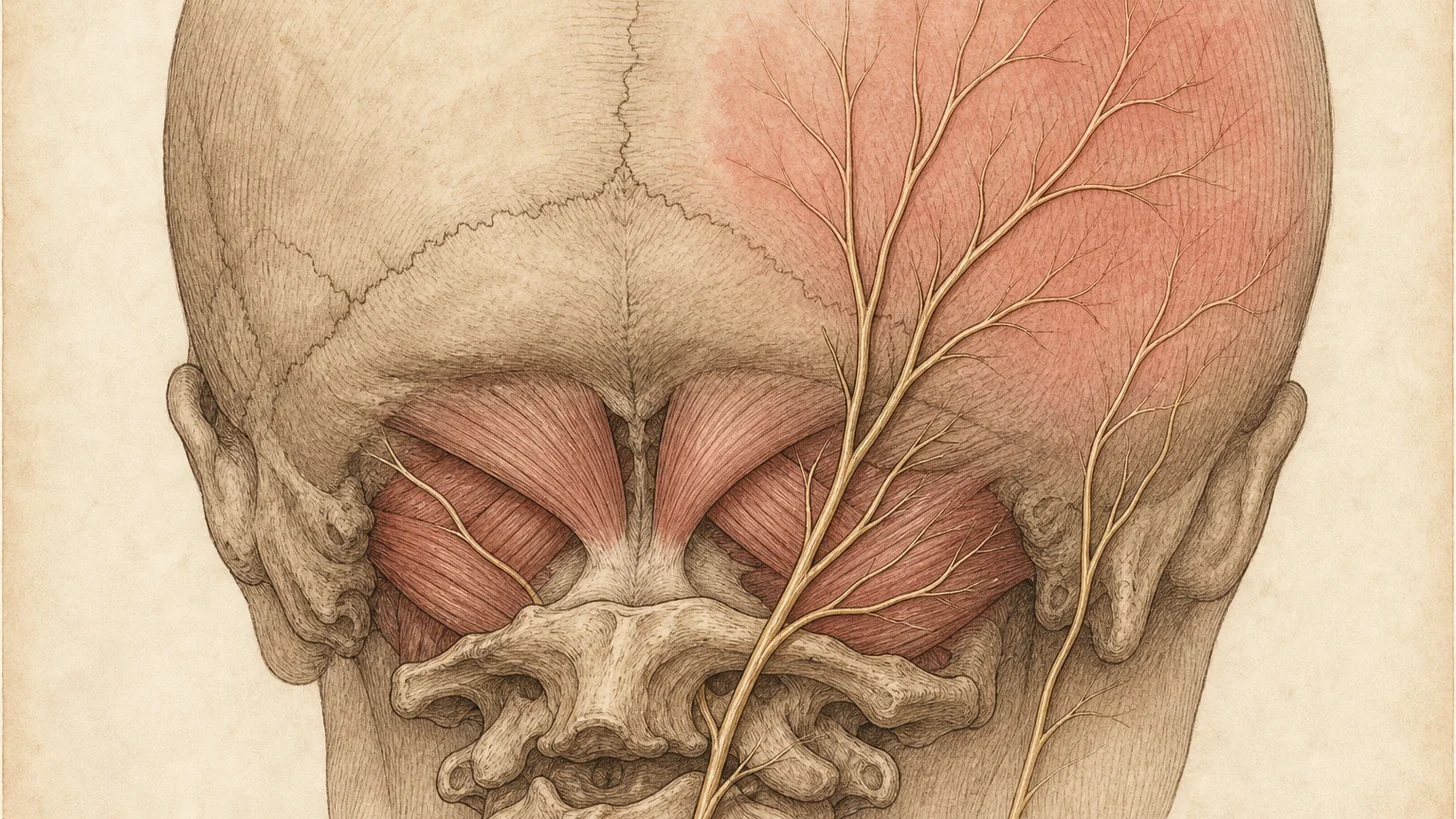
Three sensory nerves innervate the back of the head and upper neck. All three can be blocked to control different headache syndromes:
Greater occipital nerve (GON). A branch of the C2 spinal nerve, the GON passes through the tendinous attachments of the semispinalis capitis and trapezius muscles to reach the scalp beside the occipital artery, near the superior nuchal line (Loukas 2006, Mason 2024). It supplies sensation to most of the posterior scalp. In animal studies, signals from the GON and from the lining of the brain converge on the same neurons in the upper spinal cord (Bartsch and Goadsby 2002). That is one proposed reason a GON block can ease migraine and cluster headache.
Lesser occipital nerve (LON). A branch of the cervical plexus (C2–C3), the LON runs along the posterior border of the sternocleidomastoid and supplies sensation to the posterolateral scalp behind the ear. It is often blocked together with the GON in patients whose headache distribution extends laterally.
Third occipital nerve (TON). The medial branch of the C3 dorsal ramus, the TON innervates the C2–C3 facet joint and a small area of occipital scalp. Numbing the TON is the standard way to confirm headache coming from the C2–C3 joint, and the diagnosis needs complete relief from two separate, controlled blocks with different numbing medicines, the longer-acting one giving longer relief (Lord 1994). Confirmed cases are the ones considered for third occipital nerve radiofrequency ablation.
The conditions we treat with occipital nerve blocks
Occipital neuralgia. The classic indication. Patients describe brief, sharp, shooting or stabbing pain from the base of the skull up over the back of the head, By definition the scalp is also sensitive to light touch or hair brushing, and the nerve is tender to pressure or has trigger points. The pain can spread toward the forehead and eye. The international diagnostic criteria require that the pain ease temporarily with a numbing block of the affected nerve, so the block is part of how the diagnosis is made (ICHD-3 2018). How long relief lasts varies widely between patients.
Chronic migraine. For chronic migraine that preventive medication has not controlled, ONBs are an add-on with randomized-trial support. Tenderness over the GON predicted a good response in an uncontrolled clinic audit (Afridi 2006), so we check for it, though a review found the link unclear in migraine (Tobin and Flitman 2009). RCT data (including Cuadrado 2017 and Inan 2015) show fewer headache days than sham injections, from the first week (Cuadrado 2017) to three months after a course of weekly blocks (Gul 2017). ONBs are often used alongside — not instead of — migraine preventives like Botox, CGRP monoclonal antibodies, topiramate, and beta-blockers.
Cluster headache. During an active cluster period, a GON block can serve as a “bridge” while a preventive such as verapamil or galcanezumab takes effect. The placebo-controlled trials that support this, Ambrosini (2005) and Leroux (2011), injected a corticosteroid, and in Leroux the injections were added to verapamil or to the patient’s existing preventive. We discuss with you whether a block fits your cluster plan.
Cervicogenic headache. Headache referred from the upper cervical spine. One common source is the C2–C3 facet joint, which the third occipital nerve supplies. Among 100 patients with chronic neck pain after whiplash, 27% had headache from this joint, and history and examination alone could not pick them out (Lord 1994). The diagnosis needs complete relief from two separate, controlled blocks with different numbing medicines, the longer-acting one giving longer relief. When both work, third occipital nerve radiofrequency ablation is the next step. In an uncontrolled series of 49 patients from the group that developed the technique, 88% had complete relief for at least 3 months, and in those responders relief lasted a median of about 10 months, and a repeat procedure could restore it (Govind 2003). Results in other clinics have been less consistent: in a retrospective series of 40 patients, which also included ablation at the C2 ganglion, 35% had complete relief, lasting a mean of about 22 weeks (Hamer 2014). For headache from the upper neck more broadly, greater and lesser occipital nerve blocks with a mix of local anesthetics, fentanyl and clonidine beat saline injections at two weeks in a double-blind trial (Naja 2006).
Post-concussive headache. Headache after a concussion sometimes centers on the back of the head and upper neck. The evidence for blocks here comes from retrospective case series, with no placebo-controlled trial. In one retrospective series, 28 of 34 adults with post-traumatic headache that medication had not helped reported marked relief right after occipital and forehead nerve blocks given together (File 2025). We use ONBs alongside physical therapy for the neck, and vestibular therapy when dizziness is part of the picture, not instead of them.
Other indications. Occipital neuralgia-type pain after brain surgery, where one retrospective series of 41 patients found blocks with lidocaine and dexamethasone eased the pain (Wang 2021). If you have had surgery at the back of the skull, tell us, because a skull defect calls for extra caution with these blocks (Blumenfeld 2013). Medication overuse headache is another, decided case by case, where the expert consensus lists getting out of the overuse pattern as a goal of the blocks.
What an occipital nerve block is not
ONBs are not a treatment for sinus headache or for headache caused by a problem inside the skull. For chronic tension-type headache the evidence is thin, and a small open pilot study was negative: 1 of 15 patients improved (after 2 days of worse headache), 11 were unchanged and 3 got worse in the hours or days after GON blocks (Leinisch-Dahlke 2005). Before we perform a block, we confirm the diagnosis is one of the responsive syndromes above. If imaging is warranted (red flags, new-onset headache after age 50, progressive neurologic signs), we order it before proceeding.
The Modal Pain occipital nerve block procedure
Step 1 — Targeted history and exam. We localize the painful nerve by pressing over each nerve to find tenderness, and map the pain distribution to GON, LON, TON, or a combination. The physical exam drives which nerve or nerves we block.
Step 2 — Skin prep and positioning. You sit upright leaning forward, or prone for TON blocks. The posterior scalp is prepped with chlorhexidine.
Step 3 — Targeting. For GON: the nerve is identified next to the occipital artery near the superior nuchal line, approximately one-third of the distance from the external occipital protuberance to the mastoid (Mason 2024). We palpate the occipital artery to avoid intravascular injection. For LON: posterior to the mastoid, along the posterior border of the sternocleidomastoid. For TON: under ultrasound guidance beside the C2–C3 facet joint. Ultrasound can show this 2 mm nerve directly, and in the first validation study, in 14 healthy volunteers, it placed the needle accurately in 82% of attempts (Eichenberger 2006).
Step 4 — Injection. A 25-gauge needle advances to the correct depth. We aspirate — if blood returns, we reposition. Then a small volume of local anesthetic (lidocaine 1–2% or bupivacaine 0.25–0.5%) is delivered, typically about 1.5–2 mL for the lesser occipital nerve and up to 3 mL for the greater occipital nerve. A diagnostic third occipital nerve block uses less than 1 mL (Eichenberger 2006 used 0.9 mL) to keep the numbing as close to that one nerve as possible, although in a cadaver study even 0.5 mL reached the nearby greater occipital nerve (Wahezi 2016). We usually do not add a steroid: in migraine, a randomized trial found that adding triamcinolone did not improve any outcome (Ashkenazi 2008), and steroid in this thin layer of scalp tissue can rarely cause a patch of hair loss or skin dimpling (Shields 2004).
Step 5 — Immediate assessment. Within 5–15 minutes we reassess the pain. Substantial reduction suggests the targeted nerve contributes to the pain, and your headache record over the following weeks tells us more. You go home and keep that record, using the aftercare instructions.
How we decide what comes next
If a block gives clear relief and the diagnosis is chronic migraine or occipital neuralgia, we repeat it when the headache comes back. No trial has set the right interval, and the expert consensus leaves it to the headache type and the drug used (Blumenfeld 2013). In chronic migraine, a course of four weekly blocks kept headache days down for three months (Gul 2017).
If two controlled third occipital nerve blocks each give complete same-day relief that wears off on schedule with the medicine used, the C2–C3 joint is the likely source, and we plan third occipital nerve radiofrequency ablation. In an uncontrolled series of 49 patients from the group that developed the technique, 88% had complete relief for at least 3 months, and in those responders relief lasted a median of about 10 months, and a repeat procedure could restore it (Govind 2003). Results in other clinics have been less consistent (Hamer 2014).
If blocks clearly help occipital neuralgia but the relief keeps wearing off, the next step we offer is pulsed radiofrequency of the occipital nerve. Pulsed radiofrequency sends the current in short bursts, kept below the temperature that destroys nerve tissue, and is thought to change how the nerve signals. In a double-blind trial of 81 patients with occipital neuralgia or migraine with occipital nerve tenderness, pulsed radiofrequency cut average occipital pain more than a steroid injection at 6 weeks, and the difference held through 6 months. The advantage was in pain scores. Function and the other secondary measures differed little between the groups, and the trial was too small to show a difference within the 36 patients who had occipital neuralgia without migraine (Cohen 2015). A 2024 systematic review of 22 studies found benefit lasting 6 to 10 months in occipital neuralgia, mild, temporary side effects in about 3% of patients, and rated the overall evidence low quality (De Oliveira 2024).
If the block produces no meaningful relief, we do not repeat it blindly. We reexamine the diagnosis and work with your neurologist, if you have one, on preventive medication.
Combining occipital nerve blocks with other treatments
ONBs complement rather than replace a full headache care plan. They can be combined with Botox for chronic migraine, which we also give in the office (migraine injections), and with CGRP monoclonal antibodies and preventive medications, and we keep your neurologist, if you have one, informed. For cervicogenic headache, a randomized trial of 200 patients found that a specific low-load neck exercise program, including deep neck flexor training, cut headache frequency and intensity, with the effect still present at 12 months (Jull 2002). After a sport-related concussion with lingering dizziness, neck pain or headache, adding neck and vestibular physiotherapy got 73% of young patients medically cleared within 8 weeks, against 7% without it (Schneider 2014). For cluster patients, ONBs are a bridge, not a long-term plan, until verapamil or galcanezumab takes effect.
Insurance and access
Coverage for occipital nerve blocks varies by plan and by diagnosis, and some insurers classify them as investigational for certain headache types, so our office checks your plan’s policy before scheduling. Modal Pain Management accepts most major commercial PPO plans and does not accept Medicare, Medicaid, HMO plans, or workers’ compensation. We perform both occipital and third occipital nerve blocks on-site, with landmark technique or ultrasound guidance.
Verify insurance and schedule or call (646) 290-6660. Same-week consultation appointments are typically available for new patients.
Our practice difference
Dr. Movshis is a fellowship-trained pain physician who performs every occipital and third occipital nerve block personally. We do not delegate to PAs or NPs. We use ultrasound for third occipital nerve blocks so the needle, the nerve and nearby blood vessels can be seen during the injection. We follow up directly to reassess response at 2–4 weeks and decide together whether to repeat the block, move to pulsed radiofrequency or ablation, or change course. Our goal is durable headache control, not indefinite injections on a treadmill.
References
- Cuadrado ML, Aledo-Serrano Á, Navarro P, et al. Short-term effects of greater occipital nerve blocks in chronic migraine: A double-blind, randomised, placebo-controlled clinical trial. Cephalalgia. 2017;37(9):864–872. doi:10.1177/0333102416655159 · PubMed
- Inan LE, Inan N, Karadaş Ö, et al. Greater occipital nerve blockade for the treatment of chronic migraine: a randomized, multicenter, double-blind, and placebo-controlled study. Acta Neurol Scand. 2015;132(4):270–7. doi:10.1111/ane.12393 · PubMed
- Ashkenazi A, Matro R, Shaw JW, Abbas MA, Silberstein SD. Greater occipital nerve block using local anaesthetics alone or with triamcinolone for transformed migraine: a randomised comparative study. J Neurol Neurosurg Psychiatry. 2008;79(4):415–7. doi:10.1136/jnnp.2007.124420 · PubMed
- Blumenfeld A, Ashkenazi A, Napchan U, et al. Expert consensus recommendations for the performance of peripheral nerve blocks for headaches — a narrative review. Headache. 2013;53(3):437–46. doi:10.1111/head.12053 · PubMed
- Ambrosini A, Vandenheede M, Rossi P, et al. Suboccipital injection with a mixture of rapid- and long-acting steroids in cluster headache: a double-blind placebo-controlled study. Pain. 2005;118(1-2):92–6. doi:10.1016/j.pain.2005.07.015 · PubMed
- Leroux E, Valade D, Taifas I, et al. Suboccipital steroid injections for transitional treatment of patients with more than two cluster headache attacks per day: a randomised, double-blind, placebo-controlled trial. Lancet Neurol. 2011;10(10):891–7. doi:10.1016/S1474-4422(11)70186-7 · PubMed
- Gul HL, Ozon AO, Karadas O, et al. The efficacy of greater occipital nerve blockade in chronic migraine: a placebo-controlled study. Acta Neurol Scand. 2017;136(2):138–144. doi:10.1111/ane.12716 · PubMed
- Atraszkiewicz D, Ünal E, Bassett P, et al. Greater occipital nerve block for the treatment of migraine: an umbrella review, systematic review, and meta-analysis. Cephalalgia. 2025;45(12). doi:10.1177/03331024251398390 · PubMed
- Tobin J, Flitman S. Occipital nerve blocks: when and what to inject? Headache. 2009;49(10):1521–33. doi:10.1111/j.1526-4610.2009.01493.x · PubMed
- Naja ZM, El-Rajab M, Al-Tannir MA, Ziade FM, Tawfik OM. Occipital nerve blockade for cervicogenic headache: a double-blind randomized controlled clinical trial. Pain Pract. 2006;6(2):89–95. doi:10.1111/j.1533-2500.2006.00068.x · PubMed
- Dougherty C. Occipital neuralgia. Curr Pain Headache Rep. 2014;18(5):411. doi:10.1007/s11916-014-0411-x · PubMed
- Headache Classification Committee of the International Headache Society (IHS). The International Classification of Headache Disorders, 3rd edition. Cephalalgia. 2018;38(1):1–211. doi:10.1177/0333102417738202 · PubMed
- Afridi SK, Shields KG, Bhola R, Goadsby PJ. Greater occipital nerve injection in primary headache syndromes — prolonged effects from a single injection. Pain. 2006;122(1-2):126–9. doi:10.1016/j.pain.2006.01.016 · PubMed
- Shields KG, Levy MJ, Goadsby PJ. Alopecia and cutaneous atrophy after greater occipital nerve infiltration with corticosteroid. Neurology. 2004;63(11):2193–4. doi:10.1212/01.wnl.0000145832.26051.3c · PubMed
- Mason NL, Savage J, Turney JP, et al. Localization of the greater occipital nerve through palpation of bony landmarks: a cadaveric study. Clin Neurol Neurosurg. 2024;243:108355. doi:10.1016/j.clineuro.2024.108355 · PubMed
- Loukas M, El-Sedfy A, Tubbs RS, et al. Identification of greater occipital nerve landmarks for the treatment of occipital neuralgia. Folia Morphol (Warsz). 2006;65(4):337–42. PubMed
- Bartsch T, Goadsby PJ. Stimulation of the greater occipital nerve induces increased central excitability of dural afferent input. Brain. 2002;125(Pt 7):1496–509. doi:10.1093/brain/awf166 · PubMed
- Eichenberger U, Greher M, Kapral S, et al. Sonographic visualization and ultrasound-guided block of the third occipital nerve: prospective for a new method to diagnose C2-C3 zygapophysial joint pain. Anesthesiology. 2006;104(2):303–8. doi:10.1097/00000542-200602000-00016 · PubMed
- Wahezi SE, Silva K, Shaparin N, et al. Currently recommended TON injectate volumes concomitantly block the GON: clinical implications for managing cervicogenic headache. Pain Physician. 2016;19(7):E1079–86. PubMed
- Stern JI, Chiang CC, Kissoon NR, Robertson CE. Narrative review of peripheral nerve blocks for the management of headache. Headache. 2022;62(9):1077–1092. doi:10.1111/head.14385 · PubMed
- Leinisch-Dahlke E, Jürgens T, Bogdahn U, et al. Greater occipital nerve block is ineffective in chronic tension type headache. Cephalalgia. 2005;25(9):704–8. doi:10.1111/j.1468-2982.2004.00941.x · PubMed
- File C, Fang X, Ahmad R, et al. Efficacy of nerve blocks for managing refractory posttraumatic headaches. Pain Physician. 2025;28(2):137–145. PubMed
- Wang S, Han X, Zhao C, Luo F. Occipital nerve blockade for the treatment of occipital neuralgia-like acute postcraniotomy headache: a retrospective study. Pain Res Manag. 2021;2021:5572121. doi:10.1155/2021/5572121 · PubMed
- Jull G, Trott P, Potter H, et al. A randomized controlled trial of exercise and manipulative therapy for cervicogenic headache. Spine. 2002;27(17):1835–43. doi:10.1097/00007632-200209010-00004 · PubMed
- Schneider KJ, Meeuwisse WH, Nettel-Aguirre A, et al. Cervicovestibular rehabilitation in sport-related concussion: a randomised controlled trial. Br J Sports Med. 2014;48(17):1294–8. doi:10.1136/bjsports-2013-093267 · PubMed
- Lord SM, Barnsley L, Wallis BJ, Bogduk N. Third occipital nerve headache: a prevalence study. J Neurol Neurosurg Psychiatry. 1994;57(10):1187–90. doi:10.1136/jnnp.57.10.1187 · PubMed
- Govind J, King W, Bailey B, Bogduk N. Radiofrequency neurotomy for the treatment of third occipital headache. J Neurol Neurosurg Psychiatry. 2003;74(1):88–93. doi:10.1136/jnnp.74.1.88 · PubMed
- Cohen SP, Peterlin BL, Fulton L, et al. Randomized, double-blind, comparative-effectiveness study comparing pulsed radiofrequency to steroid injections for occipital neuralgia or migraine with occipital nerve tenderness. Pain. 2015;156(12):2585–2594. doi:10.1097/j.pain.0000000000000373 · PubMed
- De Oliveira K, Dhondt N, Englesakis M, Goel A, Hoydonckx Y. Pulsed radiofrequency neuromodulation of the greater occipital nerve for the treatment of headache disorders in adults: a systematic review. Can J Pain. 2024;8(1):2355571. doi:10.1080/24740527.2024.2355571 · PubMed
- Hamer JF, Purath TA. Response of cervicogenic headaches and occipital neuralgia to radiofrequency ablation of the C2 dorsal root ganglion and/or third occipital nerve. Headache. 2014;54(3):500–10. doi:10.1111/head.12295 · PubMed