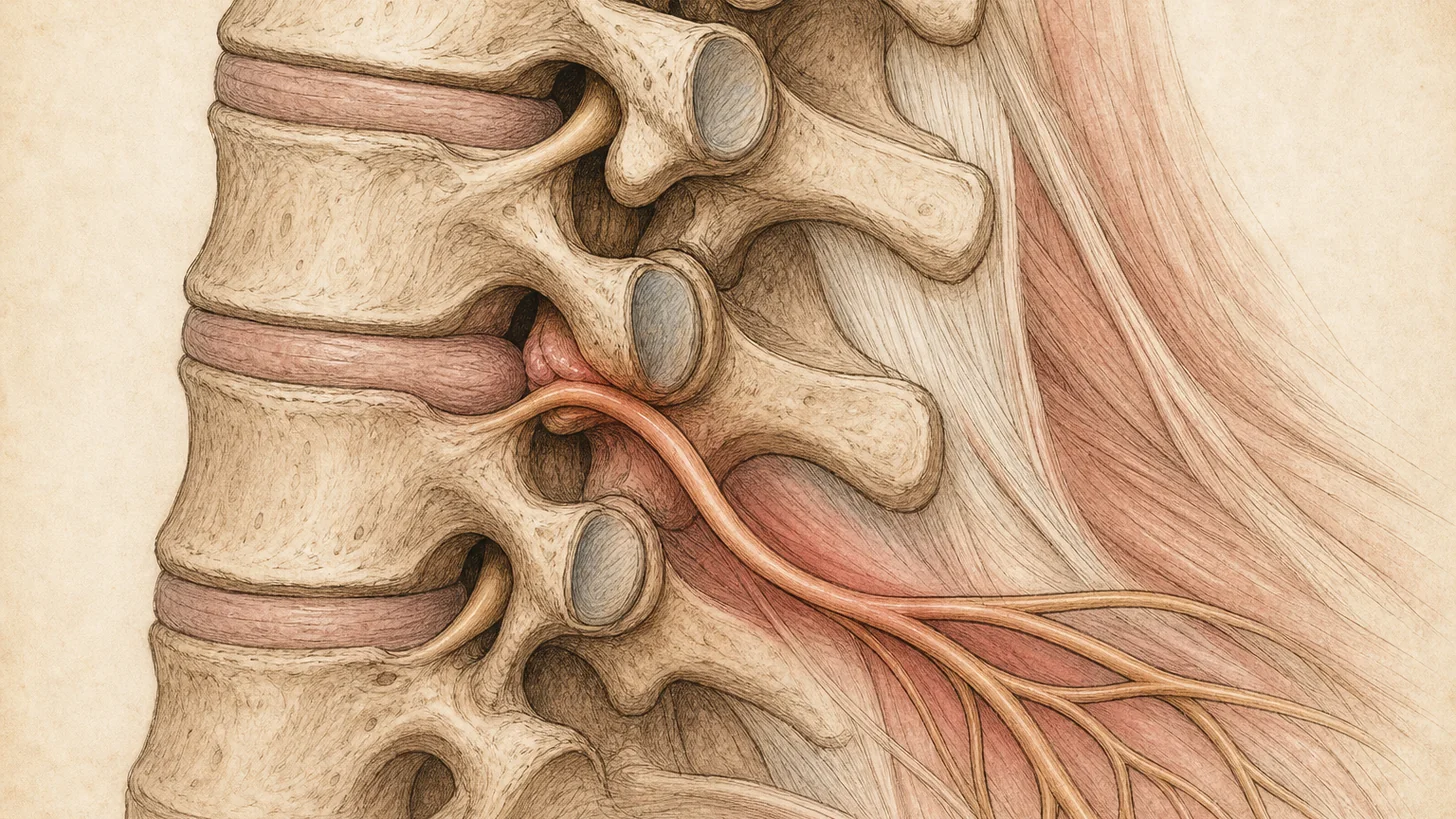
Prefer to watch? A 66-second narrated animation of the cervicogenic mechanism — how an upper neck joint refers pain into the head — with the full transcript and PubMed-verified references.
Cervicogenic headache is one of the most underdiagnosed headache types, routinely treated for years as migraine or tension headache. What makes it distinct is its origin: rather than starting in the brain or its blood vessels, the pain is generated in the cervical spine and referred to the head. The relationship between the neck and headache has been recognized for over a century, but because diagnostic criteria were debated for decades, reported prevalence and treatment recommendations have varied widely in the literature [1].
What cervicogenic headache feels like
The typical presentation is a steady, aching, pressure-like pain that begins at the base of the skull on one side and travels toward the forehead, temple, or around the eye. The pain is usually steady rather than throbbing, and it stays on the same side from attack to attack — a feature clinicians call “side-locked.” Neck stiffness and reduced range of motion almost always accompany it, and many patients can trace the headache to a specific neck posture: long hours at a screen, sleeping awkwardly, or the aftermath of a whiplash injury.
Occipital neuralgia is a close relative and a frequent point of confusion. Both produce pain at the back of the head, and the two overlap clinically; the distinction is that occipital neuralgia is a sharp, shooting pain along the occipital nerve itself, while cervicogenic headache is referred from a joint or disc in the upper neck [2].
What actually generates the pain
The mechanism is referred pain. Sensory nerves from the upper three cervical segments share processing pathways with the trigeminal nerve, so the brain misinterprets a signal from the neck as head pain. The specific generators, in rough order of frequency, are the C2-C3 facet joint (the single most common source, carried by the third occipital nerve), the C1-C2 joint, the greater occipital nerve, and the suboccipital muscles. Cervical facet arthritis, upper cervical disc degeneration, chronic muscular trigger points, and prior whiplash are the usual underlying drivers [1][2].
How cervicogenic headache is diagnosed
There is no blood test or scan that confirms cervicogenic headache. Diagnosis rests on three pillars: a history of side-locked, neck-provoked headache; a physical examination showing restricted cervical rotation and reduced neck-flexion strength [3][4]; and, when treatment escalation is being considered, a diagnostic block. The block is the closest thing to a gold standard — numbing the suspected C2-C3 facet (via its medial branch) or the greater occipital nerve and observing whether the familiar headache resolves both confirms the source and predicts which longer-term treatment will work [2].
Evidence-based treatment
Because the pain originates in the neck, effective treatment targets cervical structures rather than masking head pain. The evidence supports a stepped approach.
Cervical physical therapy is first-line. A Cochrane systematic review of exercises for mechanical neck disorders found moderate-quality evidence that cervico-scapulothoracic strengthening and endurance exercises improve pain, function, and global perceived effect in chronic cervicogenic headache, with benefit sustained at long-term follow-up [5]. This is not generic stretching — it is targeted strengthening of the deep cervical flexors and the scapulothoracic stabilizers. Our physical therapy program is built around that evidence.
Greater occipital nerve block. When the headache is severe or has not responded to conservative care, a greater occipital nerve block is often the next step. A 2021 systematic review found greater occipital nerve blocks to be effective and safe in cervicogenic headache, with the procedure being low-cost, well-tolerated, and repeatable [6]; placebo-controlled work on occipital nerve blockade in chronic headache supports a real treatment effect beyond placebo [7]. The block doubles as a diagnostic test, and selection does not strictly require tenderness over the nerve to predict response [8].
Medial branch block and radiofrequency ablation. When the C2-C3 facet joint is the confirmed generator, a medial branch block of the third occipital nerve confirms the target, and radiofrequency ablation of that nerve can then provide months of relief by interrupting the pain signal. Because the nerve slowly regenerates, the procedure can be repeated when symptoms return.
Trigger point injections address a muscular component when suboccipital or cervical trigger points are reproducing the referred pain pattern, and are typically used alongside rather than instead of the above.
When to see a specialist
A headache that begins in the neck, stays on one side, worsens with head movement, or has never fully responded to standard headache medication warrants a cervical evaluation. The earlier the cervical source is identified, the sooner a targeted treatment can replace years of trial-and-error medication.
References
This article is reviewed against the peer-reviewed literature. Citations retrieved from PubMed.
- Gallagher RM. Cervicogenic headache. Expert Review of Neurotherapeutics. 2007;7(10):1279-83. doi:10.1586/14737175.7.10.1279 · PubMed
- Barmherzig R, Kingston W. Occipital Neuralgia and Cervicogenic Headache: Diagnosis and Management. Current Neurology and Neuroscience Reports. 2019;19(5):20. doi:10.1007/s11910-019-0937-8 · PubMed
- Anarte-Lazo E, Carvalho GF, Schwarz A, Luedtke K, Falla D. Differentiating migraine, cervicogenic headache and asymptomatic individuals based on physical examination findings: a systematic review and meta-analysis. BMC Musculoskeletal Disorders. 2021;22(1):755. doi:10.1186/s12891-021-04595-w · PubMed
- Hall TM, Briffa K, Hopper D, Robinson KW. The relationship between cervicogenic headache and impairment determined by the flexion-rotation test. Journal of Manipulative and Physiological Therapeutics. 2010;33(9):666-71. doi:10.1016/j.jmpt.2010.09.002 · PubMed
- Gross A, Kay TM, Paquin JP, et al. Exercises for mechanical neck disorders. Cochrane Database of Systematic Reviews. 2015;1:CD004250. doi:10.1002/14651858.CD004250.pub5 · PubMed
- Caponnetto V, Ornello R, Frattale I, et al. Efficacy and safety of greater occipital nerve block for the treatment of cervicogenic headache: a systematic review. Expert Review of Neurotherapeutics. 2021;21(5):591-97. doi:10.1080/14737175.2021.1903320 · PubMed
- Gul HL, Ozon AO, Karadas O, Koc G, Inan LE. The efficacy of greater occipital nerve blockade in chronic migraine: a placebo-controlled study. Acta Neurologica Scandinavica. 2017;136(2):138-44. doi:10.1111/ane.12716 · PubMed
- Tobin J, Flitman S. Occipital nerve blocks: when and what to inject? Headache. 2009;49(10):1521-33. doi:10.1111/j.1526-4610.2009.01493.x · PubMed
Frequently Asked Questions
A cervicogenic headache is a secondary headache caused by a disorder in the upper cervical spine — the pain is generated in the neck and referred to the head. The most common source is the C2-C3 facet joint, whose pain signal travels through the third occipital nerve; the greater occipital nerve and suboccipital muscles are also implicated. It is typically one-sided and side-locked, meaning it stays on the same side rather than switching.
Three findings separate them. Cervicogenic headache is usually side-locked (always the same side), is reproduced or worsened by neck movement and sustained postures, and shows restricted rotation on the flexion-rotation test; a 2021 systematic review and meta-analysis found reduced flexion-rotation range and reduced neck flexion strength distinguish cervicogenic headache from migraine. Migraine more often side-shifts, throbs, and carries nausea, light and sound sensitivity, and aura. Migraine responds to triptans; cervicogenic headache usually does not.
Evidence supports a stepped approach: cervical-specific physical therapy first (strengthening and endurance exercises for the neck have moderate-quality evidence in cervicogenic headache), then targeted injections — a greater occipital nerve block or a C2-C3 medial branch block — and radiofrequency ablation of the third occipital nerve for confirmed facet-joint cases. The block is both diagnostic and therapeutic: if it stops your familiar headache, the neck is confirmed as the source.
Mobilization, soft-tissue work, and exercise are reasonable and relatively low-risk. High-velocity cervical manipulation carries rare but serious risks and is not appropriate for every patient. For headaches that are severe, chronic, or have not responded to conservative care, an interventional pain physician can confirm the pain source with a diagnostic block before committing to longer-term treatment.
Individual episodes range from hours to days. Untreated, the condition is often chronic, with pain-free intervals punctuated by flare-ups. When the C2-C3 facet joint is confirmed as the generator, radiofrequency ablation of the third occipital nerve can give months of relief, and can be repeated when the nerve regenerates.