Spinal stenosis treatment in NYC is one of the most common reasons patients walk through the doors of a pain management practice — and one of the most misunderstood. If you have been told that your spinal canal is narrowing and that surgery is your only real option, you should know that the majority of spinal stenosis patients can achieve meaningful, lasting relief through non-surgical interventional treatments. At Modal Pain Management NYC in Midtown Manhattan, Dr. Alex Movshis, MD — dual board-certified in anesthesiology and pain medicine — helps patients avoid or delay spinal surgery through targeted, evidence-based procedures.
What Is Spinal Stenosis and Why Does It Cause Pain?
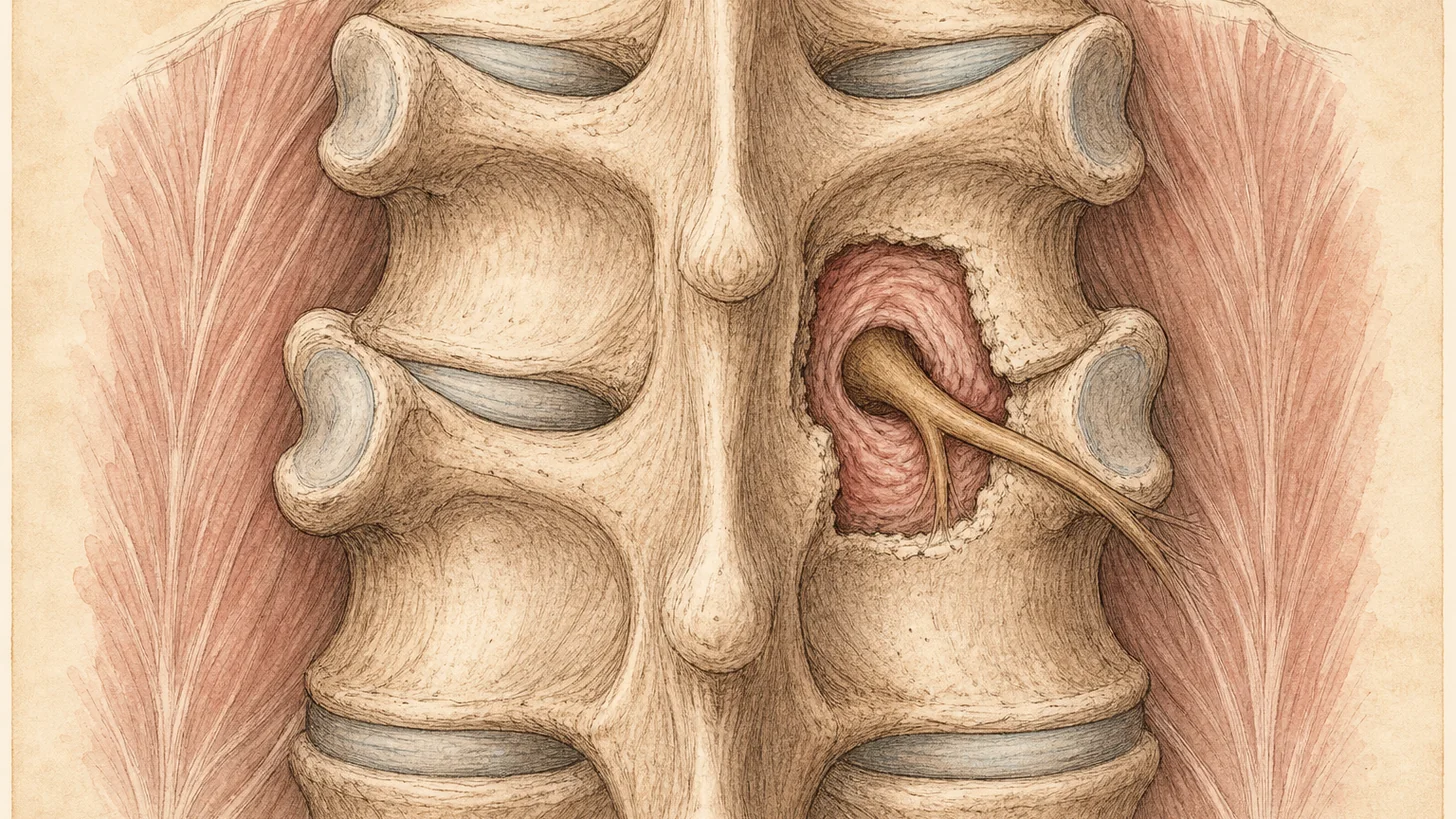
Spinal stenosis refers to a narrowing of the spaces within your spine, which puts pressure on the nerves that travel through it. The most common form is lumbar spinal stenosis, affecting the lower back, though cervical stenosis in the neck is also prevalent. The narrowing is usually caused by age-related degenerative changes: thickened ligaments, bone spurs (osteophytes), bulging discs, and facet joint enlargement gradually encroach on the spinal canal and the openings where nerve roots exit.
The hallmark symptom is neurogenic claudication — pain, heaviness, numbness, or tingling in the legs that worsens with standing and walking and improves when sitting or leaning forward. Many patients describe being able to walk only short distances before needing to sit down, or finding relief when pushing a shopping cart because the forward-leaning posture opens up the spinal canal. Cervical stenosis produces similar symptoms in the arms and hands, sometimes accompanied by balance difficulties.
What many patients do not realize is that the degree of narrowing seen on an MRI does not always correlate with the severity of symptoms. Some people with significant stenosis on imaging have minimal pain, while others with moderate narrowing are severely limited. This is precisely why a skilled pain management specialist can make such a difference — the goal is to treat the pain and functional limitation, not just the image.
Non-Surgical Spinal Stenosis Treatments Available in Manhattan
Dr. Movshis offers a range of interventional procedures specifically designed to relieve the nerve compression and inflammation caused by spinal stenosis without the risks, recovery time, and unpredictable outcomes of spinal surgery.
Epidural Steroid Injections
Epidural steroid injections (ESIs) are the most well-established interventional treatment for spinal stenosis. Using fluoroscopic (live X-ray) guidance, Dr. Movshis delivers a combination of corticosteroid and local anesthetic directly into the epidural space surrounding the compressed nerves. This reduces inflammation at the source, providing relief that typically lasts weeks to months. For lumbar stenosis, either interlaminar or transforaminal approaches may be used depending on the specific anatomy and location of the narrowing.
Nerve Blocks
When pain is driven primarily by irritation of specific nerve roots as they exit through narrowed openings (foraminal stenosis), selective nerve root blocks can be remarkably effective. These injections target individual nerves with precision, both confirming the pain source and delivering therapeutic medication. Medial branch blocks are another option when facet joint enlargement is contributing to the stenosis.
Radiofrequency Ablation
For patients whose stenosis is complicated by significant facet joint arthropathy — a common combination — radiofrequency ablation (RFA) uses controlled heat to disrupt the tiny nerves that transmit pain signals from the facet joints. The procedure provides relief that typically lasts 9 to 18 months and can be repeated. RFA is particularly valuable for spinal stenosis patients because facet joint pain and stenosis often coexist and amplify each other.
Minimally Invasive Lumbar Decompression (MILD)
The MILD procedure is a relatively recent innovation specifically designed for lumbar spinal stenosis caused by thickened ligamentum flavum. Through a tiny incision, specialized instruments remove small amounts of excess ligament and bone to restore space in the spinal canal — all without general anesthesia, implants, or stitches. It is performed as an outpatient procedure and offers a middle ground between injections and traditional open surgery.
How Dr. Movshis Develops Your Spinal Stenosis Treatment Plan
Not all spinal stenosis is the same, and a cookie-cutter approach does not work. During your initial evaluation at our office at 369 Lexington Ave, Floor 25, Dr. Movshis reviews your imaging (MRI and/or CT), performs a detailed physical examination, and — critically — listens to how your symptoms affect your daily life. The treatment plan is then built around your specific pattern of narrowing, the nerves involved, and your functional goals.
For many patients, the optimal approach involves a combination of treatments applied in sequence. A common pathway might begin with epidural steroid injections to calm acute inflammation, followed by a targeted exercise program to maintain the gains, with radiofrequency ablation added if facet joint pain is a significant contributor. This layered strategy allows each treatment to build on the last.
Spinal Stenosis and Walking: Reclaiming Your Mobility
The inability to walk comfortably is often the most distressing aspect of lumbar spinal stenosis for NYC residents. Whether you are commuting through Grand Central, walking through Midtown, or simply trying to keep up with your normal routine, neurogenic claudication can be profoundly limiting.
Patients treated at Modal Pain Management NYC frequently report dramatic improvements in their walking tolerance after interventional treatment. It is not unusual for someone who could only walk two blocks before needing to stop to regain the ability to walk 10 or more blocks comfortably — a change that fundamentally alters quality of life in a walking city like New York.
When Is Spinal Surgery Necessary?
Surgery for spinal stenosis — typically a laminectomy or laminotomy — is appropriate in certain situations: progressive neurological deficits (such as worsening leg weakness or loss of bowel and bladder control), failure of all conservative and interventional treatments over an adequate trial period, or severe stenosis with myelopathy in the cervical spine. However, studies consistently show that the majority of spinal stenosis patients do well with non-surgical management, particularly when they have access to advanced interventional techniques.
Dr. Movshis’s approach is to exhaust every appropriate non-surgical option before recommending surgery, and to be transparent with patients about when surgery is truly the better path.
Schedule Your Spinal Stenosis Evaluation in Midtown Manhattan
If you have been diagnosed with spinal stenosis — or if you are experiencing leg pain, numbness, or difficulty walking that worsens with standing — a consultation with a back pain specialist can clarify your options. Modal Pain Management NYC is conveniently located in Midtown Manhattan, easily accessible from Murray Hill, Grand Central, Turtle Bay, Kips Bay, and Gramercy. Call (646) 290-6660 or visit modalpain.com/contact to book your evaluation with Dr. Movshis.
Can spinal stenosis be treated without surgery in NYC? Yes. The majority of spinal stenosis patients achieve meaningful relief through non-surgical treatments including epidural steroid injections, nerve blocks, radiofrequency ablation, and the MILD procedure. At Modal Pain Management NYC, Dr. Movshis designs individualized treatment plans that exhaust all appropriate non-surgical options before considering surgery.
What is the best non-surgical treatment for lumbar spinal stenosis? Epidural steroid injections are the most well-established interventional treatment, delivering anti-inflammatory medication directly to the compressed nerves. Radiofrequency ablation and the MILD procedure are also highly effective depending on the specific cause of narrowing. The best approach depends on your anatomy, symptoms, and imaging findings.
How do I know if my spinal stenosis needs surgery? Surgery is typically recommended when there are progressive neurological deficits such as worsening leg weakness or loss of bladder control, or when all conservative and interventional treatments have been tried over an adequate period without sufficient relief. Your pain specialist can help you understand when surgery becomes the better option.
References
This article is reviewed against the peer-reviewed literature. Citations retrieved from PubMed.
- Katz JN, Harris MB. Clinical practice. Lumbar spinal stenosis. The New England Journal of Medicine. 2008. doi:10.1056/NEJMcp0708097 · PubMed
- Lurie J, Tomkins-Lane C. Management of lumbar spinal stenosis. BMJ. 2016. doi:10.1136/bmj.h6234 · PubMed
- Ammendolia C, Stuber KJ, Rok E, et al. Nonoperative treatment for lumbar spinal stenosis with neurogenic claudication. The Cochrane Database of Systematic Reviews. 2013. doi:10.1002/14651858.CD010712 · PubMed
- Friedly JL, Comstock BA, Turner JA, et al. A randomized trial of epidural glucocorticoid injections for spinal stenosis. The New England Journal of Medicine. 2014. doi:10.1056/NEJMoa1313265 · PubMed
- Delitto A, Piva SR, Moore CG, Welch WC. Surgery Versus Nonsurgical Treatment of Lumbar Spinal Stenosis. Annals of Internal Medicine. 2015. doi:10.7326/L15-5129-4 · PubMed
- Benyamin RM, Staats PS, MiDAS Encore I. MILD® Is an Effective Treatment for Lumbar Spinal Stenosis with Neurogenic Claudication: MiDAS ENCORE Randomized Controlled Trial. Pain Physician. 2016. · PubMed