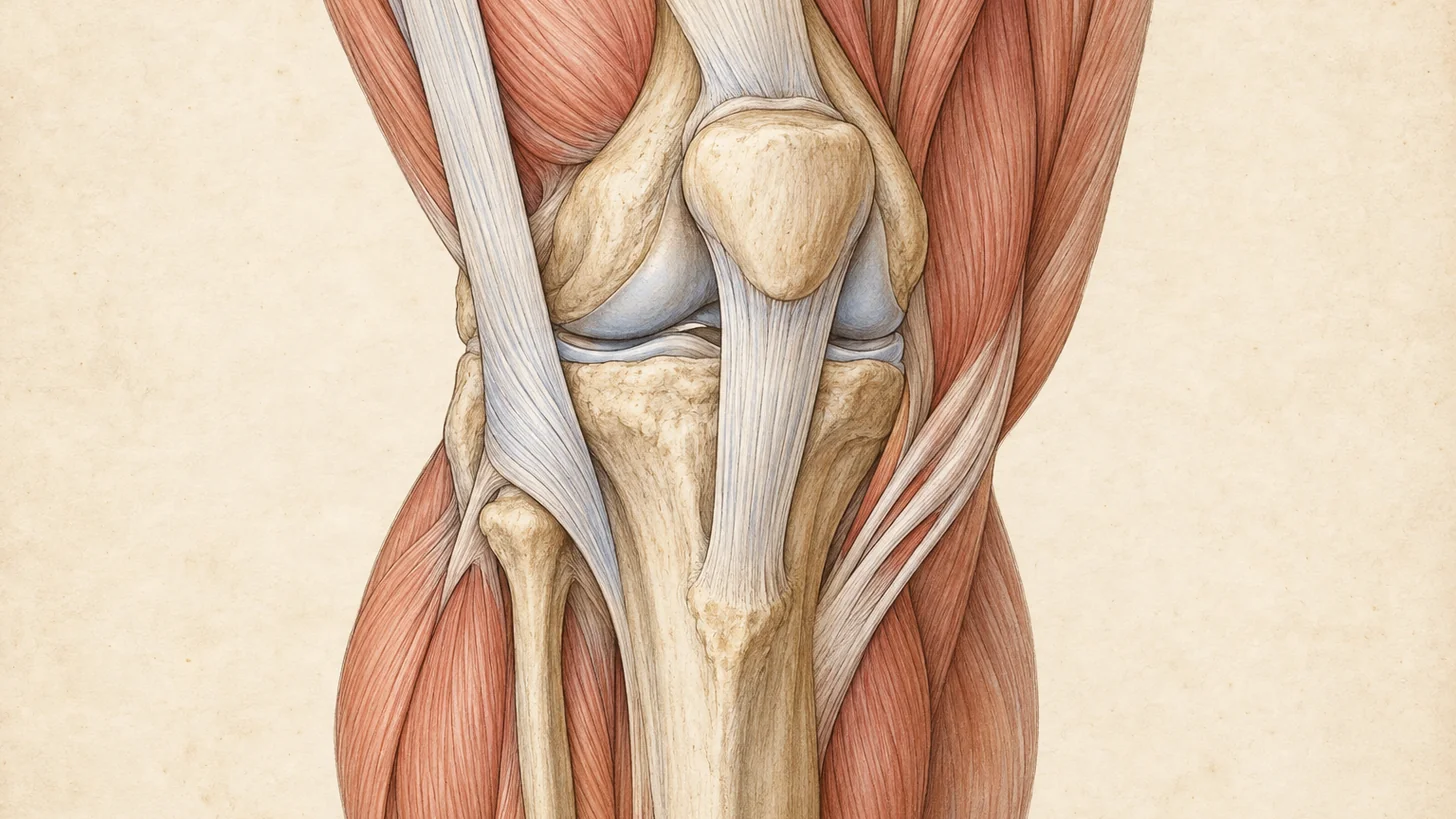
Knee bursitis is a swollen, irritated bursa, one of the small fluid sacs that cushion the front, inner side and back of the knee. At Modal Pain Management in Midtown Manhattan, Dr. Alex Movshis first works out which bursa is involved and whether it could be infected, then treats the cause. When a bursa needs to be drained or injected, he does it under ultrasound, so the needle goes into the bursa and stays clear of the patellar tendon and the vessels behind the knee.
This page covers what knee bursitis is, the five distinct types (each with its own pain pattern, causes, and treatment), how it is diagnosed at Modal Pain Management, and the evidence-based treatment ladder we use to get patients back to walking, running, kneeling, and climbing stairs without pain.
What Is a Bursa, and What Is Knee Bursitis?
A bursa is a small, flat fluid-filled sac that sits between bone and overlying soft tissue (skin, tendon, or muscle) at points of friction. The knee has roughly a dozen named bursae. Each one is normally a thin film of synovial fluid that lubricates motion and protects the underlying tissue from pressure. When a bursa becomes irritated — through repetitive pressure, direct trauma, overuse, infection, or systemic inflammation — it fills with fluid, swells, and becomes painful. That inflamed-and-distended state is bursitis.
The five clinically important knee bursae are:
- Prepatellar bursa — sits just under the skin over the front of the kneecap and is inflamed by direct kneeling pressure.
- Infrapatellar bursae (superficial and deep) — sit just below the kneecap and are inflamed by jumping, running, and patellar tendon overuse.
- Pes anserine bursa — sits on the inner shin about 2 inches below the joint line where three tendons (sartorius, gracilis, semitendinosus) insert. Pain here often comes with medial knee osteoarthritis.
- Suprapatellar bursa — connects with the joint itself in most adults, so swelling here usually reflects a knee joint problem (osteoarthritis, meniscus tear, synovitis).
- Semimembranosus bursa — sits behind the knee. When distended it forms a Baker’s cyst.
The treatment depends entirely on which bursa is involved, what is driving the inflammation, and whether infection is present. Generic “knee bursitis” advice — ice, rest, ibuprofen — is reasonable as a first step but misses the diagnostic specificity that determines outcomes.
The Five Types of Knee Bursitis
1. Prepatellar Bursitis (“Housemaid’s Knee,” “Carpet Layer’s Knee”)
Prepatellar bursitis is the most common knee bursitis and the easiest to diagnose: a soft, squishy, often golf-ball-sized swelling sits directly over the front of the kneecap. The skin may be tender to touch and painful when you kneel, but the knee joint itself usually bends and straightens normally. Historically named for occupations involving prolonged kneeling — housemaids, clergymen, carpet layers, plumbers, gardeners, roofers — it remains an occupational diagnosis today.
Prepatellar bursitis after a fall often settles over a few weeks with ice, an anti-inflammatory and a kneeling pad. Draining the fluid helps a large or recurring swelling. A review of the treatment literature reserved a steroid injection into the bursa for confirmed non-infected bursitis in people with high work or sport demands (Baumbach 2014), and kneeling pads are what keep an occupational case from coming back. Infection is common at this site: about one in three cases of prepatellar or olecranon bursitis is septic (Baumbach 2014). Septic prepatellar bursitis, with warmth, redness, fever and often a small scrape or bite over the kneecap, is drained and cultured, and no steroid is given.
2. Infrapatellar Bursitis (“Clergyman’s Knee”)
There are two infrapatellar bursae: a superficial one between the patellar tendon and skin, and a deep one between the patellar tendon and the tibia. Inflammation causes burning or aching pain just below the kneecap, worsened by jumping, running downhill, prolonged kneeling in an upright posture, or kicking. It is most common in basketball players, volleyball players, runners, and dancers. Infrapatellar bursitis often coexists with patellar tendinopathy (“jumper’s knee”), and the two sit on top of each other, so ultrasound is the simplest way to tell them apart.
3. Pes Anserine Bursitis (Inner Knee Pain)
Pes anserine bursitis causes a deep, aching pain on the inner side of the knee, about 2 inches below the joint line. It is common in middle-aged and older adults, especially women, and frequently coexists with medial compartment osteoarthritis. Patients typically report pain when climbing stairs, rising from a chair, or sleeping with their knees touching at night. Diabetes is a known risk factor, and being overweight and knee osteoarthritis may be too. Despite the name, it is still unclear whether the bursa or the tendons above it are the source of the pain (Alvarez-Nemegyei 2004). Of the usual treatments, a local steroid injection is the one tested in clinical trials (Alvarez-Nemegyei 2004). Dr. Movshis pairs it with hip and quadriceps strengthening, because an injection does not change the mechanics that keep loading the area.
4. Suprapatellar Bursitis
The suprapatellar bursa communicates with the knee joint itself in most adults, so inflammation here usually reflects an intra-articular problem: knee osteoarthritis, a meniscus tear, inflammatory arthritis (rheumatoid, psoriatic, gout), or post-traumatic synovitis. The clinical presentation is a fluid-filled fullness above the kneecap. Treatment is aimed at the joint problem, as laid out on the knee osteoarthritis page, rather than at the bursa alone.
5. Semimembranosus Bursitis (Baker’s Cyst)
A Baker’s cyst is a distended semimembranosus bursa in the popliteal fossa (behind the knee). In middle-aged and older adults, most Baker’s cysts connect with the knee joint and reflect a meniscus tear or osteoarthritis inside it (Frush 2015). Symptoms include a tightness, fullness, or visible bulge behind the knee that worsens with prolonged standing or full knee flexion. A ruptured Baker’s cyst can look like a blood clot in the calf (pain, swelling, warmth), and telling them apart takes an ultrasound the same day. Treatment focuses on the joint problem. Draining a large, painful cyst, sometimes with a steroid, is an option in selected cases.
How Knee Bursitis Is Diagnosed at Modal Pain Management
Dr. Movshis starts with a focused history (occupation, kneeling, sports, trauma, prior knee surgery, and conditions like gout or rheumatoid arthritis) and a knee exam that locates the tenderness over a specific bursa. When the exam leaves doubt, or a bursa needs a needle, ultrasound shows:
- The bursa fluid collection — confirming the diagnosis and which specific bursa is inflamed.
- The bursa wall — thickened in long-standing bursitis. Ultrasound cannot reliably tell infected fluid from non-infected fluid, which is why suspicious fluid goes to the lab.
- Adjacent structures — patellar tendon (rule out tendinopathy or tear), medial meniscus (rule out coexisting tear in pes anserine cases), popliteal vessels (rule out aneurysm or DVT in suspected Baker’s cyst), and the knee joint itself (rule out an effusion that needs separate management).
If the bursa is large or the clinical picture suggests possible infection, fluid is aspirated and sent to the lab for cell count, Gram stain, culture, and crystal analysis. X-rays are added when osteoarthritis is suspected. MRI is reserved for atypical, complex, or surgical cases.
Image-Guided Treatment of Knee Bursitis
For a large, non-infected bursa that has not settled with offloading, the main procedure is ultrasound-guided aspiration, with a steroid injection in selected cases. It is a short office procedure:
- Skin preparation and local anesthesia — the skin over the bursa is sterilized and numbed with lidocaine.
- Ultrasound-guided needle placement — a needle is advanced under real-time ultrasound directly into the bursa, avoiding the patellar tendon, popliteal vessels, and joint capsule.
- Aspiration — fluid is withdrawn and inspected, and sent for laboratory analysis if infection or crystal disease is possible.
- Corticosteroid injection — only when the fluid and the clinical picture do not suggest infection, a small volume of corticosteroid mixed with local anesthetic is placed into the drained bursa.
- Compression and discharge — a compression sleeve is applied and you walk out the same day.
Guidance matters more than people expect, even for a bursa that sits close to the skin. In a cadaver study of pes anserine bursa injections, 11 of 12 ultrasound-guided injections reached the bursa, against 2 of 12 without guidance (Finnoff 2010). No trial has tested whether better placement improves results in patients. Dr. Movshis uses ultrasound for bursa procedures because it shows where the medication goes.
Physical Therapy and Self-Care
Injection alone is insufficient when biomechanical factors are driving the inflammation. Patients with pes anserine bursitis, infrapatellar bursitis, or recurrent prepatellar bursitis benefit from a structured course of physical therapy targeting:
- Quadriceps strength — particularly vastus medialis activation to protect the patellofemoral joint.
- Hip abductor and external rotator strength — to control valgus knee collapse during gait and stair climbing.
- Hamstring and calf flexibility — reducing posterior knee tension that worsens infrapatellar and Baker’s cyst symptoms.
- Gait retraining — for runners, addressing overstriding, cadence, and shoe wear.
- Kneeling-load reduction — for occupational cases, replacing direct kneeling with kneeling pads, foam mats, or alternate work positions.
Home care during a flare is ice for 15 to 20 minutes a few times a day, an over-the-counter anti-inflammatory such as ibuprofen or naproxen at the label dose for a week or two if it is safe for you, a compression sleeve during activity, and no kneeling, deep squats or high-impact loading until the swelling has settled.
When Knee Bursitis Is an Emergency: Septic Bursitis
Septic bursitis — bacterial infection of the bursa — is a medical emergency. Untreated, the infection can spread to the joint itself, the bone, or the bloodstream. Warning signs are warmth, redness, marked tenderness, fever, chills, and often a small cut, scrape, abrasion, insect bite, or recent injection over the bursa. Diabetic patients, immunosuppressed patients, and patients on long-term corticosteroids are at higher risk.
If septic bursitis is suspected, fluid must be aspirated immediately and sent for Gram stain and culture. Empirical antibiotics covering Staphylococcus aureus (the most common organism) are started while culture results are pending. Corticosteroid is never injected into a potentially infected bursa. Most cases respond to antibiotics by mouth. Severe cases, or ones that do not respond, may need IV antibiotics or surgical drainage.
If you think your knee bursitis may be infected, particularly with fever, swelling and redness together, do not wait for a routine appointment. Call 911 or go to the nearest emergency room.
Why Modal Pain Management for Knee Bursitis in NYC
Modal Pain Management is a physician-led interventional pain practice located at 369 Lexington Avenue, Floor 25 in Midtown Manhattan (NYC 10017), led by Dr. Alex Movshis, who is dual board-certified in Anesthesiology and Pain Medicine and completed his pain fellowship at the Icahn School of Medicine at Mount Sinai. Every patient is evaluated and treated by Dr. Movshis personally. Ultrasound is in the office suite, so a bursa that needs draining or an injection is done under guidance. Same-week new-patient appointments are typically available.
For more on how we source clinical claims, see the clinical evidence and citations page. Modal Pain Management accepts most commercial PPO plans, including Aetna, Anthem Blue Cross Blue Shield, Cigna, Empire Blue Cross Blue Shield, the Empire Plan, Oscar, Oxford, UMR and UnitedHealthcare, and does not accept Medicare, Medicaid, HMO plans, or workers’ compensation. You can verify your insurance before the visit at no charge.
References
- Aaron DL, Patel A, Kayiaros S, Calfee R. Four common types of bursitis: diagnosis and management. J Am Acad Orthop Surg. 2011;19(6):359–67. doi:10.5435/00124635-201106000-00006 · PubMed
- Baumbach SF, Lobo CM, Badyine I, Mutschler W, Kanz KG. Prepatellar and olecranon bursitis: literature review and development of a treatment algorithm. Arch Orthop Trauma Surg. 2014;134(3):359–70. doi:10.1007/s00402-013-1882-7 · PubMed
- Alvarez-Nemegyei J, Canoso JJ. Evidence-Based Soft Tissue Rheumatology IV: Anserine Bursitis. J Clin Rheumatol. 2004;10(4):205–6. doi:10.1097/01.rhu.0000135561.41660.b0 · PubMed
- Frush TJ, Noyes FR. Baker’s Cyst: Diagnostic and Surgical Considerations. Sports Health. 2015;7(4):359–65. doi:10.1177/1941738113520130 · PubMed
- Finnoff JT, Nutz DJ, Henning PT, Hollman JH, Smith J. Accuracy of ultrasound-guided versus unguided pes anserinus bursa injections. PM R. 2010;2(8):732–9. doi:10.1016/j.pmrj.2010.03.014 · PubMed