A 71-year-old retired teacher has had two cortisone injections in her right knee in the past year. Each one gave her about six good weeks. She has atrial fibrillation, takes a blood thinner, and her cardiologist would rather she not have a knee replacement right now. She still walks her dog twice a day and wants to keep doing it. For someone like her, genicular nerve radiofrequency ablation is worth a serious look.
Genicular nerve radiofrequency ablation (RFA) quiets the small nerves that carry pain from the lining and capsule of an arthritic knee. It does not change the cartilage or the bone, and it does not stop the arthritis. What it can do is turn the pain down for months at a time, without surgery. At Modal Pain Management, at 369 Lexington Avenue, Floor 25, Dr. Alex Movshis, MD, dual board-certified in anesthesiology and pain medicine, performs it under ultrasound or fluoroscopic guidance in the office.
The nerves it treats
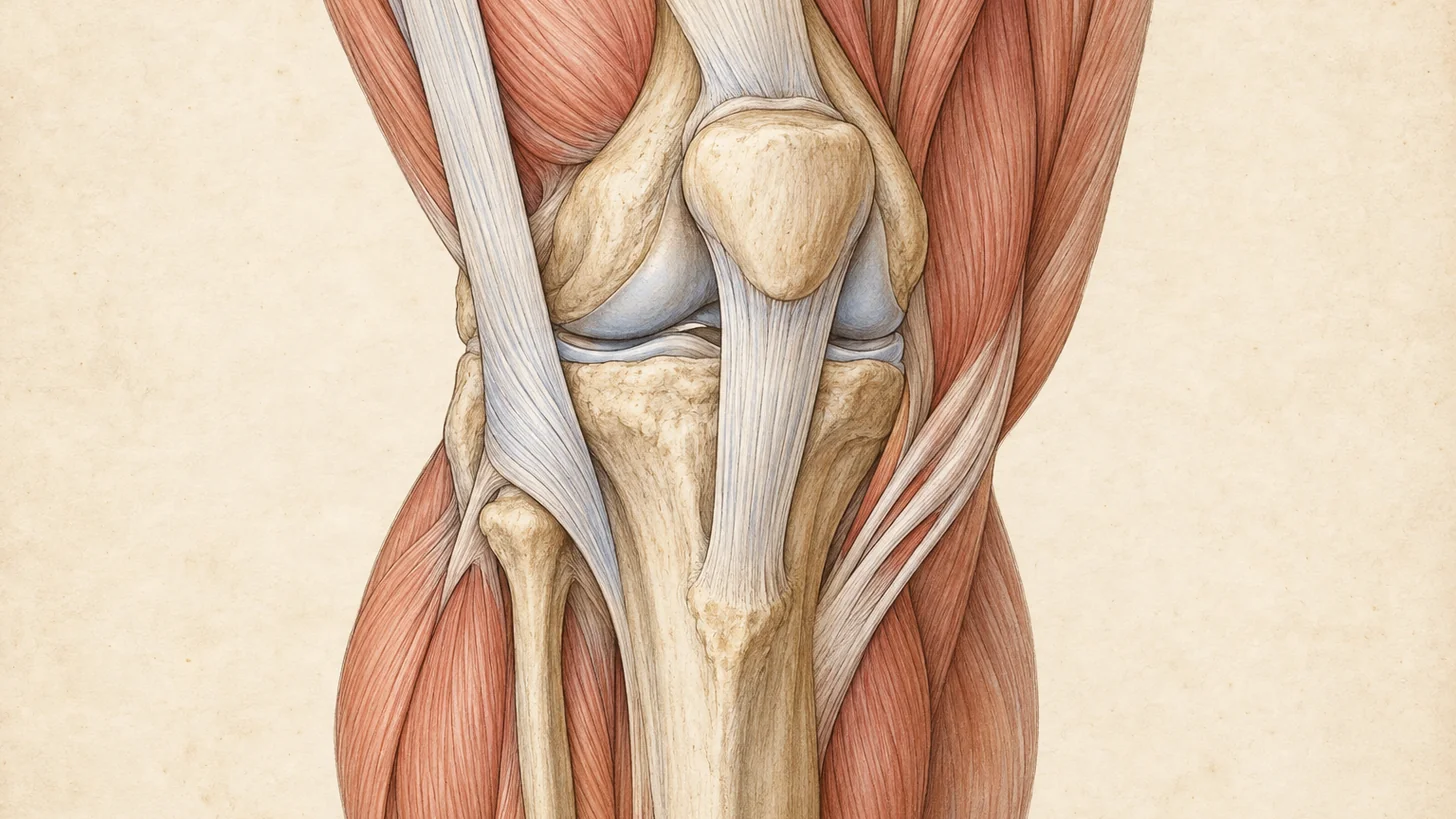
Pain from the front and sides of the knee joint travels along several small sensory branches. Most trials have treated three of them: the superior medial genicular nerve above the inner knee, the superior lateral genicular nerve above the outer knee, and the inferior medial genicular nerve below the inner knee. Each runs along the bone at a spot that can be found reliably on ultrasound or X-ray.
Cadaver dissections paint a less tidy picture. The knee capsule also receives branches from the nerves to the thigh muscles, and some branches vary from person to person (Tran 2018). The inferior lateral genicular nerve, below the outer knee, is usually left alone because it runs close to the common peroneal nerve, which controls the muscles that lift the foot (Franco 2015). Those extra branches are one reason RFA does not work for everyone.
What the trials show
The evidence for genicular RFA is real, but it is more mixed than many clinic websites suggest.
Against a sham procedure. In the first sham-controlled trial, 38 people with knee arthritis had either RF or a sham procedure. At 12 weeks, 10 of the 17 treated patients had at least half their pain gone, and pain and function scores were better than with sham (Choi 2011). A 2025 meta-analysis of 25 trials of genicular nerve procedures found that RFA reduced pain more than sham at 4 and 12 weeks, by a little under two points on a ten-point scale, but not at 24 or 48 weeks, and found no clear improvement in function. It rated the certainty low to very low and advised against routine use until better trials are done (Almeida 2025). A 2026 meta-analysis limited to eight sham-controlled trials was more favorable, finding better pain at 12 weeks and better function (Barreto 2026).
Against a single injection. Two trials sponsored by the device maker compared cooled RFA with one injection. At six months, 74% of the RFA group had at least half their pain gone, against 16% after one cortisone injection (Davis 2018). In the second trial, 71% had at least half their pain gone after RFA, against 38% after one gel injection (Chen 2020). Both enrolled only people who had responded to a diagnostic block, and in neither trial were patients blinded to which treatment they got. A single injection judged at six months is also a weak comparison, because an injection is not expected to last that long.
Across all studies. A 2026 systematic review of 28 studies and 2,218 patients with knee arthritis or pain after knee surgery, 17 of them observational, found that 51% had at least half their pain gone at six months and 43% at twelve months. Techniques that make larger lesions did better at a year, 55% against 34% (Kanjanapanang 2026).
Cooled versus conventional. Cooled RFA circulates water through the needle tip to make a larger lesion. The only randomized head-to-head comparison was a 49-patient pilot trial that included both arthritic knees and painful knee replacements. About 22% of each group had at least half their pain gone at 12 months, and cooled RF did better only in the people with a knee replacement (Belba 2025).
Guidelines. The American College of Rheumatology recommends RFA conditionally for knee arthritis (Kolasinski 2020). The American Society of Pain and Neuroscience gives it its strongest grade for knee arthritis pain and for pain after a knee replacement (Hunter 2022). The disagreement between those positions and the 2025 meta-analysis is genuine, and Dr. Movshis will walk you through it.
Who it fits, and who it doesn’t
Genicular RFA makes the most sense when:
- Knee arthritis pain keeps coming back after exercise, weight management and injections, and the knee still works mechanically.
- You want to put off a knee replacement, for personal, work or health reasons.
- Surgery carries higher risk because of heart or lung disease or other health problems.
It is not the right tool when:
- The arthritis is mild and simpler treatments have not been tried.
- The knee locks, gives way, or the pain is mainly mechanical. Those are orthopedic problems.
- The pain is coming from the hip or the back. The knee arthritis page covers how those are sorted out.
- The knee is hot and swollen. That needs to be drained and tested first.
The diagnostic block
Most insurers require a diagnostic genicular nerve block before they authorize RFA. A small amount of local anesthetic is placed at the same nerves, and you rate your usual knee pain over the next several hours while doing the things that normally hurt. Your plan’s policy sets how much relief counts as a positive block, and our office checks it before the block is scheduled. The diary you use is on the diagnostic block aftercare page.
The block is less predictive than people assume. In the only randomized trial of the question, patients who had a block before cooled RFA did no better than patients who went straight to RFA, 58.6% against 64.0% with at least half their pain gone at six months (McCormick 2018). So a positive block is an entry requirement more than a guarantee, and a negative block is a reason to look again at where the pain is coming from.
The procedure
The procedure is done in the office, awake, without general anesthesia. The skin over each target is numbed, and each radiofrequency needle is guided to the bone next to the nerve with ultrasound or fluoroscopy. Before any lesion is made, a mild electrical current confirms the needle is near a sensory nerve, which you feel as tingling in the knee, and confirms that no muscle twitches. Then each nerve is heated for about one and a half to two and a half minutes, depending on the technique. If you would prefer sedation, the procedure is done at a surgical center.
The knee is usually sore for several days. Some people have patchy numbness or a tingling, sunburn-like skin sensation around the knee for a few weeks. Relief often builds over the first few weeks rather than appearing the next morning. Dr. Movshis sees you four to six weeks later to check the result. The radiofrequency ablation aftercare page has the day-by-day instructions, including when to call and when to go to an emergency room.
Risks
Serious complications are uncommon. In a matched insurance-claims study, infection in the month after genicular RFA was about 0.1% and joint infection under 0.1%. Thermal and nerve injuries were 0% to under 0.1%, and blood clots were recorded at rates similar to a knee injection. Swelling was more common after RFA, 9.4% against 6.4% (Fuqua 2025). Case reports describe joint infection, a deep skin burn, bleeding into the joint, and injury to the pes anserine tendon on the inner knee (McCormick 2021). No study has tracked joint structure for years after RFA. The American College of Rheumatology cites the lack of long-term safety data, along with the variety of techniques studied, as reasons its recommendation is conditional (Kolasinski 2020).
Tell us if you take a blood thinner. Whether and how to adjust it is decided with you and the doctor who prescribes it, and you should not stop it on your own.
After a knee replacement
About one in five people still have significant pain after a knee replacement (Beswick 2012). Once infection, loosening and instability have been ruled out, genicular RFA is one of the options. The evidence is thin. The only randomized trial comparing RF with another treatment for this problem, in 28 patients, found RF no better than a nerve block with steroid, with both groups improving for three to six months (Qudsi-Sinclair 2017). A systematic review of 11 studies found responses ranging from 30% to 100% of patients and rated the certainty low (Meiling 2022).
When the relief wears off
The pain usually comes back as the nerves recover. In one cohort, relief after a first cooled RFA lasted a little over nine months on average (Nitz 2025). The procedure can be repeated. In the same retrospective series of 50 knees, a repeat RFA still helped, though the first repeat gave somewhat less improvement than the original, 66% against 75% (Nitz 2025). If RFA did not help the first time, Dr. Movshis does not simply repeat it. He looks again at where the pain is coming from.
What it costs
Most commercial PPO plans cover the diagnostic block and the RFA, including Aetna, Anthem Blue Cross Blue Shield, Cigna, Empire Blue Cross Blue Shield, the Empire Plan, Oscar, Oxford, UMR and UnitedHealthcare. Both usually need prior authorization, which our office submits after the consultation. Approval typically takes 7 to 14 business days. Modal Pain Management does not accept Medicare, Medicaid, HMO plans, or workers’ compensation. You can verify your insurance before the visit.
The self-pay price for genicular nerve RFA is a flat $1,000, covering the physician fee, the image guidance and the medication, with no separate facility fee. The new-patient consultation is $250. HSA and FSA cards are accepted, and payment plans are available through Cherry. Every price is on the self-pay pricing page.
References
- Choi WJ, Hwang SJ, Song JG, et al. Radiofrequency treatment relieves chronic knee osteoarthritis pain: a double-blind randomized controlled trial. Pain. 2011;152(3):481–487. doi:10.1016/j.pain.2010.09.029 · PubMed
- Almeida M, Saragiotto BT, Hunter DJ, et al. Efficacy and safety of minimally invasive interventions targeting the genicular nerves for knee osteoarthritis: A meta-analysis. Osteoarthritis Cartilage. 2025;33(5):535–547. doi:10.1016/j.joca.2025.02.780 · PubMed
- Barreto RB, Barreto AJ, do Nascimento ALM, Carvalho DMB, Queiroz B. Efficacy and safety of genicular nerve ablation techniques for knee osteoarthritis: a systematic review and meta-analysis of sham-controlled randomized trials. Pain Med. 2026;27(4):449–461. doi:10.1093/pm/pnaf140 · PubMed
- Davis T, Loudermilk E, DePalma M, et al. Prospective, Multicenter, Randomized, Crossover Clinical Trial Comparing the Safety and Effectiveness of Cooled Radiofrequency Ablation With Corticosteroid Injection in the Management of Knee Pain From Osteoarthritis. Reg Anesth Pain Med. 2018;43(1):84–91. doi:10.1097/AAP.0000000000000690 · PubMed
- Chen AF, Khalouf F, Zora K, et al. Cooled Radiofrequency Ablation Compared with a Single Injection of Hyaluronic Acid for Chronic Knee Pain: A Multicenter, Randomized Clinical Trial Demonstrating Greater Efficacy and Equivalent Safety for Cooled Radiofrequency Ablation. J Bone Joint Surg Am. 2020;102(17):1501–1510. doi:10.2106/JBJS.19.00935 · PubMed
- Kanjanapanang N, Madrid R, Lin P, et al. Effectiveness of genicular nerve radiofrequency ablation in osteoarthritis and post-surgical knee pain: systematic review. Pain Med. 2026;27(2):189–208. doi:10.1093/pm/pnaf115 · PubMed
- Belba A, Vanneste T, Kallewaard JW, et al. Cooled versus conventional radiofrequency treatment of the genicular nerves for chronic knee pain: 12-month and cost-effectiveness results from the multicenter COCOGEN trial. Reg Anesth Pain Med. 2025;50(1):36–45. doi:10.1136/rapm-2023-105127 · PubMed
- McCormick ZL, Reddy R, Korn M, et al. A Prospective Randomized Trial of Prognostic Genicular Nerve Blocks to Determine the Predictive Value for the Outcome of Cooled Radiofrequency Ablation for Chronic Knee Pain Due to Osteoarthritis. Pain Med. 2018;19(8):1628–1638. doi:10.1093/pm/pnx286 · PubMed
- Tran J, Peng PWH, Lam K, et al. Anatomical Study of the Innervation of Anterior Knee Joint Capsule: Implication for Image-Guided Intervention. Reg Anesth Pain Med. 2018;43(4):407–414. doi:10.1097/AAP.0000000000000778 · PubMed
- Franco CD, Buvanendran A, Petersohn JD, et al. Innervation of the Anterior Capsule of the Human Knee: Implications for Radiofrequency Ablation. Reg Anesth Pain Med. 2015;40(4):363–368. doi:10.1097/AAP.0000000000000269 · PubMed
- Kolasinski SL, Neogi T, Hochberg MC, et al. 2019 American College of Rheumatology/Arthritis Foundation Guideline for the Management of Osteoarthritis of the Hand, Hip, and Knee. Arthritis Rheumatol. 2020;72(2):220–233. doi:10.1002/art.41142 · PubMed
- Hunter CW, Deer TR, Jones MR, et al. Consensus Guidelines on Interventional Therapies for Knee Pain (STEP Guidelines) from the American Society of Pain and Neuroscience. J Pain Res. 2022;15:2683–2745. doi:10.2147/JPR.S370469 · PubMed
- Fuqua A, Premkumar A, Jayaram P, Wagner C. Complications and opioid-prescribing patterns following genicular nerve radiofrequency ablation versus intra-articular injection: a matched cohort study. Reg Anesth Pain Med. 2025;50(1):46–54. doi:10.1136/rapm-2023-105053 · PubMed
- McCormick ZL, Patel J, Conger A, Smith CC. The Safety of Genicular Nerve Radiofrequency Ablation. Pain Med. 2021;22(2):518–519. doi:10.1093/pm/pnaa355 · PubMed
- Beswick AD, Wylde V, Gooberman-Hill R, Blom A, Dieppe P. What proportion of patients report long-term pain after total hip or knee replacement for osteoarthritis? A systematic review of prospective studies in unselected patients. BMJ Open. 2012;2(1):e000435. doi:10.1136/bmjopen-2011-000435 · PubMed
- Qudsi-Sinclair S, Borrás-Rubio E, Abellan-Guillén JF, et al. A Comparison of Genicular Nerve Treatment Using Either Radiofrequency or Analgesic Block with Corticosteroid for Pain after a Total Knee Arthroplasty: A Double-Blind, Randomized Clinical Study. Pain Pract. 2017;17(5):578–588. doi:10.1111/papr.12481 · PubMed
- Meiling JB, Barndt BS, Ha CT, et al. The therapeutic effect of genicular nerve radiofrequency for chronic knee pain after a total knee arthroplasty: A systematic review. Interv Pain Med. 2022;1(1):100072. doi:10.1016/j.inpm.2022.100072 · PubMed
- Nitz JN, Shiferaw BT, Bartley MJ, et al. Repeat Genicular Nerve Cooled Radiofrequency Ablation: Retained Efficacy or Diminishing Returns? J Clin Med. 2025;14(12):4194. doi:10.3390/jcm14124194 · PubMed