Most breast cancer patients are told that the chest-wall and underarm pain after mastectomy will fade with time. For roughly 25–60 percent of patients, depending on the surgical extent and the published series cited (Andersen & Kehlet, 2011; Gärtner et al., 2009), it does not. That residual pain — burning, electric, sometimes triggered by light touch, often confined to a specific band from armpit to inner elbow — is called post-mastectomy pain syndrome (PMPS), and it is one of the best-characterized and most under-treated iatrogenic neuropathies in oncology medicine.
The pain is not in the patient’s head. It is not “scar tissue tightness.” It is, in the great majority of cases, a specific peripheral nerve injury — most often to the intercostobrachial nerve at the axilla — that can be identified, confirmed with a diagnostic block, and treated. The job at our consultation is to map the pain pattern to the responsible nerve, confirm with an ultrasound-guided block, and walk through a procedural ladder that escalates only as needed.
Modal Pain Management is at 369 Lexington Avenue Floor 25 in Midtown Manhattan, two blocks south of Grand Central. Dr. Alex Movshis is dual board-certified in Anesthesiology and Pain Medicine, fellowship-trained at the Icahn School of Medicine at Mount Sinai, and sees every patient personally at every visit. Same-week new-patient consultations are routine.
What PMPS actually is
Post-mastectomy pain syndrome is defined as neuropathic chest-wall, axillary, or upper-arm pain persisting more than three months after mastectomy or breast-conserving surgery with axillary intervention. Multiple peripheral nerves can be involved, but the pattern usually maps to one or a small combination of specific nerves.
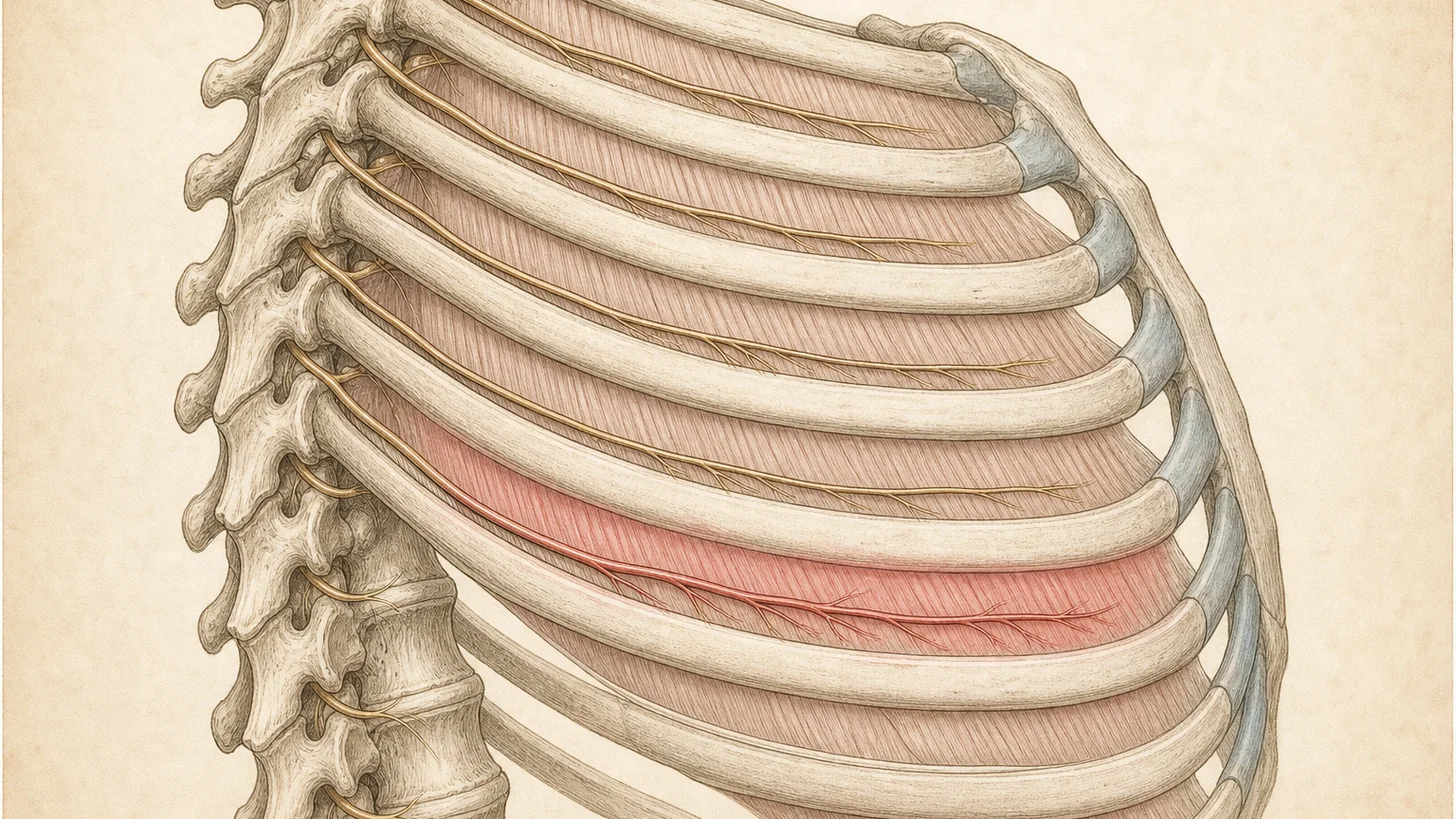
Intercostobrachial neuralgia. The intercostobrachial nerve is the lateral cutaneous branch of T1–T2 and supplies sensation to the axilla, the upper-medial arm, and the upper-medial chest wall. Axillary lymph node dissection (ALND) and to a lesser extent sentinel lymph node biopsy (SLNB) routinely transect or stretch this nerve. The resulting neuropathy produces a band of burning, electric, or hypersensitive skin from armpit to inner elbow. Wearing a bra, deodorant application, and overhead reaching all aggravate it. This is the most common single mechanism behind PMPS and the most under-recognized.
Intercostal neuralgia (T3–T6). Surgical disruption of the intercostal nerves at their distal cutaneous branches — by the mastectomy incision itself, by tissue expanders, or by implant pocket dissection — produces a band of neuropathic pain across the chest wall in one or several dermatomal distributions.
Neuroma at the mastectomy scar. Small painful neuromas form along the incision in a subset of patients. Each neuroma typically produces a discrete Tinel-positive point — gentle tapping at a specific spot reproduces a sharp, radiating pain.
Long thoracic nerve and thoracodorsal nerve injury. Less commonly, traction or transection of the long thoracic nerve (causing winged scapula and serratus anterior weakness) or the thoracodorsal nerve (causing latissimus dorsi weakness) produces a motor-deficit picture plus referred pain.
Persistent post-radiation chest-wall pain. Adjuvant radiation therapy can cause a distinct form of neuropathic pain that overlaps clinically with PMPS but has a different mechanism (radiation-induced fibrosis and nerve injury). Treatment paths overlap but differ on the medication side and on the response to steroid blocks.
What you should expect us to ask and find at the visit
The 45-minute new-patient consultation focuses on three things — the pattern, the operative report, and a careful sensory map.
The pattern. When did the pain start? What is its quality (burning, electric, aching, sharp)? What is its distribution — and can you trace it with one finger? What sets it off? What relieves it? What is its impact on sleep, on bra and clothing tolerance, on reaching overhead, on intimacy? Has it gotten better, worse, or stayed the same over the past 6 months?
The operative report. We ask for the operative report from the index surgery. Knowing whether the procedure was lumpectomy, simple mastectomy, modified radical mastectomy, or skin-sparing/nipple-sparing mastectomy; whether it involved sentinel lymph node biopsy or axillary node dissection; whether reconstruction (tissue expander, direct implant, autologous flap) was performed; and whether intra-operative regional anesthesia (paravertebral block, serratus plane block, PECS block) was used — every one of those data points changes the differential. Operative reports are usually available through the surgical practice’s patient portal in under ten minutes.
The focused physical examination. A sensory map of the affected territory using brush, cold metal, and pinprick — we draw the affected area on a paper template that becomes part of the chart. Tinel testing along the lateral chest wall, the axilla, and any palpable nodules at the incision. Strength testing of serratus anterior (long thoracic nerve), latissimus dorsi (thoracodorsal nerve), and pectoralis (medial and lateral pectoral nerves). Range-of-motion testing of the shoulder — adhesive capsulitis is a common silent comorbidity after axillary intervention.
The deliverable at the end of the visit is a working diagnosis (typically: dominant intercostobrachial neuralgia, or dominant intercostal neuralgia at specific dermatomes, or dominant neuroma at a defined point) and a recommended diagnostic block.
The procedural ladder for PMPS
Step 1 — neuropathic-pain medication. Most patients reach Modal because medication has failed, but for a fraction of newly referred PMPS cases, a structured medication trial is the right first move. Gabapentin titrated to 1800–3600 mg/day in divided doses, or pregabalin 150–600 mg/day. Tricyclic antidepressant (nortriptyline) or SNRI (duloxetine) for patients with mood comorbidity or gabapentinoid intolerance. Topical 5% lidocaine patch (Lidoderm) over the affected band is highly effective for the focal cutaneous component and is often underused.
Step 2 — ultrasound-guided intercostobrachial nerve block. The single most informative procedure. Performed in our procedure suite under ultrasound guidance, the block delivers 4–5 mL of local anesthetic plus low-dose corticosteroid into the axillary fascia at the intercostobrachial nerve target. The diagnostic answer arrives in 15 minutes — if the band of burning pain abolishes, the diagnosis is intercostobrachial neuralgia. The block is also therapeutic: most patients get 4–12 weeks of relief with steroid added.
Step 3 — ultrasound-guided intercostal nerve blocks. For patients with a more medial chest-wall pain distribution or with pain across multiple dermatomes, sequential intercostal blocks at T3, T4, T5, and T6 separate the affected levels and document the diagnostic-therapeutic response.
Step 4 — pulsed radiofrequency ablation of the intercostobrachial or intercostal nerve. For patients who respond clearly to diagnostic-therapeutic blocks but get diminishing duration with each repeat, pulsed RFA at the same target delivers 6–12 months of relief in the majority of selected patients. Pulsed (rather than conventional thermal) is essential here — the nerves are predominantly sensory and innervate cosmetically sensitive territory, so the lesion must be neuromodulatory rather than destructive.
Step 5 — ultrasound-guided neuroma injection. For palpable or sonographically-identified neuromas at the scar, direct injection of corticosteroid plus local anesthetic typically produces durable relief; cryoablation or chemical neurolysis (dilute phenol, alcohol) are options for refractory neuromas before considering surgical excision.
Step 6 — stellate ganglion block for sympathetically-maintained components. A subset of PMPS patients have a sympathetically-maintained pain component — typically marked by allodynia, color or temperature change, or sweating in the affected territory. Diagnostic stellate ganglion block under ultrasound guidance is both diagnostic and therapeutic for this subset.
Step 7 — peripheral nerve stimulation (PNS) and surgical neurectomy referral. For the small fraction of patients who fail the above ladder, peripheral nerve stimulation of the intercostobrachial or intercostal nerve is an option with growing published evidence. Surgical neurectomy or selective neurolysis by a peripheral-nerve surgeon is the salvage option for severe, well-localized, single-nerve cases.
What insurance covers, and how we handle it
Most commercial PPO insurance plans cover image-guided peripheral nerve blocks and radiofrequency ablation for chronic post-surgical neuropathic pain, typically with prior authorization. The diagnostic block is usually approved as part of a structured workup; therapeutic blocks and RFA require documented response to the diagnostic procedure.
Modal Pain Management verifies your benefits before the first procedure and handles prior authorization on your behalf. We accept most major commercial PPO plans and do not participate with Medicare or Medicaid. Check your plan or call (646) 290-6660.
Coordination with your oncology team
PMPS care does not replace oncology care — it complements it. We send notes to your medical oncologist, radiation oncologist, and breast surgeon after each visit and welcome direct referrals from oncology teams across NYC. For patients still on active surveillance, on anti-hormonal therapy (tamoxifen, aromatase inhibitors), or undergoing reconstructive surgery, treatment timing is coordinated with the oncology team.
When to come in
The right cadence is same-week consultation for any of the following: chest-wall, axillary, or upper-arm pain persisting more than three months after breast surgery; pain that limits sleep, work, or daily function; pain that is worsening rather than improving over time; failure of a structured trial of gabapentinoid plus topical lidocaine; or recurrent pain after a prior block elsewhere that briefly worked.
To schedule, book online or call (646) 290-6660.
For the broader post-surgical nerve pain framework — including post-thoracotomy, post-hernia, and post-arthroplasty patterns — see the post-surgical and scar-tissue nerve pain overview.
References
- Gärtner R, Jensen MB, Nielsen J, Ewertz M, Kroman N, Kehlet H. Prevalence of and factors associated with persistent pain following breast cancer surgery. JAMA. 2009;302(18):1985–92. doi:10.1001/jama.2009.1568 · PubMed
- Andersen KG, Kehlet H. Persistent pain after breast cancer treatment: a critical review of risk factors and strategies for prevention. J Pain. 2011;12(7):725–46. doi:10.1016/j.jpain.2010.12.005 · PubMed
- Waltho D, Rockwell G. Post-breast surgery pain syndrome: establishing a consensus for the definition of post-mastectomy pain syndrome to provide a standardized clinical and research approach - a review of the literature and discussion. Can J Surg. 2016;59(5):342–50. doi:10.1503/cjs.000716 · PubMed
- Wijayasinghe N, Andersen KG, Kehlet H. Neural blockade for persistent pain after breast cancer surgery. Reg Anesth Pain Med. 2014;39(4):272–8. doi:10.1097/AAP.0000000000000101 · PubMed
- Kehlet H, Jensen TS, Woolf CJ. Persistent postsurgical pain: risk factors and prevention. Lancet. 2006;367(9522):1618–25. doi:10.1016/S0140-6736(06)68700-X · PubMed
- Schug SA, Lavand’homme P, Barke A, et al. The IASP classification of chronic pain for ICD-11: chronic postsurgical or posttraumatic pain. Pain. 2019;160(1):45–52. doi:10.1097/j.pain.0000000000001413 · PubMed
- Deer T, Pope J, Benyamin R, et al. Prospective, Multicenter, Randomized, Double-Blinded, Partial Crossover Study to Assess the Safety and Efficacy of the Novel Neuromodulation System in the Treatment of Patients With Chronic Pain of Peripheral Nerve Origin. Neuromodulation. 2016;19(1):91–100. doi:10.1111/ner.12381 · PubMed