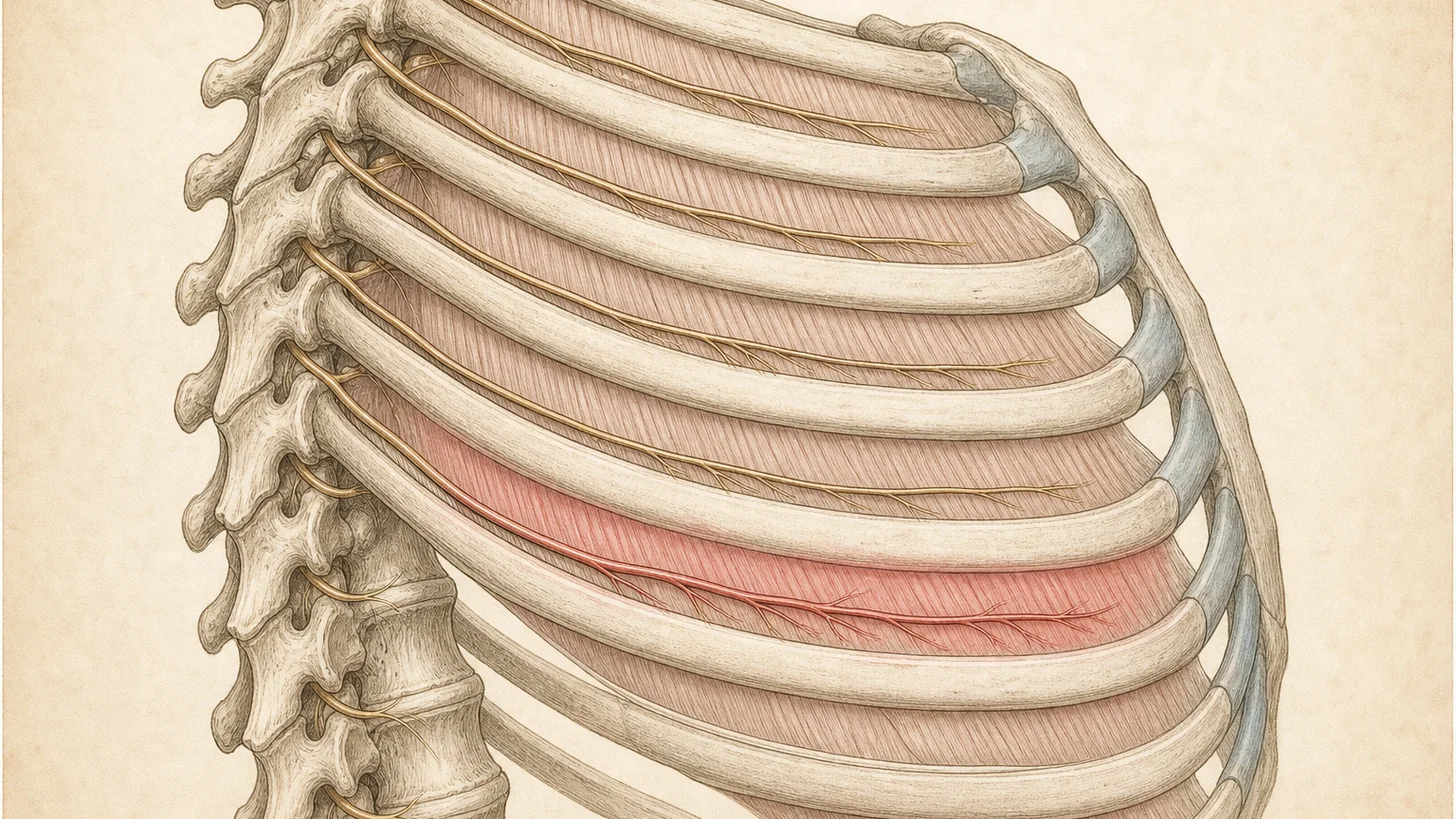
Roughly half of patients who have a thoracotomy develop chronic chest-wall pain that persists more than three months after surgery — a 2014 meta-analysis put the rate at 57 percent at three months and 47 percent at six months (Bayman & Brennan, 2014) — among the highest rates of chronic post-surgical pain of any common operation. Video-assisted thoracoscopic surgery (VATS) was supposed to fix the problem; the literature now shows VATS reduces but does not eliminate the rate of chronic pain, with published series reporting 20–35 percent of VATS patients developing post-thoracotomy pain syndrome (PTPS).
The mechanism is straightforward. The intercostal nerves run in a tight neurovascular bundle along the inferior margin of each rib. Rib retraction during open thoracotomy stretches them; intercostal blocks placed for postoperative analgesia can occasionally injure them; trocar placement and instrumentation during VATS can crush them at the entry site. Whatever the mechanism, the resulting clinical picture — burning, electric, or stabbing pain in a chest-wall band, often with allodynia to clothing and to deep breathing — is well-characterized, image-diagnosable, and responsive to a stepwise procedural ladder.
Modal Pain Management is at 369 Lexington Avenue Floor 25 in Midtown Manhattan. Dr. Alex Movshis is dual board-certified in Anesthesiology and Pain Medicine, fellowship-trained at the Icahn School of Medicine at Mount Sinai, and has trained extensively in image-guided intercostal nerve blocks during his anesthesiology residency at Mount Sinai. Same-week new-patient consultations are routine.
What PTPS actually is
Post-thoracotomy pain syndrome is defined as recurrent or persistent pain along the surgical incision or the territory of the affected intercostal nerves, lasting more than two months after thoracic surgery. The IASP and the pain-medicine literature converge on this definition; some authors extend the post-VATS criterion to three months.
The pain pattern divides into two phenotypes — and they often coexist.
Neuropathic intercostal pain. Burning, electric, or lancinating pain in one or more intercostal dermatomes, with allodynia (light touch hurts), hyperalgesia (proportionally greater pain than expected for a given stimulus), or a Tinel-positive point along the scar or at the trocar entry sites. This is the dominant pattern in roughly half of PTPS patients.
Mechanical / musculoskeletal post-thoracotomy pain. Aching, deep, exertional chest-wall pain reproduced by deep breathing, twisting, or coughing. Mechanism includes scar contracture, intercostal muscle dysfunction, costovertebral or costochondral joint dysfunction adjacent to the operative field, and myofascial trigger points in the latissimus, serratus, and intercostal musculature.
Most patients have a mixed picture, with one phenotype dominant. The first job at the visit is figuring out which is the dominant pain generator, because the procedural answers diverge from there.
The diagnostic workup
Operative report review. Open thoracotomy vs. VATS vs. robotic; rib resection or rib retraction; number and location of trocar ports; whether a paravertebral catheter or thoracic epidural was placed for postoperative analgesia and for how long; presence of intra-operative complications affecting the chest wall. All of these tighten the differential.
Focused neurological and musculoskeletal examination. Sensory mapping of the affected dermatomes using brush, cold metal, and pinprick. Tinel testing along the surgical scar and trocar entry points. Strength testing of serratus anterior (long thoracic nerve, if surgery involved the lateral chest wall) and intercostal muscles. Active and passive range-of-motion of the shoulder — adhesive capsulitis is a common silent comorbidity after thoracotomy. Trigger-point palpation of latissimus, serratus anterior, pectoralis, and the intercostals themselves.
Diagnostic intercostal nerve block. The diagnostic gold standard. Performed under ultrasound guidance — typically at the angle of the rib or in a paravertebral approach — the block delivers 3–4 mL of local anesthetic at the affected level(s). Diagnostic interpretation in 10–15 minutes: if the burning chest-wall pain abolishes, the diagnosis is intercostal neuralgia at that level, and the same procedure becomes therapeutic with corticosteroid added.
Targeted imaging is rarely needed at the consultation. Bedside ultrasound is sufficient for most cases. For ambiguous presentations — multifocal pain across more than three dermatomes, suspected neuroma, atypical pain pattern — high-resolution musculoskeletal ultrasound at the consultation, MR neurography of the chest wall, or a screening CT chest may be added.
The procedural ladder for PTPS
Step 1 — neuropathic-pain medication. Gabapentin 1800–3600 mg/day or pregabalin 150–600 mg/day for the neuropathic component; tricyclic antidepressant or SNRI for patients who do not tolerate gabapentinoids. Topical 5% lidocaine patch (Lidoderm) over the affected band is highly effective and underused.
Step 2 — ultrasound-guided intercostal nerve block at the affected level(s). Diagnostic and therapeutic in the same visit. Local anesthetic plus corticosteroid produces 4–12 weeks of relief in the majority of patients with a confirmed intercostal neuralgia component.
Step 3 — paravertebral nerve block for multi-level or proximal-component PTPS. For patients whose pain involves three or more intercostal levels or extends posteriorly toward the paravertebral chain, an ultrasound-guided paravertebral block at the apex of the affected segment can cover multiple levels with one needle pass.
Step 4 — trigger point injections of the latissimus, serratus, intercostals, and pectoralis. Mechanical and myofascial PTPS responds well to ultrasound-guided trigger-point therapy at the affected muscles, often in the same session as the diagnostic intercostal block.
Step 5 — pulsed radiofrequency ablation of the affected intercostal nerves. For patients who respond clearly to diagnostic-therapeutic blocks but get diminishing duration with each repeat, pulsed RFA at the same intercostal levels delivers 6–12 months of relief in the majority of selected patients. Pulsed (not conventional thermal) RFA is preferred — the intercostal nerves are predominantly sensory but have small motor components to the intercostal muscles, and the lesion must be neuromodulatory rather than destructive.
Step 6 — cryoablation of the intercostal nerve. For patients with severe, well-localized, single-level or two-level intercostal neuralgia refractory to pulsed RFA, percutaneous cryoneurolysis produces 6–12+ months of dense sensory blockade and is repeatable as the nerve regenerates. We coordinate referral to NYC programs with cryoablation experience for selected cases.
Step 7 — peripheral nerve stimulation (PNS) referral. Percutaneous PNS at the intercostal level is a growing option for severe refractory PTPS and has FDA clearance with strong published case-series evidence. We coordinate referral for evaluation.
Step 8 — thoracic neurosurgical or peripheral-nerve surgical referral. For severe, refractory single-level intercostal neuralgia with a confirmed neuroma, surgical neurectomy by an experienced peripheral-nerve surgeon is the salvage option. We coordinate referral and provide the diagnostic-block documentation required.
Coordination with your thoracic surgery team
PTPS care does not replace thoracic oncology or thoracic surgery follow-up — it complements it. We send notes to your thoracic surgeon and medical oncologist (if relevant) after each visit and welcome direct referrals from thoracic surgery practices across NYC.
Insurance and scheduling
Most commercial PPO insurance plans cover image-guided intercostal blocks, paravertebral blocks, trigger point injections, and pulsed RFA for chronic post-thoracotomy pain, typically with prior authorization. Modal Pain Management verifies benefits before the first procedure. We accept most major commercial PPO plans and do not participate with Medicare or Medicaid. Check your plan or call (646) 290-6660.
For the broader post-surgical nerve pain framework — including post-mastectomy, post-hernia, and post-arthroplasty patterns — see the post-surgical and scar-tissue nerve pain overview. For chronic neuropathic pain involving the chest wall after axillary intervention, see post-mastectomy pain syndrome.
References
- Bayman EO, Brennan TJ. Incidence and severity of chronic pain at 3 and 6 months after thoracotomy: meta-analysis. J Pain. 2014;15(9):887–97. doi:10.1016/j.jpain.2014.06.005 · PubMed
- Bayman EO, Parekh KR, Keech J, Selte A, Brennan TJ. A Prospective Study of Chronic Pain after Thoracic Surgery. Anesthesiology. 2017;126(5):938–951. doi:10.1097/ALN.0000000000001576 · PubMed
- Wildgaard K, Ravn J, Kehlet H. Chronic post-thoracotomy pain: a critical review of pathogenic mechanisms and strategies for prevention. Eur J Cardiothorac Surg. 2009;36(1):170–80. doi:10.1016/j.ejcts.2009.02.005 · PubMed
- Gerner P. Postthoracotomy pain management problems. Anesthesiol Clin. 2008;26(2):355–67, vii. doi:10.1016/j.anclin.2008.01.007 · PubMed
- Kehlet H, Jensen TS, Woolf CJ. Persistent postsurgical pain: risk factors and prevention. Lancet. 2006;367(9522):1618–25. doi:10.1016/S0140-6736(06)68700-X · PubMed
- Schug SA, Lavand’homme P, Barke A, et al. The IASP classification of chronic pain for ICD-11: chronic postsurgical or posttraumatic pain. Pain. 2019;160(1):45–52. doi:10.1097/j.pain.0000000000001413 · PubMed
- Deer T, Pope J, Benyamin R, et al. Prospective, Multicenter, Randomized, Double-Blinded, Partial Crossover Study to Assess the Safety and Efficacy of the Novel Neuromodulation System in the Treatment of Patients With Chronic Pain of Peripheral Nerve Origin. Neuromodulation. 2016;19(1):91–100. doi:10.1111/ner.12381 · PubMed