Prefer to watch? A 127-second 3D animation of facet arthropathy: what wears in the joint, why the scan can’t say whether it hurts, the two numbing tests that can, and what radiofrequency ablation does, with the full transcript and PubMed-verified references.
What facet arthropathy means
Each level of the spine has a disc in front and two facet joints behind it, one on each side. They are true synovial joints, like a knuckle or a knee: smooth cartilage on the joint surfaces, a little lubricating fluid, and a capsule around the outside (Gellhorn 2013). They guide and limit how the spine bends and twists. Small nerves called medial branches carry pain signals from each joint and its capsule (Gellhorn 2013, Cohen and Raja 2007).
Arthropathy means disease of a joint. On a spine report it almost always means wear-and-tear change, so facet arthropathy, facet arthritis, facet joint osteoarthritis and degenerative facet changes all describe the same finding. Over time the cartilage thins, the joint space narrows, the edges grow bone spurs (osteophytes) and the capsule and bone around the joint thicken. Researchers now think of it as a failure of the whole joint, not just its cartilage (Gellhorn 2013).
Facet joint syndrome and facet joint pain are different terms. They describe pain coming from the joints, which is a clinical diagnosis. No picture can make it.
Reading the words on your MRI, CT or X-ray report
Radiology reports describe what the joints look like. They don’t say whether the joints hurt. Here is what the common phrases mean.
Mild, moderate or severe. These grades describe how far the wear has gone. Research studies grade it on a four-step scale, judging joint space narrowing, bone spurs, enlargement of the joint, erosions, small cysts and gas inside the joint (Suri 2013), and reports use the same kind of words. Mild means early changes. Severe means several of these are marked.
Bilateral. Both the left and right joint at that level show the change. It describes where the wear is, not how bad it is.
Hypertrophy, or hypertrophic facet arthropathy. The joint has enlarged from bone spurs and thickened tissue. That matters because an enlarged joint takes up room that the spinal nerves need. Together with a bulging disc and a thickened ligament, it can narrow the canal or the openings where nerves exit, which is spinal stenosis (Gellhorn 2013). Stenosis causes leg or arm symptoms, not just back or neck pain.
L4-L5, L5-S1 or a neck level such as C5-C6. The level named is where the change was seen. In the lower back, facet wear is most common at L4-L5 (45% of people in the CT study) and L5-S1 (38%) (Kalichman 2008).
How common it is. In the Framingham CT study of 188 adults, moderate or more advanced facet wear rose steeply with age (Kalichman 2008). Mild changes were not even counted, because they are close to universal by middle age (Suri 2013).
| Age | Moderate or more advanced facet wear on CT |
|---|---|
| Under 40 | 24% |
| 40 to 49 | 45% |
| 50 to 59 | 74% |
| 60 to 69 | 89% |
| 70 and over | 69% |
In that study, people with facet wear at any level were no more likely to report low back pain in the past year than people without it (Kalichman 2008). The picture is not quite that simple. A later analysis of older adults from the same community found that severe wear was linked to back pain, and each additional severely worn joint raised the odds further (Suri 2013). So the report is a fair starting point. It still cannot tell which joint, if any, is causing your pain.
Is facet arthropathy serious?
For most people, no. It is part of how spines age, and most of the time it causes no symptoms. It becomes important in two ways. A worn joint can be a real source of chronic back or neck pain, and enlarged joints can contribute to stenosis that pinches nerves. Neither shows up on the report alone, which is why the history, the exam and, when needed, numbing tests matter more than the wording of the scan.
When facet arthropathy hurts: why bending backward is the classic trigger
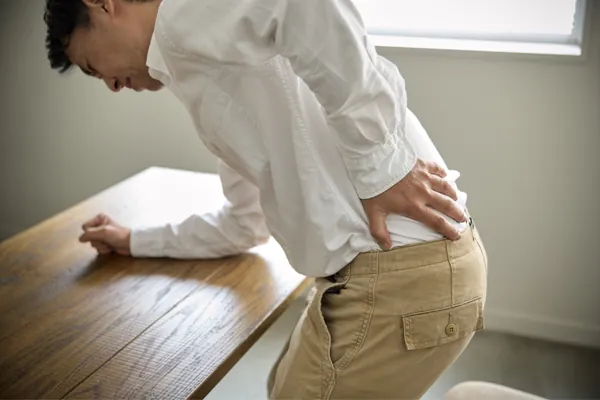
When a facet joint is the source, the pain usually sits mostly in the back or neck, to one or both sides of the spine, and is often tender to press just off the midline.
Leaning back and twisting. Bending backward shifts more of the spine’s load onto the facet joints (Gellhorn 2013), and twisting loads them on one side. So a painful joint often hurts more when you arch your back, look up, stand up from a chair or stand for a long time, and feels better bending forward.
Where it spreads. From the lower back, facet pain is referred mainly into the buttock and thigh (Gellhorn 2013). From the neck, each joint refers to a fairly consistent area. In a study of 61 patients, the upper joints referred pain to the back of the head and neck, the middle joints to the lower neck and top of the shoulder, and the lowest joints to the shoulder blade (Fukui 1996).
Why that is not proof. These patterns overlap with disc, sacroiliac joint and muscle pain. History and exam findings cannot reliably identify a painful facet joint (Cohen and Raja 2007), and neither can a CT scan on its own (Kalichman 2008). In one study of 192 patients treated with radiofrequency ablation, pain on leaning back and twisting predicted a poorer result, and only tenderness beside the spine predicted a good one (Cohen 2007).
How common facet pain is. In 500 patients with chronic spine pain referred to an interventional practice and tested with comparative blocks, the facet joints were the source in 55% of chronic neck pain and 31% of chronic low back pain (Manchikanti 2004). Other estimates for the lower back run lower, at up to 15% (Cohen and Raja 2007). The answer depends on who is studied and how.
What sets it off. Age-related wear is the most common background. Neck facet pain often follows whiplash: the sham-controlled neck trial discussed below enrolled people whose pain began with a car crash (Lord 1996).
How a painful facet joint is diagnosed: two numbing tests
Because the scan and the exam cannot settle it, the test is a medial branch block. Under X-ray guidance, a small amount of local anesthetic is placed on the medial branch nerves to the suspected joints. While the anesthetic works, you do the movements that normally bring the pain on and record your usual pain in a pain diary.
At Modal Pain Management, every patient has two blocks before any ablation, on separate days:
- The first uses lidocaine, which typically wears off in about two hours (Hurley 2022).
- The second uses bupivacaine, which lasts longer.
The joints count as a likely source only if your usual pain drops by at least 80% both times, for about as long as each anesthetic lasts. That is the standard the Medicare coverage policy for New York requires before radiofrequency ablation (CMS L35936), and we apply it to every patient, whatever the insurance plan.
The reason for two is false positives. In the 500-patient series, a single lidocaine block was falsely positive in 63% of neck pain and 27% of low back pain (Manchikanti 2004). Comparing a short-acting and a long-acting anesthetic is a check on that: in a double-blind study of neck pain after whiplash, relief that lasted longer with the longer-acting bupivacaine was very unlikely to be chance, and the authors concluded that comparative blocks are a valid test (Barnsley 1993). For balance: a 2020 multisociety guideline recommends a single block with at least 50% relief, with the Spine Intervention Society dissenting in favor of two blocks at 80%, and notes that a single block is falsely positive in an estimated 17% to 41% of patients (Cohen 2020). We use the stricter standard so that fewer people go on to an ablation that was never going to help.
Treatment for facet arthropathy pain
Time and exercise first. Most back and neck pain improves substantially in the first six weeks. In pooled studies, new low back pain fell from 52 to 23 out of 100 by six weeks (Costa 2012). Neck pain fell by about half in that time, then often levelled off (Hush 2011). For chronic low back pain, the American College of Physicians recommends non-drug treatment first, led by exercise and rehabilitation, with anti-inflammatory medicines considered after an inadequate response (Qaseem 2017). Physical therapy is how most people get that exercise in a structured way.
Medial branch blocks are a test, not a treatment. The relief lasts hours by design. Some practices inject steroid into the facet joint itself instead. We don’t. The lumbar (2020) and cervical (2022) consensus guidelines prefer medial branch blocks for deciding who goes on to ablation (Cohen 2020, Hurley 2022).
Radiofrequency ablation. When both blocks are positive, radiofrequency ablation uses heat to quiet the medial branch nerves. It treats the nerves, not the joint, and does not reverse the wear.
- How well it works in responders. In carefully selected patients, about half to two-thirds report at least 50% less pain six months to two years after lumbar ablation (Conger 2020, Schneider 2020). In the sham-controlled neck trial, pain took a median of 263 days to come halfway back after real treatment, against 8 days after sham (Lord 1996).
- How long it lasts. After a first ablation that works, relief usually lasts 7 to 9 months, and a repeat usually works again if the first one did (Smuck 2012). The pain returns because the treated nerves slowly recover.
- What the negative trials found. In the Dutch MINT facet trial of 251 people, ablation added to a three-month exercise program did no better than the exercise program alone at three months (Juch 2017). A 2025 BMJ guideline panel made a strong recommendation against joint radiofrequency ablation for axial (non-radiating) back or neck pain lasting three months or more (Busse 2025). Supporters of the procedure point to stricter patient selection and technique in the positive studies. We tell patients about both sides before they decide.
When back or neck pain is an emergency
These are not signs of facet joint pain. Back or neck pain with fever, new numbness between the legs or in the saddle area, trouble controlling your bladder or bowels, or new weakness in a leg or arm can signal nerve compression (which enlarged facet joints can contribute to), infection or another serious problem (Finucane 2020). For any of these, call 911 or go to the nearest emergency room.
In the neck, clumsy hands (trouble with buttons or keys) and unsteady walking that keep getting worse can mean the spinal cord is being compressed, and need urgent evaluation (Davies 2018). If they are changing quickly, call 911 or go to the nearest emergency room.
When to see a pain specialist
See a specialist if back or neck pain has lasted more than three months despite exercise and time, if it keeps you from work or sleep, or if a report mentioning facet arthropathy has left you unsure what to do next. An evaluation sorts out whether the pain is more likely coming from the facet joints, a disc, a nerve root, the sacroiliac joint or muscle, which decides what treatment makes sense. For back pain or neck pain with arm or leg symptoms, the workup is different.
Modal Pain Management NYC is led by Dr. Alex Movshis, MD, a dual board-certified anesthesiologist and interventional pain management specialist trained at the Icahn School of Medicine at Mount Sinai. He reviews your images with you, examines your back or neck and, when the pattern fits, runs the two-block test himself. Call (646) 290-6660 or visit modalpain.com/contact to schedule a consultation.
References
This article is reviewed against the peer-reviewed literature. Citations retrieved from PubMed.
- Kalichman L, Li L, Kim DH, et al. Facet joint osteoarthritis and low back pain in the community-based population. Spine. 2008. doi:10.1097/BRS.0b013e318184ef95 · PubMed
- Suri P, Hunter DJ, Rainville J, Guermazi A, Katz JN. Presence and extent of severe facet joint osteoarthritis are associated with back pain in older adults. Osteoarthritis and Cartilage. 2013. doi:10.1016/j.joca.2013.05.013 · PubMed
- Gellhorn AC, Katz JN, Suri P. Osteoarthritis of the spine: the facet joints. Nature Reviews Rheumatology. 2013. doi:10.1038/nrrheum.2012.199 · PubMed
- Cohen SP, Raja SN. Pathogenesis, diagnosis, and treatment of lumbar zygapophysial (facet) joint pain. Anesthesiology. 2007. doi:10.1097/00000542-200703000-00024 · PubMed
- Cohen SP, Hurley RW, Christo PJ, et al. Clinical predictors of success and failure for lumbar facet radiofrequency denervation. The Clinical Journal of Pain. 2007. doi:10.1097/01.ajp.0000210941.04182.ea · PubMed
- Manchikanti L, Boswell MV, Singh V, Pampati V, Damron KS, Beyer CD. Prevalence of facet joint pain in chronic spinal pain of cervical, thoracic, and lumbar regions. BMC Musculoskeletal Disorders. 2004. doi:10.1186/1471-2474-5-15 · PubMed
- Fukui S, Ohseto K, Shiotani M, et al. Referred pain distribution of the cervical zygapophyseal joints and cervical dorsal rami. Pain. 1996. doi:10.1016/S0304-3959(96)03173-9 · PubMed
- Barnsley L, Lord S, Bogduk N. Comparative local anaesthetic blocks in the diagnosis of cervical zygapophysial joint pain. Pain. 1993. doi:10.1016/0304-3959(93)90189-V · PubMed
- Cohen SP, Bhaskar A, Bhatia A, et al. Consensus practice guidelines on interventions for lumbar facet joint pain from a multispecialty, international working group. Regional Anesthesia and Pain Medicine. 2020. doi:10.1136/rapm-2019-101243 · PubMed
- Hurley RW, Adams MCB, Barad M, et al. Consensus practice guidelines on interventions for cervical spine (facet) joint pain from a multispecialty international working group. Regional Anesthesia and Pain Medicine. 2022. doi:10.1136/rapm-2021-103031 · PubMed
- da C Menezes Costa L, Maher CG, Hancock MJ, et al. The prognosis of acute and persistent low-back pain: a meta-analysis. CMAJ. 2012. doi:10.1503/cmaj.111271 · PubMed
- Hush JM, Lin CC, Michaleff ZA, Verhagen A, Refshauge KM. Prognosis of acute idiopathic neck pain is poor: a systematic review and meta-analysis. Archives of Physical Medicine and Rehabilitation. 2011. doi:10.1016/j.apmr.2010.12.025 · PubMed
- Qaseem A, Wilt TJ, McLean RM, Forciea MA. Noninvasive Treatments for Acute, Subacute, and Chronic Low Back Pain: A Clinical Practice Guideline From the American College of Physicians. Annals of Internal Medicine. 2017. doi:10.7326/M16-2367 · PubMed
- Lord SM, Barnsley L, Wallis BJ, McDonald GJ, Bogduk N. Percutaneous radio-frequency neurotomy for chronic cervical zygapophyseal-joint pain. The New England Journal of Medicine. 1996. doi:10.1056/NEJM199612053352302 · PubMed
- Smuck M, Crisostomo RA, Trivedi K, Agrawal D. Success of initial and repeated medial branch neurotomy for zygapophysial joint pain: a systematic review. PM&R. 2012. doi:10.1016/j.pmrj.2012.06.007 · PubMed
- Conger A, Burnham T, Salazar F, et al. The Effectiveness of Radiofrequency Ablation of Medial Branch Nerves for Chronic Lumbar Facet Joint Syndrome in Patients Selected by Guideline-Concordant Dual Comparative Medial Branch Blocks. Pain Medicine. 2020. doi:10.1093/pm/pnz248 · PubMed
- Schneider BJ, Doan L, Maes MK, et al. Systematic Review of the Effectiveness of Lumbar Medial Branch Thermal Radiofrequency Neurotomy, Stratified for Diagnostic Methods and Procedural Technique. Pain Medicine. 2020. doi:10.1093/pm/pnz349 · PubMed
- Juch JNS, Maas ET, Ostelo RWJG, et al. Effect of Radiofrequency Denervation on Pain Intensity Among Patients With Chronic Low Back Pain: The Mint Randomized Clinical Trials. JAMA. 2017. doi:10.1001/jama.2017.7918 · PubMed
- Busse JW, Genevay S, Agarwal A, et al. Commonly used interventional procedures for non-cancer chronic spine pain: a clinical practice guideline. BMJ. 2025. doi:10.1136/bmj-2024-079970 · PubMed
- Finucane LM, Downie A, Mercer C, et al. International Framework for Red Flags for Potential Serious Spinal Pathologies. Journal of Orthopaedic & Sports Physical Therapy. 2020. doi:10.2519/jospt.2020.9971 · PubMed
- Davies BM, Mowforth OD, Smith EK, Kotter MR. Degenerative cervical myelopathy. BMJ. 2018. doi:10.1136/bmj.k186 · PubMed
Frequently Asked Questions
Usually not. Facet arthropathy is wear in the small joints at the back of the spine, and it is so common with age that on CT scans of the lower back, moderate or more advanced wear was found in 89% of people in their 60s (Kalichman 2008). Most of the time it causes no symptoms. It matters in two situations: when a worn joint is a source of pain, which takes two numbing tests to show, and when enlarged joints help narrow the spaces for the nerves (spinal stenosis). Back or neck pain with fever, numbness between the legs, trouble controlling your bladder or bowels, or new weakness is a different matter. Call 911 or go to the nearest emergency room. Clumsy hands or unsteady walking that keeps getting worse needs urgent evaluation, and if it is changing quickly, call 911 or go to the nearest emergency room.
In practice, nothing. Arthropathy means any disease of a joint, and arthritis means joint inflammation, but on a spine report both describe the same thing: wear-and-tear (degenerative) change in the facet joints, also called facet joint osteoarthritis. Facet joint syndrome is a different idea. It describes pain that comes from those joints, which the scan cannot show.
Mild means the radiologist sees early wear, such as slight narrowing of the joint space or small bone spurs. Bilateral means the joints on both the left and right side of that level show it. Both words describe the picture, not the pain. Mild facet changes are close to universal by middle age (Suri 2013). In a CT study, even moderate or more advanced facet wear was no more common in people with back pain than in people without it (Kalichman 2008).
Bending backward shifts more load onto the facet joints (Gellhorn 2013), and their capsules are supplied with pain-sensing nerves, so a painful joint often hurts more in that position. It is a clue, not proof. In a study of 192 patients, pain on leaning back and twisting actually predicted a poorer result from radiofrequency ablation (Cohen 2007), and history and exam findings cannot reliably identify a painful facet joint (Cohen and Raja 2007). That is why two numbing tests are used before any longer-lasting treatment.
It varies. New back pain usually improves a lot within six weeks (Costa 2012), while neck pain improves by about half and then often levels off (Hush 2011). Pain from facet arthritis can come and go for months or years. When radiofrequency ablation is used and works, relief usually lasts 7 to 9 months, as the treated nerves regrow, and a repeat usually works again if the first one did (Smuck 2012).
The wear itself cannot be reversed, but it is often painless, and when it does hurt the pain can usually be brought down. Exercise is the first treatment. When pain lasts for months and two numbing tests point to specific joints, radiofrequency ablation can quiet their nerves for months at a time (Lord 1996). Not every trial agrees (Juch 2017), and a 2025 guideline advises against it (Busse 2025).