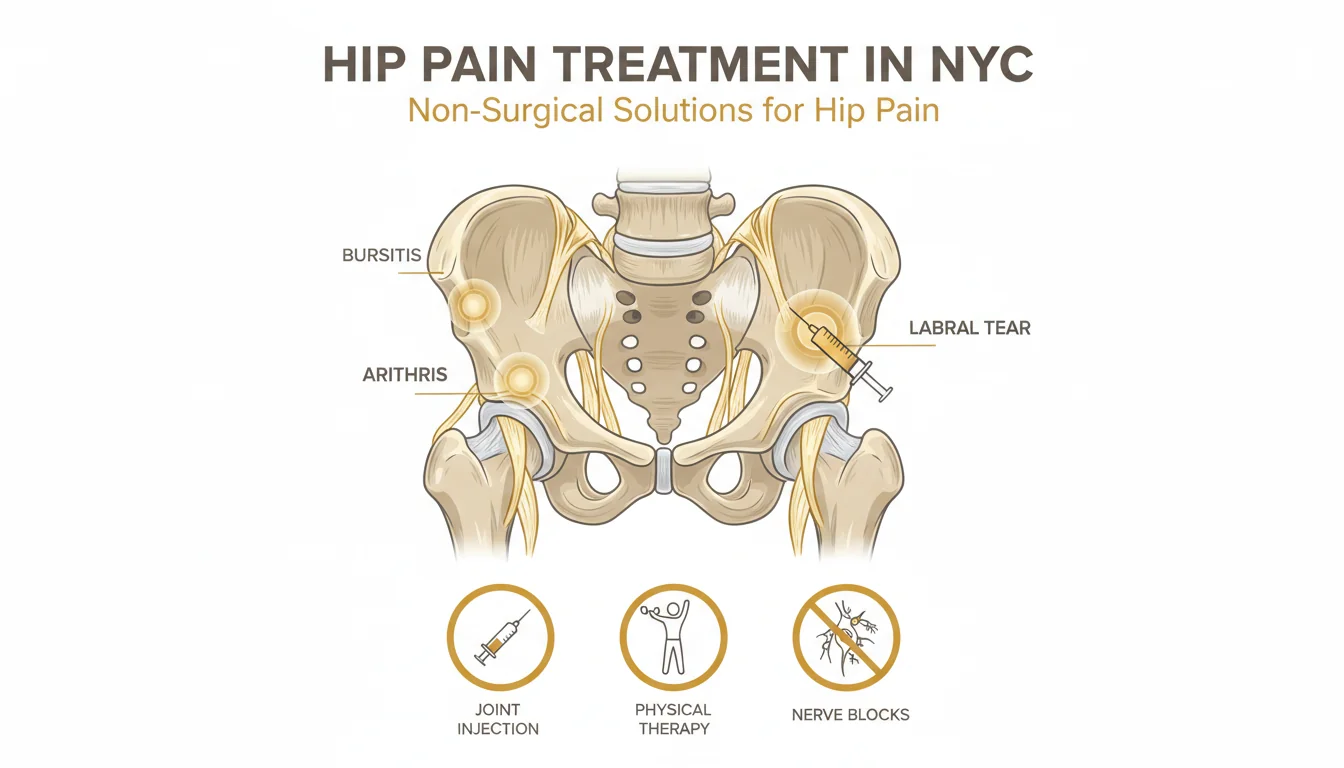
Pain on the outside of the hip, worst lying on that side, is common after 50. In a population study of adults aged 50 to 79, about 24% of women and 9% of men had it on one or both sides (Segal 2007). At Modal Pain Management in Midtown Manhattan, Dr. Alex Movshis uses ultrasound to look at the trochanteric bursa, the gluteus medius and minimus tendons and the iliotibial band, and to guide injections into the structure that hurts.
This page covers what hip bursitis actually is (it is rarely just bursitis — it is usually a tendon problem with the modern name “greater trochanteric pain syndrome”), how it is distinguished from the other causes of lateral hip and buttock pain, how it is diagnosed at Modal Pain Management, and the evidence-based image-guided treatment ladder we use to get patients back to walking, sleeping on their side, climbing stairs, and exercising without pain.
Hip Bursitis Has Been Renamed: Greater Trochanteric Pain Syndrome (GTPS)
For decades the standard diagnosis for lateral hip pain was “trochanteric bursitis” — and the standard treatment was a cortisone injection into the bursa. Modern imaging changed that. When patients with classic “trochanteric bursitis” symptoms are evaluated with high-resolution ultrasound and MRI, most have tendinopathy of the gluteus medius and gluteus minimus tendons at their insertions on the greater trochanter, and the bursa, which sits on top of those tendons, is involved secondarily (Grimaldi 2015).
Because the tendon is the primary pain generator in most cases, the umbrella diagnosis was renamed to greater trochanteric pain syndrome (GTPS). This terminology change has clinical consequences. A plan aimed only at the bursa (rest plus repeated cortisone injections) does not treat the tendon problem underneath. The image-guided ladder we use at Modal Pain Management explicitly accounts for the bursal versus tendinous components and selects treatments accordingly.
The four overlapping conditions that fall under the GTPS umbrella are:
- Gluteus medius tendinopathy — the most common, affecting the insertion on the lateral facet of the greater trochanter.
- Gluteus minimus tendinopathy — often coexists with gluteus medius involvement and affects the insertion on the anterior facet.
- Trochanteric bursitis (true bursal inflammation) — fluid distension of the bursa, often secondary to underlying tendinopathy.
- External snapping hip (coxa saltans externa) — the iliotibial band snapping over the greater trochanter with hip motion.
Distinguishing which of these is dominant — and treating accordingly — is what separates a successful 12-month outcome from a recurrence-prone “I keep getting cortisone shots that don’t last” pattern.
Why It Hurts on the Outside of Your Hip: The Anatomy
The greater trochanter is the bony prominence on the outer side of the upper thigh — easy to feel by pressing firmly on the lateral hip while lying on the opposite side. Several structures attach to or pass over the greater trochanter:
- Gluteus medius tendon inserts on the lateral and superoposterior facets of the trochanter. It is the main hip abductor and holds the pelvis level when you stand on one leg.
- Gluteus minimus tendon inserts on the anterior facet and assists hip abduction and internal rotation.
- Trochanteric bursa is a fluid-filled sac that sits superficial to the gluteus medius tendon and deep to the iliotibial band, reducing friction during gait.
- Subgluteus medius and subgluteus minimus bursae sit deep to those tendons and can also become inflamed.
- Iliotibial (IT) band passes directly over the greater trochanter as it travels from the iliac crest to the lateral knee. At the knee end, the same band is the source of IT band syndrome, the outside-of-knee pain that arrives at a predictable point in a run.
Compressive load is the main driver: positions that pull the thigh across the body (hip adduction), such as sleeping on the painful side, sitting cross-legged or standing hitched onto one hip, press the IT band and the gluteal tendons against the trochanter (Grimaldi 2015). That load drives the gluteal tendinopathy and secondary bursal inflammation that we collectively call GTPS.
GTPS vs. Other Causes of Lateral Hip and Buttock Pain
Lateral hip pain has a long differential diagnosis, and the wrong diagnosis leads to predictable treatment failure. At Modal Pain Management we systematically rule out each of the following before settling on GTPS as the working diagnosis:
- Hip osteoarthritis (OA) — pain is typically in the groin, not the lateral hip, and worse with internal rotation. FABER and FADIR tests are often positive, and X-ray shows joint space narrowing. Some patients have both hip OA and GTPS simultaneously.
- Lumbar radiculopathy (L5 or S1) — pain radiates from the low back down the back or outer thigh past the knee, often with a positive straight leg raise, weakness lifting or pushing down the foot, and numbness in a dermatomal pattern. See our sciatica page.
- Piriformis syndrome — deep buttock pain that worsens with sitting and eases with walking, is reproduced by the FAIR test, and often radiates down the back of the thigh. See our dedicated piriformis syndrome page.
- Femoroacetabular impingement (FAI) and hip labral tear — usually younger active adults, with groin pain on deep flexion, internal rotation and pivoting and a positive FADIR test. MRI or MR arthrogram shows the tear.
- Sacroiliac (SI) joint pain — pain over the SI joint and back of the pelvis, with positive FABER, thigh thrust, distraction and compression tests. It can refer to the lateral hip.
- Meralgia paresthetica — entrapment of the lateral femoral cutaneous nerve causing burning and numbness over the front and outer thigh, often from a tight belt line or a wallet pressing at the hip. See meralgia paresthetica.
- Hip stress fracture (femoral neck or trochanter) — in runners, military recruits, or people with osteoporosis or relative energy deficiency. Pain comes with weight-bearing, MRI makes the diagnosis, and a missed femoral neck stress fracture can become a complete fracture.
- Septic bursitis or septic arthritis — a warm, red, swollen hip with fever or chills. This is an emergency that needs same-day aspiration and culture.
A focused exam usually separates GTPS from these mimics, with ultrasound added when the exam leaves doubt. X-rays are added when hip OA, fracture, or other bone problems are suspected. MRI is kept for atypical cases, a suspected gluteal tendon tear that may need surgery, or pain that has not responded to treatment.
How GTPS Is Diagnosed at Modal Pain Management
Dr. Movshis starts with a focused history (sleep position, sitting habits, recent activity changes, prior hip surgery, lumbar spine history, menopause status) and a structured physical exam, and adds ultrasound when the exam leaves doubt or an injection is planned.
Key exam maneuvers include:
- Direct palpation over the greater trochanter, posterior facet (gluteus medius insertion), and anterior facet (gluteus minimus insertion) to identify the painful structure.
- Resisted hip abduction (in side-lying) and the single-leg stance test. In a 65-patient study, lateral hip pain within 30 seconds of standing on the painful leg made gluteal tendinopathy on MRI very likely, while a hip that was not tender to pressure over the trochanter made it unlikely (Grimaldi 2017).
- Trendelenburg test — pelvic drop on the contralateral side during single-leg stance indicates gluteus medius weakness or pain inhibition.
- FABER (Patrick) test — to screen for hip joint pathology and SI joint pain.
- FADIR test — to screen for femoroacetabular impingement and labral pathology.
- Straight leg raise and slump test — to rule out lumbar radiculopathy.
Ultrasound shows:
- The trochanteric bursa — confirming or ruling out fluid distension.
- The gluteus medius and minimus tendons at their trochanteric insertions — assessing thickness, fibrillar pattern, partial-thickness tears, calcific deposits, and dynamic snapping with hip motion.
- The iliotibial band as it passes over the trochanter — identifying snapping hip and friction zones.
- The gluteus medius and minimus muscle bellies — screening for fatty atrophy, which suggests chronic full-thickness tendon tear and changes management.
It also guides any injection into the right layer. X-rays, MRI, and lumbar imaging are added only when the exam calls for them.
The Image-Guided Treatment Ladder for GTPS
Modal Pain Management treats GTPS using a stepwise, evidence-based ladder. Each step is selected based on the bursa-versus-tendon balance identified on ultrasound, the chronicity of symptoms, and how much functional improvement the patient needs.
Step 1 — Load Management and Physical Therapy (6–8 weeks)
The strongest evidence supports a structured education-plus-exercise program. In the 2018 LEAP randomized trial, 204 people with lateral hip pain for more than three months were assigned to eight weeks of education and exercise, one corticosteroid injection, or wait and see. At 8 weeks, 77%, 58% and 29% reported success. At one year the figures were 78%, 57% and 52%, and pain scores for exercise and injection were similar by then (Mellor 2018). The program includes:
- Postural education: stop sleeping on the painful side (sleep on the other side with a pillow between the knees), stop sitting cross-legged or crossing the legs at the knees, and stop standing with your weight shifted onto one hip.
- Isometric gluteal loading: side-lying hip abduction holds, banded clamshells, isometric wall press of the abducted leg.
- Progressive isotonic loading: side-lying hip abduction, banded side-stepping, single-leg bridges, step-ups.
- Eccentric and functional progression: lateral lunges, single-leg deadlifts, step-downs, gait retraining to reduce pelvic drop and valgus knee collapse.
- Treatment of contributing biomechanics: addressing leg-length discrepancy with a heel lift, treating co-existing lumbar pathology, and screening for total hip replacement-related lateral mechanics.
Physical therapy is the step with the best trial support, and the one most often skipped.
Step 2 — Ultrasound-Guided Corticosteroid Injection
For patients with substantial bursal inflammation on ultrasound, severe pain limiting their ability to sleep or work, or those who need fast functional improvement for an upcoming event, ultrasound-guided trochanteric bursa corticosteroid injection is added on top of the exercise program, not in place of it. Whether image guidance improves results here is less clear than often claimed. In a 65-patient trial, trochanteric injections placed under fluoroscopy did no better than injections placed by landmarks at one and three months (Cohen 2009). Dr. Movshis uses ultrasound because it shows whether the bursa holds fluid and where the tendon is damaged, so the medication goes into the right layer.
The steroid takes days to build, and most of its effect shows by about two weeks, which is when we judge it. In the PRP trial below, the cortisone benefit peaked at about 6 weeks and was not maintained beyond 24 weeks (Fitzpatrick 2019). Repeat steroid injections are limited. Across tendinopathy trials, the early benefit of cortisone tended to fade or reverse at 6 to 12 months (Coombes 2010), and the long-term goal in GTPS is a stronger tendon.
Step 3 — Ultrasound-Guided PRP (Platelet-Rich Plasma) Injection
For chronic GTPS (>3 months), patients with imaging evidence of gluteal tendinopathy or partial-thickness tears, patients who have already received one or two cortisone injections, and patients trying to avoid further tendon injury, we offer ultrasound-guided PRP injection of the gluteus medius and minimus tendons as a self-pay option. PRP delivers a concentrated dose of the patient’s own platelet-derived growth factors directly into the degenerated tendon. The aim is a repair response rather than suppressed inflammation, a rationale that is plausible but not proven in patients.
Randomized controlled trials (Begkas et al., 2020, Fitzpatrick et al., 2018, 2019 with 2-year follow-up) show that for chronic gluteal tendinopathy, a single PRP injection outperformed a single corticosteroid injection at 12 and 24 weeks, and the PRP group was still improved at 2 years while the cortisone benefit had faded by 24 weeks. Both trials were small (80 and 24 patients), and the larger one used leukocyte-rich PRP, while we use leukocyte-poor PRP. Both compared PRP with cortisone, not with placebo. In the one adequately powered placebo-controlled trial, 79 patients received leukocyte-rich PRP or saline into the trochanteric bursa and gluteus medius tendon, and there was no difference at any point up to 12 months (Atchia et al., 2025). A smaller New Zealand trial against saline was also negative (Thompson and Pearson, 2019). Part of PRP’s lead over cortisone may reflect cortisone wearing off rather than PRP doing more than a placebo. Compared with cortisone, the effect is slower but lasted longer in those trials, and PRP contains no steroid. A 2017 meta-analysis of tendinopathy trials found the largest effects with a single ultrasound-guided injection of leukocyte-rich PRP (Fitzpatrick 2017), a different preparation from the leukocyte-poor PRP used here. At Modal Pain Management, PRP is performed under continuous ultrasound guidance with peppering of the affected tendon segments, followed by a structured 6-week loading progression. Soreness for several days is common, anti-inflammatories are avoided for 2 weeks before and 2 weeks after, and the activity schedule is on the PRP aftercare page.
Step 4 — ESWT and Surgical Referral (Selected Cases)
For refractory cases that have failed steps 1–3, options include:
- Extracorporeal shockwave therapy (ESWT) — focused or radial shockwave applied to the gluteal tendons. Modal Pain does not offer it and refers to NYC providers who do.
- Surgical referral — reserved for patients with full-thickness gluteus medius or minimus tendon tears confirmed on MRI, particularly those with persistent abductor weakness, marked Trendelenburg gait, or post-total-hip-replacement abductor mechanism failure. We refer to selected NYC orthopedic hip specialists for endoscopic or open gluteal tendon repair.
Most people never need step 4. Surgery is reserved for recalcitrant cases (Aaron 2011).
Physical Therapy and Self-Care for GTPS
Even the best image-guided injection is only as durable as the postural and biomechanical work that follows. Patients with GTPS benefit from a structured course of physical therapy targeting:
- Hip abductor strength — particularly the posterior fibers of the gluteus medius, which control pelvic drop on single-leg stance.
- Gluteal endurance — graduated loading to build the capacity to withstand walking, stair climbing, and prolonged standing without symptoms.
- Lumbopelvic stability — core and hip control work to address the pelvic drop / valgus knee collapse pattern.
- No IT band stretching — stretches that pull the leg across the body add compression over the trochanter, so they are left out while the tendon settles (Grimaldi 2015).
- Gait retraining — for runners, addressing overstriding, cadence, hill running volume, and shoe wear.
Home self-care includes:
- Sleep position modification — sleep on the unaffected side with a thick pillow between the knees to keep the upper hip from dropping inward. If you must sleep on the painful side, a softer mattress topper helps.
- Sitting position modification — uncross the legs, sit with both feet flat on the floor, and rise from low chairs using both legs evenly.
- Standing posture — distribute weight evenly between both feet rather than “hanging on the hip” with your weight shifted to one side.
- Activity modification — cut back on hill walking, treadmill incline work and long stair climbs for a while, then bring them back gradually.
- Anti-inflammatories — an over-the-counter ibuprofen or naproxen at the label dose for a week or two during a flare, if it is safe for you.
When Hip Pain Is an Emergency
Most lateral hip pain is not an emergency — but a few presentations require same-day evaluation:
- Septic bursitis or septic arthritis — warm, red, markedly tender hip with fever, chills, or recent overlying skin infection. Diabetic, immunosuppressed, and recent-injection patients are at highest risk. Aspiration with culture is required before any steroid is administered.
- Acute trauma with inability to bear weight — particularly in older patients or those with osteoporosis. Hip fracture must be ruled out with X-ray (and sometimes MRI for occult fractures).
- Stress fracture in a runner — progressive hip pain with weight-bearing in a high-mileage runner, military recruit, or patient with relative energy deficiency. MRI is required for diagnosis. A missed femoral neck stress fracture can progress to a complete, displaced fracture.
If any of these fit, do not wait for a routine appointment. Call 911 or go to the nearest emergency room.
Why Modal Pain Management for Hip Bursitis and GTPS in NYC
Modal Pain Management is a physician-led interventional pain practice located at 369 Lexington Avenue, Floor 25 in Midtown Manhattan (NYC 10017), led by Dr. Alex Movshis, who is dual board-certified in Anesthesiology and Pain Medicine and completed his pain fellowship at the Icahn School of Medicine at Mount Sinai. Every patient is evaluated and treated by Dr. Movshis personally. Ultrasound and fluoroscopy are in the office suite, so injections are placed under guidance. Same-week new-patient appointments are typically available.
For more on how we source clinical claims, see the clinical evidence and citations page. Modal Pain Management accepts most commercial PPO plans, including Aetna, Anthem Blue Cross Blue Shield, Cigna, Empire Blue Cross Blue Shield, the Empire Plan, Oscar, Oxford, UMR and UnitedHealthcare, and does not accept Medicare, Medicaid, HMO plans, or workers’ compensation. PRP is self-pay. You can verify your insurance before the visit at no charge.
References
- Segal NA, Felson DT, Torner JC, et al. Greater trochanteric pain syndrome: epidemiology and associated factors. Arch Phys Med Rehabil. 2007;88(8):988–92. doi:10.1016/j.apmr.2007.04.014 · PubMed
- Grimaldi A, Mellor R, Hodges P, Bennell K, Wajswelner H, Vicenzino B. Gluteal Tendinopathy: A Review of Mechanisms, Assessment and Management. Sports Med. 2015;45(8):1107–19. doi:10.1007/s40279-015-0336-5 · PubMed
- Mellor R, Bennell K, Grimaldi A, et al. Education plus exercise versus corticosteroid injection use versus a wait and see approach on global outcome and pain from gluteal tendinopathy: prospective, single blinded, randomised clinical trial. Br J Sports Med. 2018;52(22):1464–1472. doi:10.1136/bjsports-2018-k1662rep · PubMed
- Fitzpatrick J, Bulsara MK, O’Donnell J, McCrory PR, Zheng MH. The Effectiveness of Platelet-Rich Plasma Injections in Gluteal Tendinopathy: A Randomized, Double-Blind Controlled Trial Comparing a Single Platelet-Rich Plasma Injection With a Single Corticosteroid Injection. Am J Sports Med. 2018;46(4):933–939. doi:10.1177/0363546517745525 · PubMed
- Fitzpatrick J, Bulsara MK, O’Donnell J, Zheng MH. Leucocyte-Rich Platelet-Rich Plasma Treatment of Gluteus Medius and Minimus Tendinopathy: A Double-Blind Randomized Controlled Trial With 2-Year Follow-up. Am J Sports Med. 2019;47(5):1130–1137. doi:10.1177/0363546519826969 · PubMed
- Begkas D, Chatzopoulos ST, Touzopoulos P, Balanika A, Pastroudis A. Ultrasound-guided Platelet-rich Plasma Application Versus Corticosteroid Injections for the Treatment of Greater Trochanteric Pain Syndrome: A Prospective Controlled Randomized Comparative Clinical Study. Cureus. 2020;12(1):e6583. doi:10.7759/cureus.6583 · PubMed
- Atchia I, Ali M, Oderuth E, Holleyman R, Malviya A. Efficacy of Platelet-Rich Plasma Versus Placebo for the Treatment of Greater Trochanteric Pain Syndrome: A Double-Blinded Randomized Controlled Trial. J Bone Joint Surg Am. 2025;107(5):444–451. doi:10.2106/JBJS.24.00763 · PubMed
- Thompson G, Pearson JF. No attributable effects of PRP on greater trochanteric pain syndrome. N Z Med J. 2019;132(1507):22–32. PubMed
- Fitzpatrick J, Bulsara M, Zheng MH. The Effectiveness of Platelet-Rich Plasma in the Treatment of Tendinopathy: A Meta-analysis of Randomized Controlled Clinical Trials. Am J Sports Med. 2017;45(1):226–233. doi:10.1177/0363546516643716 · PubMed
- Aaron DL, Patel A, Kayiaros S, Calfee R. Four common types of bursitis: diagnosis and management. J Am Acad Orthop Surg. 2011;19(6):359–67. doi:10.5435/00124635-201106000-00006 · PubMed
- Grimaldi A, Mellor R, Nicolson P, Hodges P, Bennell K, Vicenzino B. Utility of clinical tests to diagnose MRI-confirmed gluteal tendinopathy in patients presenting with lateral hip pain. Br J Sports Med. 2017;51(6):519–524. doi:10.1136/bjsports-2016-096175 · PubMed
- Cohen SP, Strassels SA, Foster L, et al. Comparison of fluoroscopically guided and blind corticosteroid injections for greater trochanteric pain syndrome: multicentre randomised controlled trial. BMJ. 2009;338:b1088. doi:10.1136/bmj.b1088 · PubMed
- Coombes BK, Bisset L, Vicenzino B. Efficacy and safety of corticosteroid injections and other injections for management of tendinopathy: a systematic review of randomised controlled trials. Lancet. 2010;376(9754):1751–67. doi:10.1016/S0140-6736(10)61160-9 · PubMed