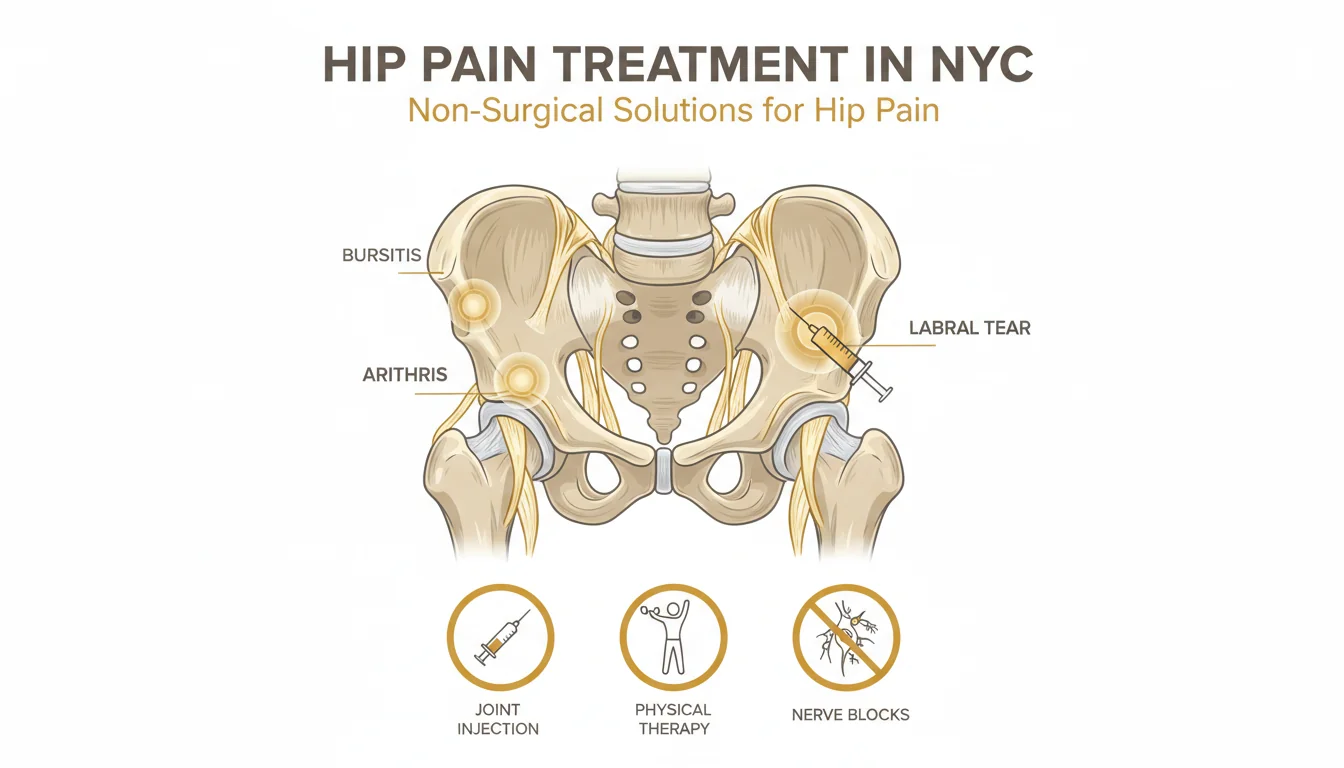
Hip labral tear and femoroacetabular impingement (FAI) are among the most common — and most frequently missed — causes of disabling deep groin pain in young and middle-aged adults. At Modal Pain Management in Midtown Manhattan, Dr. Alex Movshis uses high-resolution imaging, a focused physical examination, and image-guided diagnostic and therapeutic intra-articular hip injection to deliver a modern, structured non-operative pathway for labral tear and FAI — confirming the diagnosis, controlling the pain, retraining the mechanics, and reserving hip arthroscopy for the patients who actually need it.
This page covers what a hip labral tear actually is, why femoroacetabular impingement is usually the underlying mechanical driver, how labral tear is reliably distinguished from hip osteoarthritis and the other causes of groin pain, how Dr. Movshis diagnoses it, the evidence-based image-guided non-surgical treatment ladder we use, when hip arthroscopy is appropriate, and what to expect at your first visit.
Not Every Labral Tear Needs a Scope
The dominant clinical narrative around hip labral tears for the past two decades has been: MRI shows a labral tear, you get hip arthroscopy. The published evidence supports a more selective approach. The UK FASHIoN trial (Lancet, 2018) randomized 348 patients with femoroacetabular impingement syndrome and no arthritis to hip arthroscopy or a personalized, physiotherapist-led hip therapy program. Both arms improved. The surgical advantage at 12 months was modest, a 6.8-point difference on the iHOT-33 score, just above the 6.1-point threshold the authors set for a meaningful difference (Griffin 2018). Longer follow-up will show whether that gap holds. The practical lesson is that many patients can reasonably try structured non-operative care first, and some will want surgery after it.
This matters for two reasons. First, hip arthroscopy carries real risks, including cartilage injury during surgery, traction-related nerve irritation, heterotopic ossification, persistent groin pain, and later conversion to hip replacement, which is more likely when cartilage wear or dysplasia is already present. In FASHIoN, five of the six serious adverse events in the surgery group were related to treatment, including one hip infection (Griffin 2018). Second, labral tears are common in people with no symptoms at all. MRI showed labral tears in 69% of 45 volunteers who had never had hip pain (Register 2012), so a labral tear on MRI is not, by itself, a surgical indication. The clinical question is not “is there a tear?” — it is “is the hip joint generating the pain, what mechanical factors are driving it, and what structured treatment will restore function?”
Modal Pain Management’s role in this is to deliver the structured non-operative pathway with the same precision a hip arthroscopist applies in the operating room — image-guided diagnostic injection, targeted physical therapy, and injection options where they fit, with the evidence for each laid out honestly, and to refer to one of the strong NYC-based hip arthroscopy programs when surgery is genuinely the right answer.
Why It Hurts There: The Anatomy of Labral Tear and FAI
The hip is a ball-and-socket synovial joint. The femoral head sits in the acetabulum (the cup of the pelvis), and the rim of the acetabulum is encircled by the acetabular labrum — a triangular fibrocartilaginous ring that deepens the socket, increases joint stability, and seals synovial fluid into the joint to maintain hydraulic pressure across the articular surfaces. The labrum is innervated by free nerve endings, particularly in its anterosuperior portion, which is why labral tearing produces pain. Its blood supply, however, reaches mainly the outer edge, so the inner part does not heal back to native tissue once torn.
In femoroacetabular impingement (FAI), abnormal bony morphology causes premature contact between the femoral head-neck junction and the acetabular rim during routine hip motion. Cam impingement is an aspherical, non-round femoral head-neck junction (typically anterolateral) that bumps into the acetabular rim during hip flexion and internal rotation, shearing the labrum and the adjacent chondral surface from the bone. Pincer impingement is overcoverage of the femoral head by an abnormally deep or retroverted acetabulum, with the acetabular rim crushing the labrum on flexion. Most symptomatic patients have mixed cam-pincer impingement. The labral tear is often a downstream consequence of the impingement mechanics, which is why surgeons usually address the bone shape along with the labrum, and why a targeted motor-control and hip-stability program, which changes how the hip moves through the impinging arc, is the center of non-operative care.
Pain in labral tear and FAI comes from several structures: the torn labrum itself (free nerve endings in its anterosuperior portion), the irritated joint capsule, and the inflamed synovium that develops in response to cartilage and labral injury. The capsule gets its nerve supply from branches of the femoral and obturator nerves, among others. An image-guided injection into the joint reaches the synovium, capsule, and labrum at once, which is why it works as a diagnostic test for pain coming from inside the hip.
Understanding this anatomy explains why image-guided treatment matters. The intra-articular space is small and sits close to major structures (femoral artery and vein, femoral nerve). Blind landmark injection reached the hip joint in 72% of injections in pooled studies, versus 100% for ultrasound guidance (Hoeber 2016), and the common anterior landmark approach reached the joint in only 60% of cadaver hips (Leopold 2001). Under ultrasound, 97% of needles were confirmed inside the joint by contrast fluoroscopy in one series (Smith 2009). Treatment delivered into the wrong tissue does not work.
Hip Labral Tear vs. The Other Causes of Hip and Groin Pain
The single most important step in evaluating hip and groin pain is determining where the pain actually is and what is generating it. The differential diagnosis is wide and the wrong diagnosis leads to the wrong treatment.
Hip labral tear and FAI typically produce deep anterior groin pain, mechanical and intermittent (worse with hip flexion, twisting, prolonged sitting, deep squat), often with mechanical symptoms (clicking, catching, snapping, or transient locking), positive FADIR test on physical exam, and most commonly in patients in their 20s–40s with a history of high-volume hip flexion sport. The C-sign — patients cupping the front of the hip in a C-shape — is classic.
Hip osteoarthritis typically produces deep anterior groin pain similar in location to FAI but with a more constant, mechanical (load-related) pattern, morning stiffness that usually lasts under an hour, restricted internal rotation on exam, and X-ray findings of joint space narrowing and osteophytes. Most common in patients over 50. Coexisting FAI and OA is common — a labral tear in the setting of advanced OA (Tönnis grade 2+) is treated very differently from an isolated labral tear in a 30-year-old.
Greater trochanteric pain syndrome (hip bursitis / GTPS) produces lateral hip pain over the bony prominence on the outside of the upper thigh, worse lying on the affected side at night, with tenderness on direct palpation. This is gluteus medius and minimus tendinopathy with secondary bursal inflammation — Modal Pain Management treats it on a separate page.
Sacroiliac (SI) joint dysfunction produces deep buttock pain just inferior and medial to the dimples of Venus (the Fortin finger sign), worse with single-leg standing and asymmetric loading, with positive provocative tests (FABER, distraction, compression, thigh thrust). Frequently mislabeled as lumbar disc or hip pain.
Piriformis syndrome produces deep buttock pain that worsens with prolonged sitting and may radiate down the back of the leg, mimicking sciatica. Reproduced by the FAIR test.
Athletic pubalgia (“sports hernia”) produces lower abdominal and adductor-region pain with kicking, cutting, and sit-ups, in athletes (soccer, ice hockey). Frequently coexists with FAI in elite athletes — the dual pathology must be recognized to avoid treating only half the problem.
Adductor strain / tendinopathy produces pain along the adductor longus tendon at the pubic symphysis, reproduced by resisted adduction, more localized than intra-articular hip pain.
Iliopsoas tendinopathy / snapping hip (internal coxa saltans) produces an audible or palpable snap at the front of the hip with hip flexion-extension, often with anterior groin discomfort, and may coexist with intra-articular pathology.
Lumbar radiculopathy (L1–L2) can produce groin pain referred from the upper lumbar nerve roots — usually with a history of low back pain and reproduction of symptoms by lumbar maneuvers.
Femoral neck stress fracture in runners, military recruits, and patients with low bone density — groin pain that worsens progressively with running, with pain on hop test or single-leg stance. A diagnosis not to miss, and MRI is required.
Avascular necrosis (osteonecrosis) of the femoral head produces deep groin pain often without injury, particularly in patients with chronic corticosteroid use, sickle cell disease, heavy alcohol use, or after a hip fracture or dislocation. MRI is required for early diagnosis before subchondral collapse.
A focused history and physical examination at the consultation visit narrows this list to 1–2 leading possibilities. Imaging and, when needed, image-guided diagnostic intra-articular injection then confirms the pain generator before any therapeutic intervention is performed.
How Hip Labral Tear Is Diagnosed
Diagnosis combines history, physical exam, imaging, and — when the picture is incomplete — diagnostic image-guided intra-articular injection.
History looks for the characteristic mechanical pattern: deep anterior groin pain in a young or middle-aged adult, provoked by hip flexion (sitting in a low chair, deep squatting, prolonged car or airline travel) and by twisting or pivoting, often with mechanical symptoms (clicking, catching, locking, or giving way). A history of high-volume hip flexion sport (soccer, ice hockey, dance, gymnastics, martial arts, CrossFit, golf) raises pre-test probability. Sudden onset after a specific injury — a fall onto the hip, a sudden cutting maneuver, a hip dislocation — is also common.
Physical exam focuses on provocative maneuvers that compress the labrum and the femoral head against the acetabular rim. The FADIR test (passive flexion, adduction, and internal rotation of the hip) reproduces the patient’s deep groin pain. Pooled studies found it very sensitive for FAI and labral tear, at 94–99%, but not specific, so it is a screening test: a negative FADIR makes a labral problem unlikely, and a positive one needs imaging to back it up (Reiman 2015). The FABER test (figure-of-four position) is positive in both intra-articular hip pathology and SI joint dysfunction. The scour test and resisted straight-leg raise can also reproduce intra-articular pain. Range of motion is examined for the loss of internal rotation that suggests cam impingement and for the loss of flexion that suggests pincer impingement. A neurologic exam excludes lumbar radiculopathy, and the lateral hip is palpated to rule out greater trochanteric pain syndrome.
Plain radiographs are obtained first and include a standing anteroposterior pelvis view and a lateral view of the affected hip (Dunn lateral or frog-leg). The plain films are inspected for cam morphology (an aspherical femoral head-neck junction, alpha angle >55°), pincer morphology (a deep or retroverted acetabulum, lateral center-edge angle >40°, crossover sign), joint space narrowing (suggesting coexisting osteoarthritis and changing the treatment calculus), borderline dysplasia (lateral center-edge angle <25°, which contraindicates many arthroscopic procedures), and other diagnoses (femoral neck stress fracture, avascular necrosis with subchondral collapse).
Magnetic resonance arthrography (MRA) — MRI performed after intra-articular injection of dilute gadolinium contrast — is the most sensitive imaging study for labral tear. In 40 patients who later had arthroscopy, standard MRI missed the problem in 42% and MR arthrography in 8%, though arthrography had twice as many false positives (Byrd 2004). The contrast distends the joint and outlines labral pathology that conventional MRI sequences miss. MRA also detects associated chondral injury, paralabral cysts, ligamentum teres injury, and (importantly) coexisting osteoarthritis. Non-contrast 3T MRI with a dedicated hip protocol may narrow this gap and is reasonable when MRA is not available.
Image-guided diagnostic intra-articular hip injection serves as a final diagnostic step when imaging is equivocal or when there are multiple potential pain generators (frequently FAI/labral coexisting with SI joint or trochanteric pathology). Fluoroscopic or ultrasound-guided injection of local anesthetic (typically with corticosteroid for therapeutic effect) is performed in the office. Substantial pain relief in the first hours after injection (the diagnostic anesthetic phase) makes it likely that the hip joint itself is generating the pain. In the Byrd series, the anesthetic response correctly identified a problem inside the joint 90% of the time (Byrd 2004). Relief from the numbing medicine does not mean a steroid will last (Krych 2014). This diagnostic injection is one of the most useful tests in hip pain workup and is frequently the step that separates “labral tear that needs treatment” from “labral tear that is an incidental MRI finding.”
The Image-Guided Non-Surgical Treatment Ladder
Modal Pain Management uses a structured, evidence-based, image-guided treatment ladder for hip labral tear and FAI. The ladder is sequenced — most patients work through the early steps before considering arthroscopy — and the treatments are designed to address the multiple pain generators (synovitis, capsular irritation, abnormal mechanics) rather than only the structural tear.
Step 1: Image-guided diagnostic and therapeutic intra-articular injection. Fluoroscopic or ultrasound-guided injection of local anesthetic plus corticosteroid serves a dual purpose. The anesthetic phase shows, within hours, whether the hip joint is the likely pain generator. The steroid’s benefit is usually short when there is no arthritis. In a series of 54 patients with FAI and labral tear, only 37% still had meaningful relief at 14 days and 6% at 6 weeks, and relief averaged about 10 days (Krych 2014). The authors concluded that the injection’s real value in these patients is diagnostic. Even a short window of less pain can help some patients get started with physical therapy. Repeated steroid injections are kept to a minimum and spaced at least 3 months apart, because rapid joint damage after hip and knee injections, though uncommon, has been described (Kompel 2019).
Step 2: Targeted hip-stability and motor-control physical therapy. This is the core of non-operative care for FAI and labral tear. The program, run by Modal’s in-house physical therapists on the same floor, focuses on gluteus medius and minimus strengthening, deep hip external rotator activation, lumbopelvic motor control, hip flexor length and quality, and sport- or work-specific movement retraining. The goal is to alter how the hip moves through the impinging arc — for example, reducing the anterior pelvic tilt that increases impingement during squatting and reducing the femoral internal rotation moment during gait. A typical program runs 8–12 weeks. The comparison arm in the FASHIoN trial was an individualized, supervised, progressive physiotherapist-led program of this kind (Griffin 2018).
Step 3: Platelet-rich plasma (PRP) intra-articular injection. Image-guided autologous PRP delivers concentrated platelets and their growth factors (PDGF, TGF-β, VEGF, IGF-1) directly to the labrum, capsule, and chondral surface. The proposed mechanism is modulation of the inflammatory environment in the joint, not re-growing labral tissue. The evidence is thin. No randomized trial has tested PRP injection on its own for labral tears. The trials that exist added PRP to arthroscopic surgery and found no clear benefit overall, and in hip arthritis PRP was no better than hyaluronic acid (Garcia 2020, Battaglia 2013). Because it is made from your own blood, allergic reactions to PRP itself are not expected, but soreness for several days is common and any joint injection carries a small infection risk. We discuss it as a self-pay option for patients with mild-to-moderate intra-articular pathology who have not improved with physical therapy and want to try it.
Hyaluronic acid (gel) injection is not offered for the hip at Modal Pain. Hip trials have not shown a reliable benefit over placebo injection (Leite 2018), and the 2019 American College of Rheumatology/Arthritis Foundation guideline strongly recommends against it for hip osteoarthritis (Kolasinski 2020).
Step 4: Hip arthroscopy referral. When non-operative care has been completed and pain or mechanical symptoms persist, hip arthroscopy is the appropriate next step. The procedure typically combines acetabular rim trimming (for pincer), femoral head-neck osteochondroplasty (for cam), and labral repair or selective debridement. Modal Pain Management refers to NYC-based hip arthroscopists for patients who meet appropriate criteria: imaging-confirmed structurally significant FAI, true mechanical symptoms (locking, catching, giving way) caused by an unstable labral flap or loose body, high-level athletic or occupational demand, and failure of several months of structured non-operative care. Patients with established osteoarthritis (Tönnis grade 2 or higher), borderline or frank dysplasia, or older patients without impingement shapes are typically poor arthroscopy candidates. For them, the right pathway may be continued non-operative care or, eventually, total hip replacement, and when arthritis is the main problem, the options on our hip osteoarthritis page apply.
Physical Therapy and Self-Care for Labral Tear and FAI
Several patient-controlled measures have a measurable effect on labral tear and FAI symptoms and are part of every treatment plan.
Activity modification reduces the symptomatic flares without eliminating activity. Specific modifications: avoid prolonged deep hip flexion (low chairs, deep car seats, long airline flights without aisle breaks), avoid repetitive cutting and pivoting sports during a flare, replace deep squats with box squats or partial-range squats during physical therapy, and avoid the specific provocative motion that reproduces the patient’s symptoms (often hip flexion plus internal rotation).
Hip-stability strengthening — gluteus medius, gluteus minimus, deep hip external rotators, and core/lumbopelvic motor control — directly alters how the hip moves through the impinging arc and is the center of non-operative care for FAI. A typical program runs 8–12 weeks under a physical therapist with hip expertise.
Hip flexor length and quality work — focused on iliopsoas and rectus femoris — relieves anterior hip tightness that worsens impingement during sitting and standing. A short daily program of hip flexor mobilization (couch stretch, half-kneeling stretch, active hip extension) is standard.
Cycling, swimming, and aquatic exercise are excellent low-impact alternatives to running and high-impact sport during a flare and during the early phase of physical therapy. Stationary cycling with appropriate seat height (high enough to avoid deep hip flexion at the top of the stroke) maintains aerobic fitness without provoking the impinging arc.
Weight management matters because every step loads the hip with a multiple of body weight, so losing excess weight lowers the load the joint carries all day.
Sleep posture matters: sleeping on the affected side without a pillow between the knees crowds the hip in adduction and aggravates symptoms. A pillow between the knees in side-lying, or supine sleep, is preferred during a flare.
When Hip Pain Is an Emergency
Most hip pain — including FAI and labral tear — is not an emergency and is appropriately worked up in the outpatient setting. Several presentations are different and require urgent evaluation rather than an outpatient pain management visit.
Severe hip pain with fever, chills, or systemic illness raises concern for septic arthritis — particularly in patients with diabetes, recent joint procedure, immunosuppression, or IV drug use. Septic arthritis is a surgical emergency.
Severe hip pain after trauma, particularly the inability to bear weight, raises concern for hip fracture or hip dislocation and requires immediate emergency evaluation. In older adults, falls from standing height can produce occult femoral neck fracture that requires CT or MRI to identify.
New, severe groin pain in a patient with sickle cell disease, chronic high-dose corticosteroid exposure, heavy alcohol use, organ transplant history, or prior hip fracture or dislocation raises concern for avascular necrosis (osteonecrosis) of the femoral head — early diagnosis on MRI before subchondral collapse changes the surgical options dramatically.
Progressive groin pain in a runner, military recruit, or patient with low bone density raises concern for femoral neck stress fracture — a diagnosis not to miss because completed fractures of the femoral neck have a high rate of avascular necrosis. A dedicated MRI is required.
If any of these red flags are present, call 911 or go to the nearest emergency room, or get a same-day orthopedic evaluation, rather than waiting for an outpatient pain management consultation.
New hip pain in a patient with a history of cancer raises concern for metastatic disease and needs prompt evaluation by a doctor and imaging. Call 911 or go to the nearest emergency room only if severe symptoms come with it: severe or rapidly worsening pain, new weakness or numbness in the legs, numbness in the groin or inner thighs, new trouble controlling bladder or bowels, or fever.
Why Modal Pain Management
Modal Pain Management is a Midtown Manhattan pain management practice (369 Lexington Avenue) led by Dr. Alex Movshis, a board-certified pain management physician with subspecialty training in interventional pain medicine and image-guided procedures. The practice was built around a small set of organizing principles that matter for hip labral tear and FAI: every diagnostic injection and every therapeutic injection is performed under fluoroscopic or ultrasound guidance (no blind injections), the diagnostic process is structured to confirm the actual pain generator before any therapeutic intervention is performed (because labral tears on MRI are common in adults without symptoms), the treatment ladder is sequenced from least to most invasive (diagnostic injection, physical therapy, injection options with honest evidence, surgical referral), and surgical referral is offered honestly when arthroscopy is the right answer rather than reflexively or never. Modal Pain Management works directly with NYC-based hip arthroscopists and orthopedic surgeons and the first visit, which takes 45–60 minutes and may include an ultrasound exam, produces a clear written treatment plan — most patients leave knowing exactly what their next step is. Most commercial PPO plans are accepted, and same-week appointments are typically available.
References
- Griffin DR, Dickenson EJ, O’Donnell J, et al. The Warwick Agreement on femoroacetabular impingement syndrome (FAI syndrome): an international consensus statement. Br J Sports Med. 2016;50(19):1169–76. doi:10.1136/bjsports-2016-096743 · PubMed
- Griffin DR, Dickenson EJ, Wall PDH, et al. Hip arthroscopy versus best conservative care for the treatment of femoroacetabular impingement syndrome (UK FASHIoN): a multicentre randomised controlled trial. Lancet. 2018;391(10136):2225–2235. doi:10.1016/S0140-6736(18)31202-9 · PubMed
- Register B, Pennock AT, Ho CP, Strickland CD, Lawand A, Philippon MJ. Prevalence of abnormal hip findings in asymptomatic participants: a prospective, blinded study. Am J Sports Med. 2012;40(12):2720–4. doi:10.1177/0363546512462124 · PubMed
- Reiman MP, Goode AP, Cook CE, Hölmich P, Thorborg K. Diagnostic accuracy of clinical tests for the diagnosis of hip femoroacetabular impingement/labral tear: a systematic review with meta-analysis. Br J Sports Med. 2015;49(12):811. doi:10.1136/bjsports-2014-094302 · PubMed
- Byrd JW, Jones KS. Diagnostic accuracy of clinical assessment, magnetic resonance imaging, magnetic resonance arthrography, and intra-articular injection in hip arthroscopy patients. Am J Sports Med. 2004;32(7):1668–74. doi:10.1177/0363546504266480 · PubMed
- Krych AJ, Griffith TB, Hudgens JL, Kuzma SA, Sierra RJ, Levy BA. Limited therapeutic benefits of intra-articular cortisone injection for patients with femoro-acetabular impingement and labral tear. Knee Surg Sports Traumatol Arthrosc. 2014;22(4):750–5. doi:10.1007/s00167-014-2862-3 · PubMed
- Hoeber S, Aly AR, Ashworth N, Rajasekaran S. Ultrasound-guided hip joint injections are more accurate than landmark-guided injections: a systematic review and meta-analysis. Br J Sports Med. 2016;50(7):392–396. doi:10.1136/bjsports-2014-094570 · PubMed
- Smith J, Hurdle MF, Weingarten TN. Accuracy of sonographically guided intra-articular injections in the native adult hip. J Ultrasound Med. 2009;28(3):329–35. doi:10.7863/jum.2009.28.3.329 · PubMed
- Leopold SS, Battista V, Oliverio JA. Safety and efficacy of intraarticular hip injection using anatomic landmarks. Clin Orthop Relat Res. 2001;(391):192–197. doi:10.1097/00003086-200110000-00021 · PubMed
- Kompel AJ, Roemer FW, Murakami AM, Diaz LE, Crema MD, Guermazi A. Intra-articular Corticosteroid Injections in the Hip and Knee: Perhaps Not as Safe as We Thought? Radiology. 2019;293(3):656–663. doi:10.1148/radiol.2019190341 · PubMed
- Battaglia M, Guaraldi F, Vannini F, et al. Efficacy of ultrasound-guided intra-articular injections of platelet-rich plasma versus hyaluronic acid for hip osteoarthritis. Orthopedics. 2013;36(12):e1501–8. doi:10.3928/01477447-20131120-13 · PubMed
- Garcia FL, Williams BT, Polce EM, et al. Preparation Methods and Clinical Outcomes of Platelet-Rich Plasma for Intra-articular Hip Disorders: A Systematic Review and Meta-analysis of Randomized Clinical Trials. Orthop J Sports Med. 2020;8(10):2325967120960414. doi:10.1177/2325967120960414 · PubMed
- Leite VF, Daud Amadera JE, Buehler AM. Viscosupplementation for Hip Osteoarthritis: A Systematic Review and Meta-Analysis of the Efficacy on Pain and Disability, and the Occurrence of Adverse Events. Arch Phys Med Rehabil. 2018;99(3):574–583.e1. doi:10.1016/j.apmr.2017.07.010 · PubMed
- Kolasinski SL, Neogi T, Hochberg MC, et al. 2019 American College of Rheumatology/Arthritis Foundation Guideline for the Management of Osteoarthritis of the Hand, Hip, and Knee. Arthritis Rheumatol. 2020;72(2):220–233. doi:10.1002/art.41142 · PubMed