Hip osteoarthritis is one of the most common causes of disabling adult hip and groin pain, and one of the most frequently misdiagnosed. At Modal Pain Management in Midtown Manhattan, Dr. Alex Movshis uses high-resolution imaging, a structured physical examination, and image-guided diagnostic and therapeutic injection to deliver a structured, non-surgical approach to hip arthritis, treating symptoms early and reserving surgery for the patients who need it. Most patients walk out of the consultation visit with a clear diagnosis, a written treatment plan, and a meaningfully better answer than “you’ll need a hip replacement someday.”
This page covers what hip osteoarthritis actually is, how it is reliably distinguished from the dozen other things that can cause groin and hip pain, how Dr. Movshis diagnoses it, the evidence-based image-guided non-surgical treatment ladder we use, when surgical referral is appropriate, and what to expect at your first visit.
Hip Osteoarthritis Is Not an Automatic Walk to the Operating Room
The usual story around hip osteoarthritis has been: conservative treatment fails, you get total hip replacement (THA), end of story. There is a middle ground. A structured, image-guided ladder of non-surgical treatments (exercise and weight management, corticosteroid injection, and, for selected patients, PRP) can control symptoms for a time in the right patients. The evidence behind each step differs a lot, and we say so plainly.
This matters for two reasons. First, hip implants wear out. In national registry data, about 58% of hip replacements were still in place at 25 years (Evans 2019), and revision surgery is technically harder than the first operation, so timing matters for younger and middle-aged patients. Second, X-ray findings and symptoms do not always match, and some patients told they need a hip replacement on the basis of an X-ray alone do well for a while on a structured non-surgical program. Dr. Movshis works alongside NYC-based orthopedic surgeons and refers when surgical replacement is the right answer — and helps patients delay it when it is not.
Why It Hurts There: The Anatomy of Hip Osteoarthritis
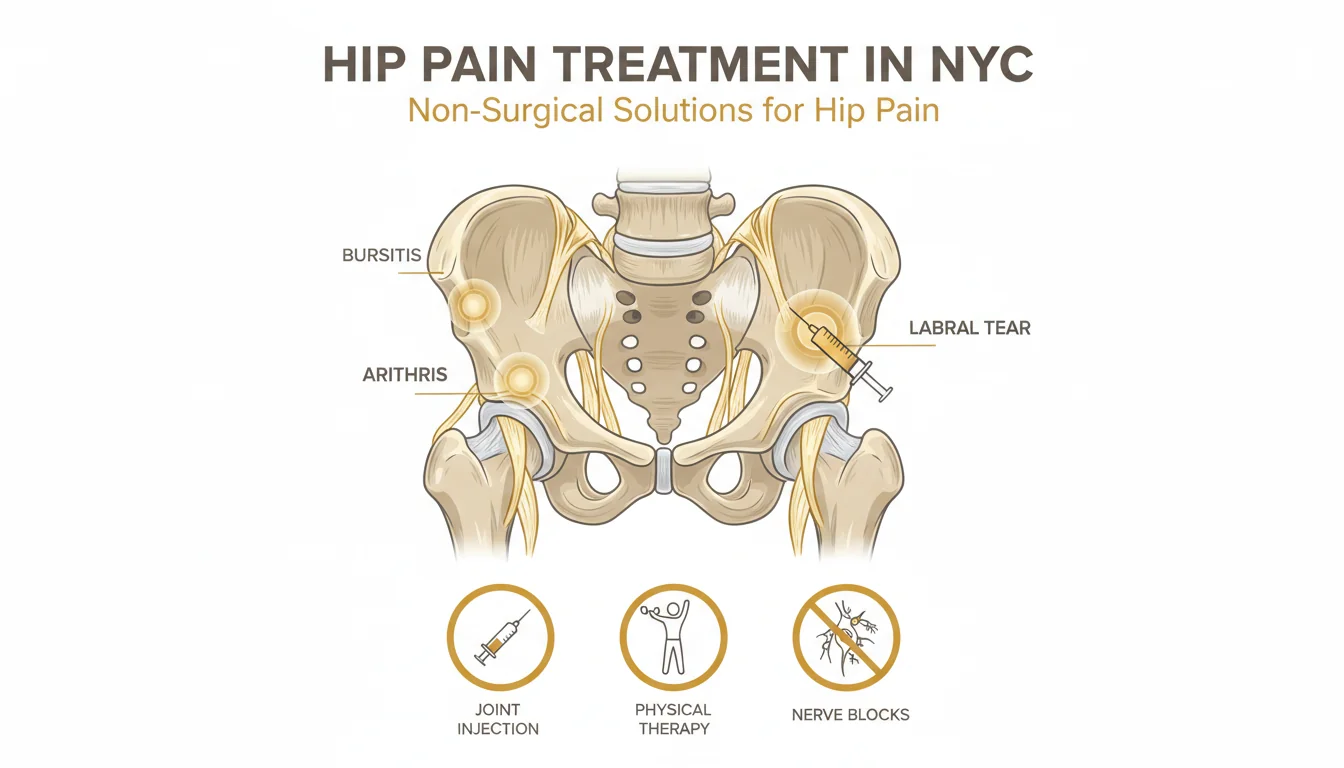
The hip is a ball-and-socket synovial joint formed by the femoral head (the ball) and the acetabulum of the pelvis (the socket). Both surfaces are covered with hyaline cartilage that distributes load, allows nearly frictionless motion, and absorbs the substantial forces transmitted through the hip during walking, running, and stair-climbing. The acetabular labrum — a fibrocartilaginous ring around the rim of the socket — increases joint stability and seals synovial fluid into the joint. The hip capsule, reinforced by the iliofemoral, ischiofemoral, and pubofemoral ligaments, encloses the joint and contains synovial fluid.
In hip osteoarthritis, the hyaline cartilage progressively thins, fissures, and finally wears away, exposing the underlying subchondral bone. As cartilage is lost, the joint space (the gap between the femoral head and acetabulum on X-ray) narrows. Subchondral bone responds by becoming sclerotic, by forming bony osteophytes (spurs) at the joint margins, and by developing subchondral cysts. The synovium becomes inflamed and produces pain-mediating cytokines (Murphy 2016). The capsule thickens and the joint loses range of motion — typically internal rotation first, then flexion and extension, then external rotation. Pain is generated by inflamed synovium, exposed subchondral bone, and an irritated capsule. The capsule’s nerve supply comes mainly from the obturator nerve and the nerve to quadratus femoris, with femoral nerve branches to the front, and it varies a lot from person to person (Tomlinson 2021).
Understanding this anatomy explains why image-guided treatment matters. The intra-articular space is small and sits close to major structures (femoral artery and vein, femoral nerve). Blind landmark injection reached the hip joint in 72% of injections in pooled studies, versus 100% for ultrasound guidance (Hoeber 2016), and the common anterior landmark approach reached the joint in only 60% of cadaver hips (Leopold 2001). Under ultrasound, 97% of needles were confirmed inside the joint by contrast fluoroscopy in one series (Smith 2009). Treatment delivered into the wrong tissue does not work.
Hip Osteoarthritis vs. The Other Causes of Hip and Groin Pain
The single most important step in evaluating hip pain is determining where the pain actually is and what is generating it. The differential diagnosis is wide and the wrong diagnosis leads to the wrong treatment.
Hip osteoarthritis typically produces deep anterior groin pain, mechanical (worse with weight-bearing, better with rest), with morning stiffness, restricted internal rotation on exam, and X-ray findings of joint space narrowing and osteophytes. The C-sign is classic — patients cup the hand around the lateral hip in a C-shape to localize the pain.
Greater trochanteric pain syndrome (hip bursitis / GTPS) produces lateral hip pain over the bony prominence on the outside of the upper thigh, worse lying on the affected side at night, with tenderness on direct palpation. This is gluteus medius and minimus tendinopathy with secondary bursal inflammation — Modal Pain Management treats it on a separate page.
Sacroiliac (SI) joint dysfunction produces deep buttock pain just inferior and medial to the dimples of Venus (the Fortin finger sign), worse with single-leg standing and asymmetric loading, with positive provocative tests (FABER, distraction, compression, thigh thrust). Frequently mislabeled as lumbar disc or hip pain. In a classic block study, the SI joint was the pain source in about 30% of patients with chronic low back pain centered below L5 (Schwarzer 1995).
Piriformis syndrome produces deep buttock pain that worsens with prolonged sitting and may radiate down the back of the leg, mimicking sciatica. Reproduced by the FAIR test.
Femoroacetabular impingement (FAI) and labral tear produces anterior groin pain with mechanical clicking, catching, or locking, classically reproduced by the FADIR test (flexion, adduction, internal rotation), more common in younger active patients (20s–40s) than osteoarthritis. May coexist with early OA.
Iliopsoas tendinitis or bursitis produces anterior groin pain reproduced by resisted hip flexion and direct palpation over the iliopsoas tendon. Often misdiagnosed as hip OA in active middle-aged patients with normal X-rays.
Inflammatory arthritis (rheumatoid, psoriatic, ankylosing spondylitis, reactive) produces hip pain with morning stiffness lasting more than 60 minutes, sometimes bilateral, with elevated inflammatory markers (ESR, CRP) and additional joint involvement. Requires rheumatology co-management.
Avascular necrosis (AVN) of the femoral head produces sudden or rapidly progressive groin pain in patients with risk factors (corticosteroid use, alcohol use, sickle cell disease, prior hip trauma, lupus). MRI is the test of choice — X-ray is normal in early disease.
Inguinal or sports hernia, adductor tendinopathy, and lumbar L3–L4 radiculopathy can all refer pain to the anterior hip and groin and must be considered.
Septic arthritis and fracture are emergencies that must be ruled out in the right clinical context (acute severe pain, fever, inability to bear weight). Metastatic malignancy must be ruled out promptly in a patient with a history of cancer and new hip pain.
The diagnostic workup at Modal Pain Management addresses each of these in a structured order so the right diagnosis drives the right treatment.
How Hip Osteoarthritis Is Diagnosed
The diagnosis of hip osteoarthritis is made by combining a structured history, a focused physical examination, targeted imaging, and — when needed — a diagnostic intra-articular injection.
The history asks about pain location (anterior groin is most specific for hip OA), pain character (deep mechanical ache rather than sharp shock), mechanical triggers (weight-bearing, stairs, getting up from low chairs), morning stiffness duration (usually under an hour in OA, while longer stiffness raises concern for inflammatory arthritis), prior hip injury or surgery, family history of joint replacement, occupational and recreational loading, and red flags (acute onset without trauma, fever, weight loss, history of cancer).
The physical examination systematically tests range of motion (internal rotation is the most sensitive early finding — restricted long before flexion or extension), provocative tests (FADIR for impingement and labral pathology, FABER for hip and SI joint, Stinchfield resisted-hip-flexion for iliopsoas), gait analysis (antalgic gait, Trendelenburg sign), muscle strength (hip abductors, flexors, extensors), neurovascular exam, and palpation of the trochanter, SI joint, and lumbar spine to address the differential.
Imaging begins with weight-bearing AP pelvis and frog-lateral hip X-rays — the standard initial workup that demonstrates joint space narrowing, osteophytes, subchondral sclerosis, subchondral cysts, and the Kellgren-Lawrence grade. MRI is reserved for cases where the X-ray does not match the clinical picture, where labral pathology, AVN, or stress fracture is suspected, or where surgical planning requires soft-tissue detail. High-resolution musculoskeletal ultrasound at the bedside during the consultation visit is increasingly valuable — it visualizes effusion, synovitis, dynamic impingement, iliopsoas tendinopathy, and guides therapeutic injection.
When clinical and imaging findings are mixed (early X-ray changes plus differential considerations), a diagnostic image-guided intra-articular hip injection with local anesthetic (with or without corticosteroid) is the reference test. Substantial pain relief during the anesthetic window makes the hip joint the likely main pain generator. This step changes management for many patients with confusing pictures.
The Image-Guided Treatment Ladder for Hip Osteoarthritis
Modal Pain Management uses a structured, evidence-based, image-guided ladder for hip osteoarthritis that is tailored to your disease stage, functional impairment, prior treatments, and goals.
Step 1 — Foundation: weight management plus structured physical therapy. The 2019 American College of Rheumatology/Arthritis Foundation guideline strongly recommends exercise for hip OA, and weight loss for people who are overweight (Kolasinski 2020). In a Cochrane review of hip OA trials, land-based exercise reduced pain and improved function, and the benefit lasted at least three to six months after supervised treatment ended (Fransen 2014). Structured physical therapy emphasizes hip abductor and core strengthening (the gluteus medius and minimus are the workhorses of pelvic stability), targeted range-of-motion work (especially internal rotation), gait retraining, and aquatic exercise for patients who cannot tolerate land-based loading. This foundation continues at every subsequent step on the ladder.
Step 2 — Image-guided intra-articular corticosteroid injection for fast flare control and to confirm the hip joint as the pain generator. Performed under fluoroscopic or ultrasound guidance, the injection delivers a corticosteroid-anesthetic mixture into the joint. In a placebo-controlled trial, 68% of steroid patients had at least a 20% pain improvement at 2 months versus 24% with placebo, and 58% versus 10% at 3 months (Lambert 2007). In another trial, benefit appeared within the first week (Atchia 2011). Injections are spaced at least 3 months apart and kept to the fewest that work, because repeated steroid exposure has been linked to faster cartilage loss in the knee (McAlindon 2017) and, uncommonly, to rapid joint damage after hip and knee injections (Kompel 2019). How often an injection can be repeated also depends on your plan’s rules.
Step 3 — Platelet-rich plasma (PRP) for selected patients who want to try it. Hyaluronic acid (gel) is not offered for the hip, because hip trials have not shown a reliable benefit over placebo injection (Leite 2018) and the 2019 American College of Rheumatology/Arthritis Foundation guideline strongly recommends against it for hip OA (Kolasinski 2020). Image-guided intra-articular PRP has weak evidence in the hip. In the main randomized trial, PRP improved pain and function from baseline but was no better than hyaluronic acid at 12 months (Battaglia 2013), a pooled analysis of hip trials found no difference between the two (Garcia 2020), and the supportive Sánchez series had no control group (Sánchez 2012). The American College of Rheumatology and OARSI both recommend against PRP for hip OA (Kolasinski 2020, Bannuru 2019). Most insurers do not cover it. PRP is typically delivered as a series of 2–3 injections spaced 2–4 weeks apart.
Step 4 — Surgical referral for total hip arthroplasty. Modal Pain Management refers patients to NYC-based orthopedic surgeons when severe daily pain limits function despite the steps above, when X-ray demonstrates Kellgren-Lawrence grade 3 or 4 disease, when night pain disrupts sleep, and when the patient is a reasonable surgical candidate. Modern total hip replacement is one of the most successful operations in medicine, with substantial pain and function gains in well-selected patients and implants that last for decades in many of them (Evans 2019). The role of pain management is to make sure that decision is being made for the right reasons and at the right time — not by default.
In parallel, patients with red flags or features suggesting inflammatory arthritis are referred for rheumatology workup, patients with suspected AVN or labral pathology get appropriate MRI and orthopedic consultation, patients with red flags suggesting septic arthritis or fracture are told to call 911 or go to the nearest emergency room, and patients with a history of cancer and new hip pain get prompt evaluation and imaging.
Physical Therapy and Self-Care for Hip Osteoarthritis
Image-guided injection works best when paired with a structured exercise program. Exercise is the part of hip OA care with the most consistent evidence (Fransen 2014), and an injection is most useful as a window that makes the exercise possible. The core elements:
- Hip abductor strengthening — clamshells, side-lying leg lifts, banded lateral walks, single-leg bridges. The gluteus medius and minimus are the primary stabilizers of the pelvis during single-leg stance and are commonly weak in hip OA.
- Core and hip extensor work — bridges, dead bugs, bird dogs, modified planks. Pelvic stability reduces the asymmetric loading that worsens hip arthritis.
- Range-of-motion and stretching — gentle hip flexor stretches, internal rotation work in supine, supervised yoga or Pilates with appropriate modifications.
- Aquatic exercise — pool walking and aquatic therapy take much of the body’s weight off the joint, more in deeper water, and suit patients who cannot tolerate land-based work.
- Stationary cycling — low-impact cardiovascular conditioning that maintains hip range of motion without high joint load. Recumbent or upright bicycle, both work.
Self-care measures that consistently help: weight management (single most impactful), supportive footwear with cushioning, limiting deep flexion postures (low chairs, deep recliners, long airline flights), sleeping with a pillow between the knees on the unaffected side, a cane or walking poles during flares, and avoiding sudden increases in walking volume. Modal Pain Management coordinates these elements at the consultation visit.
When Hip Pain Is an Emergency
Most hip osteoarthritis is managed in the outpatient setting on the timeline of weeks. Certain presentations are emergencies and warrant immediate evaluation in the emergency department, not in the office:
- Acute severe hip pain with fever, chills, or recent infection — septic arthritis is a surgical emergency.
- Inability to bear weight on the leg after a fall or trauma — femoral neck or acetabular fracture must be ruled out, especially in older adults.
- Acute, severe groin pain in a patient on long-term corticosteroids, with sickle cell disease, or with heavy alcohol use — avascular necrosis of the femoral head can present this way and requires urgent MRI.
- New leg weakness, numbness, or loss of bowel or bladder control with hip and back pain — cauda equina syndrome requires emergency MRI and neurosurgical consultation.
If any of these apply, call 911 or go to the nearest emergency room first. New hip pain in a patient with a history of cancer needs prompt evaluation by a doctor and imaging to rule out spread to the bone. Call 911 or go to the nearest emergency room only if severe symptoms come with it: severe or rapidly worsening pain, new weakness or numbness in the legs, numbness in the groin or inner thighs, new trouble controlling bladder or bowels, or fever. Modal Pain Management is the right setting for non-emergency, structured hip osteoarthritis evaluation and treatment.
Why Modal Pain Management for Hip Osteoarthritis
Modal Pain Management treats hip osteoarthritis with the approach described above: image-guided diagnosis, image-guided therapy with the evidence for each option laid out plainly, structured physical therapy, and a clear referral pathway for surgical and rheumatology cases. Dr. Alex Movshis is a board-certified pain management physician based at 369 Lexington Avenue in Midtown Manhattan, with same-week consultations, most commercial PPO plans accepted, and image-guided procedures performed in-office under fluoroscopic or ultrasound guidance. The first visit takes 45–60 minutes and may include an ultrasound exam. Most patients leave it with a clear diagnosis and a written treatment plan, and most procedures are scheduled within 1–2 weeks. The goal is not to put off surgery for the sake of putting off surgery — it is to make sure that every patient with hip arthritis has had a fair shot at the high-quality non-surgical options that exist before going to the operating room.
References
- Murphy NJ, Eyles JP, Hunter DJ. Hip Osteoarthritis: Etiopathogenesis and Implications for Management. Adv Ther. 2016;33(11):1921–1946. doi:10.1007/s12325-016-0409-3 · PubMed
- Bannuru RR, Osani MC, Vaysbrot EE, et al. OARSI guidelines for the non-surgical management of knee, hip, and polyarticular osteoarthritis. Osteoarthritis Cartilage. 2019;27(11):1578–1589. doi:10.1016/j.joca.2019.06.011 · PubMed
- Kolasinski SL, Neogi T, Hochberg MC, et al. 2019 American College of Rheumatology/Arthritis Foundation Guideline for the Management of Osteoarthritis of the Hand, Hip, and Knee. Arthritis Rheumatol. 2020;72(2):220–233. doi:10.1002/art.41142 · PubMed
- Fransen M, McConnell S, Hernandez-Molina G, Reichenbach S. Exercise for osteoarthritis of the hip. Cochrane Database Syst Rev. 2014;2014(4):CD007912. doi:10.1002/14651858.CD007912.pub2 · PubMed
- Lambert RG, Hutchings EJ, Grace MG, Jhangri GS, Conner-Spady B, Maksymowych WP. Steroid injection for osteoarthritis of the hip: a randomized, double-blind, placebo-controlled trial. Arthritis Rheum. 2007;56(7):2278–87. doi:10.1002/art.22739 · PubMed
- Atchia I, Kane D, Reed MR, Isaacs JD, Birrell F. Efficacy of a single ultrasound-guided injection for the treatment of hip osteoarthritis. Ann Rheum Dis. 2011;70(1):110–6. doi:10.1136/ard.2009.127183 · PubMed
- Smith J, Hurdle MF, Weingarten TN. Accuracy of sonographically guided intra-articular injections in the native adult hip. J Ultrasound Med. 2009;28(3):329–35. doi:10.7863/jum.2009.28.3.329 · PubMed
- Leopold SS, Battista V, Oliverio JA. Safety and efficacy of intraarticular hip injection using anatomic landmarks. Clin Orthop Relat Res. 2001;(391):192–197. doi:10.1097/00003086-200110000-00021 · PubMed
- Leite VF, Daud Amadera JE, Buehler AM. Viscosupplementation for Hip Osteoarthritis: A Systematic Review and Meta-Analysis of the Efficacy on Pain and Disability, and the Occurrence of Adverse Events. Arch Phys Med Rehabil. 2018;99(3):574–583.e1. doi:10.1016/j.apmr.2017.07.010 · PubMed
- Battaglia M, Guaraldi F, Vannini F, et al. Efficacy of ultrasound-guided intra-articular injections of platelet-rich plasma versus hyaluronic acid for hip osteoarthritis. Orthopedics. 2013;36(12):e1501–8. doi:10.3928/01477447-20131120-13 · PubMed
- Sánchez M, Guadilla J, Fiz N, Andia I. Ultrasound-guided platelet-rich plasma injections for the treatment of osteoarthritis of the hip. Rheumatology (Oxford). 2012;51(1):144–50. doi:10.1093/rheumatology/ker303 · PubMed
- Garcia FL, Williams BT, Polce EM, et al. Preparation Methods and Clinical Outcomes of Platelet-Rich Plasma for Intra-articular Hip Disorders: A Systematic Review and Meta-analysis of Randomized Clinical Trials. Orthop J Sports Med. 2020;8(10):2325967120960414. doi:10.1177/2325967120960414 · PubMed
- Kompel AJ, Roemer FW, Murakami AM, Diaz LE, Crema MD, Guermazi A. Intra-articular Corticosteroid Injections in the Hip and Knee: Perhaps Not as Safe as We Thought? Radiology. 2019;293(3):656–663. doi:10.1148/radiol.2019190341 · PubMed
- McAlindon TE, LaValley MP, Harvey WF, et al. Effect of Intra-articular Triamcinolone vs Saline on Knee Cartilage Volume and Pain in Patients With Knee Osteoarthritis: A Randomized Clinical Trial. JAMA. 2017;317(19):1967–1975. doi:10.1001/jama.2017.5283 · PubMed
- Evans JT, Evans JP, Walker RW, Blom AW, Whitehouse MR, Sayers A. How long does a hip replacement last? A systematic review and meta-analysis of case series and national registry reports with more than 15 years of follow-up. Lancet. 2019;393(10172):647–654. doi:10.1016/S0140-6736(18)31665-9 · PubMed
- Schwarzer AC, Aprill CN, Bogduk N. The sacroiliac joint in chronic low back pain. Spine (Phila Pa 1976). 1995;20(1):31–7. doi:10.1097/00007632-199501000-00007 · PubMed
- Hoeber S, Aly AR, Ashworth N, Rajasekaran S. Ultrasound-guided hip joint injections are more accurate than landmark-guided injections: a systematic review and meta-analysis. Br J Sports Med. 2016;50(7):392–396. doi:10.1136/bjsports-2014-094570 · PubMed
- Tomlinson J, Ondruschka B, Prietzel T, Zwirner J, Hammer N. A systematic review and meta-analysis of the hip capsule innervation and its clinical implications. Sci Rep. 2021;11(1):5299. doi:10.1038/s41598-021-84345-z · PubMed