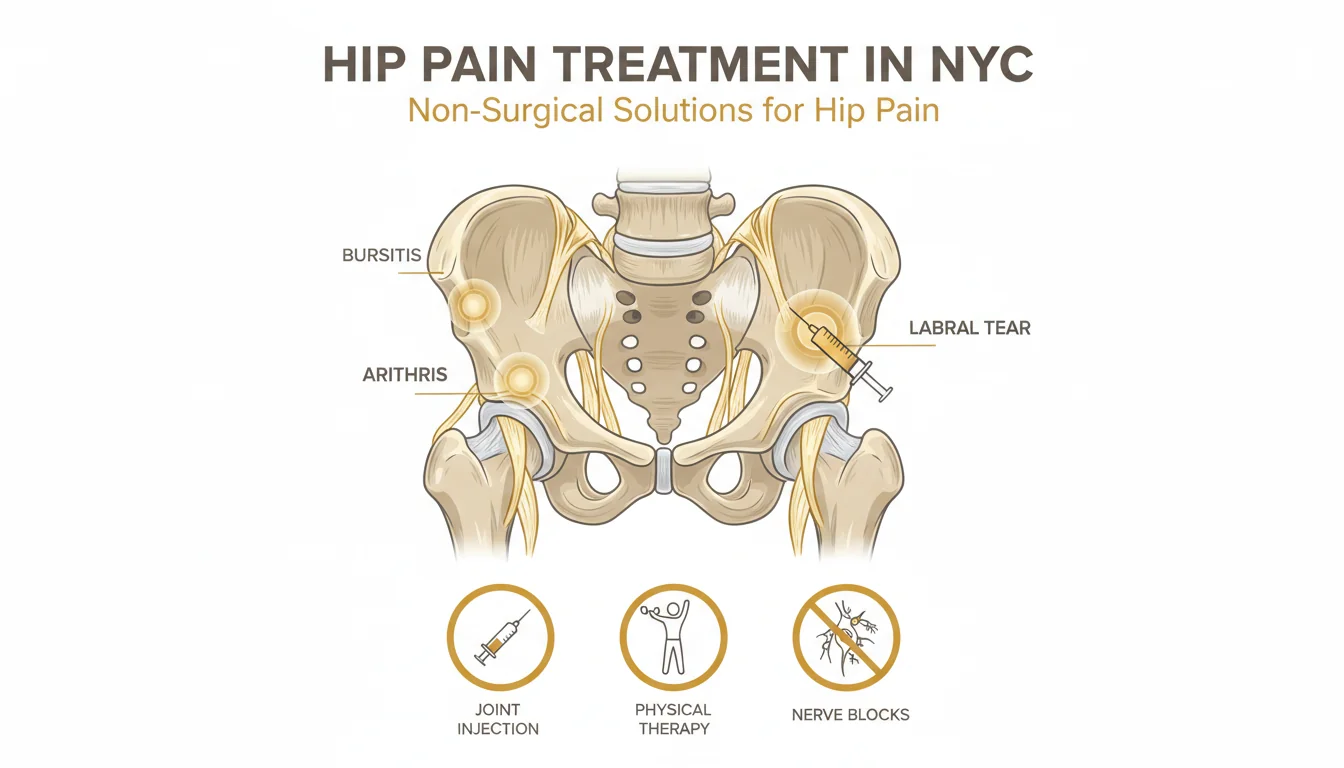
At Modal Pain Management in Midtown Manhattan, Dr. Alex Movshis performs image-guided hip joint injections, both to test whether the hip joint is the source of pain and to treat it, for hip osteoarthritis, femoroacetabular impingement, acetabular labral tears, and inflammatory hip arthritis. Hip joint pain is one of the most commonly confused musculoskeletal presentations — lumbar radiculopathy, sacroiliac joint dysfunction, trochanteric bursitis, and iliopsoas pathology all produce overlapping pain patterns, and X-rays alone cannot settle the question: in two large U.S. cohorts, most hips with frequent pain showed no radiographic osteoarthritis, and most hips with radiographic osteoarthritis were not frequently painful (Kim 2015). Image-guided injection — performed under live fluoroscopic or ultrasound guidance, with contrast confirmation of intra-articular placement under fluoroscopy — is the most reliable way both to test whether the hip joint is the pain source and to deliver medication directly into the joint. Located at 369 Lexington Avenue Floor 25 in NYC 10017, we perform every hip injection under image guidance, which the 2019 American College of Rheumatology/Arthritis Foundation osteoarthritis guideline strongly recommends for the hip (Kolasinski 2020).
The Hip Joint and Why It Hurts
The hip joint is a large ball-and-socket synovial joint formed by the femoral head (the ball, the spherical upper end of the thigh bone) and the acetabulum (the socket, the cup-shaped cavity in the pelvis). The articular surfaces are covered with hyaline cartilage, the joint is lined with a synovial membrane that produces joint fluid, and the joint edge is rimmed by the acetabular labrum, a fibrocartilaginous ring that deepens the socket, increases contact area, and contributes to the joint’s stability and suction-seal mechanics. The joint capsule is dense and heavily innervated, and the surrounding muscles — the gluteal group, the iliopsoas, the adductors, and the deep hip rotators — produce the powerful movements of the hip.
Hip joint pain arises from several overlapping pathologies:
Hip osteoarthritis is the most common indication for image-guided hip injection. Progressive loss of articular cartilage exposes subchondral bone, triggers synovial inflammation, and produces the characteristic pattern of groin pain, anterior thigh pain, and reduced hip internal rotation that defines symptomatic hip OA. In a population study of adults 45 and older in North Carolina, 28% had radiographic hip OA and nearly 10% had symptomatic hip OA (Jordan 2009).
Femoroacetabular impingement (FAI) — an abnormal contact between the femoral head-neck junction and the acetabular rim during hip motion, produced by a cam-type deformity on the femur, a pincer-type overhang on the acetabulum, or both — is an increasingly recognized cause of hip pain in younger, active adults and is linked to earlier hip osteoarthritis in some people. FAI produces pain with deep flexion and internal rotation (the FADIR-positive pattern) and often damages the acetabular labrum over time.
Acetabular labral tears — tears of the fibrocartilaginous ring at the socket edge — produce catching or clicking sensations, groin pain with pivoting, and pain with deep hip flexion. Labral tears are frequently associated with FAI. Image-guided intra-articular injection is an important diagnostic tool when the labral tear’s clinical relevance is uncertain (relief during the anesthetic window makes the joint itself the likely source, rather than structures outside it or pain referred from elsewhere). For more detail on the underlying condition, see our hip labral tear page.
Inflammatory arthritis — rheumatoid arthritis, psoriatic arthritis, ankylosing spondylitis-related hip involvement — produces true synovitis of the hip and often responds well to intra-articular corticosteroid as a local adjunct to systemic disease-modifying therapy.
Post-traumatic hip pain — chronic pain after a hip fracture, hip dislocation, or acetabular injury — is a less common but clinically important indication, particularly for patients who have completed orthopedic recovery and have residual mechanical hip pain.
Clinical Evaluation Before Injection
At the consultation visit, Dr. Movshis performs a structured clinical evaluation designed to judge whether the hip joint is the dominant pain source and to characterize the underlying pathology. The evaluation includes:
A pain history that specifically probes for the C-sign (patients cupping the lateral hip with a C-shaped hand, pointing to both groin and lateral pain), pain with weight-bearing, pain with stairs and getting in and out of a car, pain with pivoting, and the functional impact on sleep, work, and daily activity.
A structured physical examination: range of motion testing for the hip (reduced internal rotation is one of the classic examination findings in hip OA), the FABER test (hip flexion, abduction, external rotation in a figure-four position), the FADIR test (flexion, adduction, internal rotation — positive in FAI and labral pathology), Stinchfield resisted hip flexion (positive in intra-articular pathology), single-leg stance and Trendelenburg test for gluteal function, and a lumbar spine and sacroiliac joint screen to rule out referred pain.
A structured review of imaging: weight-bearing anteroposterior pelvis radiograph and a lateral hip view are the minimum required imaging for any patient being considered for hip injection. MRI is indicated when labral pathology, avascular necrosis, or stress fracture is suspected. CT can be useful for surgical planning in FAI but is less commonly needed for injection decisions.
When the clinical picture supports the hip joint as the dominant pain source, and when conservative measures (physical therapy focused on hip abductor strengthening, oral anti-inflammatories, activity modification) have been attempted without adequate relief, image-guided hip injection is the appropriate next step.
How the Procedure Works
The image-guided hip joint injection is performed in our in-office procedure suite under sterile conditions. The patient is positioned supine (face up) on the procedure table with the affected leg slightly internally rotated — a position that opens the anterior hip capsule and facilitates needle access.
Under live fluoroscopic guidance, a small-gauge spinal needle (typically 22 gauge, 3.5 inches) is advanced through an anterior or anterolateral approach to the femoral head–neck junction, where the anterior capsule attaches. Fluoroscopic confirmation of the bony landmark is performed, 0.5–1 mL of iodinated contrast is injected, and the characteristic intra-articular arthrogram — contrast outlining the femoral head-neck junction and the acetabular recesses — confirms correct placement.
Under ultrasound guidance, the needle is visualized in real time as it advances through the skin and soft tissue to the anterior hip capsule, and intra-articular placement is confirmed by direct visualization of the needle tip within the capsule and observation of the injectate distributing along the femoral neck. Ultrasound-guided hip injection accuracy in experienced hands is well-documented: 97% of needles were confirmed intra-articular by contrast fluoroscopy in Smith 2009, and a meta-analysis pooled ultrasound-guided accuracy at 100% versus 72% for landmark-guided injection (Hoeber 2016).
Once intra-articular placement is confirmed, the therapeutic injectate is slowly delivered. The volume and composition depend on the specific indication:
For corticosteroid injection: typically 1–2 mL of 0.5% bupivacaine (long-acting local anesthetic) mixed with 40–80 mg of triamcinolone or an equivalent long-acting corticosteroid. The local anesthetic provides the diagnostic window (several hours), and the corticosteroid provides the 6–12 week therapeutic effect.
Hyaluronic acid (gel) is not injected into the hip at Modal Pain, because hip trials have not shown a reliable benefit over placebo injection (Leite 2018).
For platelet-rich plasma (PRP): the patient’s own blood is drawn at the beginning of the visit, processed in a centrifuge to concentrate platelets 3–8 fold, and the resulting PRP is injected intra-articularly. PRP for hip OA has weak evidence (in trials it was no better than hyaluronic acid) and is generally self-pay. See our full PRP therapy page.
The total procedure time is 15–25 minutes from skin prep to completion. After the injection, the patient is observed for 15–20 minutes in the recovery area, given a structured pain diary, and discharged with post-procedure instructions.
The Evidence Base
The evidence supporting image-guided corticosteroid hip injection for symptomatic hip osteoarthritis is well-established, though modest in effect size when compared across randomized controlled trials. The 2019 American College of Rheumatology/Arthritis Foundation guideline strongly recommends intra-articular corticosteroid injection for hip OA (Kolasinski 2020). The 2019 OARSI guidelines reached a different conclusion and did not recommend intra-articular corticosteroid for hip OA. Placebo-controlled randomized trials (Lambert 2007, Atchia 2011) have shown clinically meaningful pain reduction over 8–12 weeks. In Lambert’s fluoroscopically guided trial, 68% of steroid patients had at least a 20% pain improvement at 2 months versus 24% with placebo, and 58% versus 10% at 3 months. An earlier open study found relief lasting up to 12 weeks but largely gone by 26 weeks (Plant 1997).
The evidence for hyaluronic acid viscosupplementation of the hip is weaker than the analogous evidence for the knee and more inconsistent across studies. The 2018 Leite meta-analysis found no reliable benefit over placebo injection and recommended against hip viscosupplementation, and the 2019 American College of Rheumatology/Arthritis Foundation guideline strongly recommends against hyaluronic acid injection for hip OA (Kolasinski 2020). For that reason Dr. Movshis does not offer it for the hip. Gel is used in the knee only.
The evidence for platelet-rich plasma (PRP) for hip OA is still emerging. Randomized trials have mostly compared PRP with hyaluronic acid and found broadly similar results (Battaglia 2013), and the 2019 American College of Rheumatology/Arthritis Foundation guideline recommends against PRP for hip OA, citing the lack of standardized preparations (Kolasinski 2020). The hip trial base is also much smaller than the knee trial base. For PRP in other settings, including lateral epicondylitis, see the PRP therapy page for a full evidence discussion.
The evidence for accuracy of image-guided versus blind hip injection is settled. Landmark-guided (blind) hip injection reached the joint in 72% of injections in pooled studies, versus 100% for ultrasound guidance (Hoeber 2016), and the common anterior landmark approach succeeded in only 60% of cadaver hips (Leopold 2001). The 2019 American College of Rheumatology/Arthritis Foundation guideline strongly recommends image guidance for hip injections (Kolasinski 2020).
The concern about steroid-induced cartilage effects and accelerated OA (Kompel 2019, McAlindon 2017 studies) is a real signal in the literature. The effect size is modest, causality is debated, and the practical implication is a spacing rule that is not based on trial evidence (Uson 2021): at Modal Pain, corticosteroid injections into the same hip are spaced at least 3 months apart — not to avoid steroid injection altogether, which would deprive patients of a meaningful symptomatic tool.
Who Is a Good Candidate — and Who Isn’t
The strongest candidates for image-guided hip joint injection are:
- people with symptomatic hip osteoarthritis on X-ray whose pain has not responded to 6–12 weeks of physical therapy and conservative care
- people with femoroacetabular impingement and acetabular labral pathology in whom the hip joint’s share of the pain is uncertain. Here the injection is mainly diagnostic, because steroid relief in FAI and labral tears without arthritis is usually short, averaging about 10 days in one series (Krych 2014)
- people with inflammatory hip arthritis, where the injection is a local adjunct to systemic disease-modifying therapy
- people who are not surgical candidates for hip replacement because of medical conditions, age or preference
- people who want to delay hip replacement while keeping enough function for work, exercise and daily life
The procedure is not the right first-line treatment for:
- suspected septic hip arthritis, a surgical emergency
- active skin infection over the injection site
- pain that comes mainly from the lumbar spine, the sacroiliac joint or the trochanteric bursa, where those structures need their own workup first
- acute hip fracture
- metal implant artifact that prevents reliable image guidance
- blood thinning that is not under control
Comparison: Hip Injection vs. Other Hip Pain Treatments
Compared to oral anti-inflammatory medications and analgesics: NSAIDs and acetaminophen give modest pain reduction but carry cumulative stomach, heart and kidney risks with long-term use, and long-term opioids carry tolerance, dependence and overdose risks. A single image-guided steroid injection delivers medication to the joint without daily systemic drug exposure.
Compared to physical therapy alone: targeted physical therapy (hip abductor strengthening, core stabilization, hip internal rotation mobility work) is the foundational long-term management and should continue regardless of whether injections are performed. Injection and PT are complementary: the injection reduces pain to a level that enables productive PT, and the PT addresses the mechanical contributors that drive ongoing joint loading.
Compared to hyaluronic acid viscosupplementation: corticosteroid has the stronger evidence base in hip OA, with benefit seen within the first week in trials (Atchia 2011), and it is far more consistently covered by insurance. Hip HA has not shown a reliable benefit over placebo (Leite 2018), and Modal Pain does not offer it for the hip.
Compared to platelet-rich plasma (PRP): PRP aims at biologic tissue support (growth factors to the cartilage and soft tissue) rather than inflammation reduction. It is generally self-pay, and hip trials have mostly compared it with hyaluronic acid and found similar results (Battaglia 2013). PRP is reasonable to discuss in patients with early-to-moderate hip OA who want to trial a biologic option.
Compared to hip arthroscopy: hip arthroscopy is a minimally invasive surgical procedure used to treat labral tears, cam-type femoral neck deformity in FAI, and loose bodies. It is appropriate for patients with mechanical symptoms (true catching, locking), significant FAI morphology on imaging, and failure of non-surgical options. Hip arthroscopy is not an alternative to injection — the two address different problems — but many arthroscopy candidates have also failed injection as part of the workup.
Compared to total hip arthroplasty (hip replacement): THA is the standard surgical treatment for end-stage hip OA. It produces excellent pain relief and functional improvement, with about 89% of implants still in place at 15 years in registry data (Evans 2019), at the cost of surgical risk, a 6–12 week recovery, and a one-time procedure with finite implant lifespan. Image-guided hip injection is a non-surgical option appropriate for earlier disease, for patients who want to delay THA, and for patients who are not surgical candidates. The two are sequential, not competing, options.
What to Expect: The Patient Pathway
The full pathway from initial consultation to therapeutic hip injection at Modal Pain Management typically runs 2 to 4 weeks for a new patient.
Initial consultation visit (45–60 minutes, which may include an ultrasound exam). Dr. Movshis reviews your hip history, prior imaging, prior treatments, and medical context. A structured physical examination — including the FABER, FADIR, Stinchfield resisted flexion, Trendelenburg, and hip range-of-motion testing — points to the hip as the pain source and screens for referred pain from the lumbar spine and SI joint. Imaging is reviewed. The diagnostic plan, the specific injectate (corticosteroid or PRP), expected response rates, alternatives, and cost/insurance picture are discussed in plain language.
Insurance authorization (7–14 business days). Our team submits prior authorization documenting conservative care, exam findings, and imaging.
Image-guided hip injection (15–25 minute procedure). Performed in our Midtown NYC office under live fluoroscopic or ultrasound guidance, usually without sedation. If you want sedation, the injection is done at a surgical center. You drive home after a 15–20 minute observation period.
Follow-up visit (15 minutes, 2–3 weeks after the injection). The pain diary is reviewed, the response objectively measured, and the long-term plan updated.
Ongoing management. Most patients combine intermittent injections with a sustained physical therapy program. When response shortens or disease progresses, the plan escalates to alternative injectates or to orthopedic surgical consultation.
Recovery, Activity, and Return to Function
Most patients walk out of the office, resume desk work the next day, and are back to normal activity within a day or two. The day-by-day instructions, including steroid flares, exercise by joint, blood sugar in diabetes, and when to judge the result, are on the cortisone and gel injection aftercare page.
Many patients use the post-injection pain reduction as an opportunity to re-engage with physical therapy — particularly gluteus medius strengthening, which is often difficult to sustain when pain is severe.
Insurance, Authorization, and Practical Logistics
Most commercial PPO plans cover image-guided corticosteroid hip joint injection when the clinical workup supports hip pathology and conservative care has been documented. PRP is generally self-pay.
Modal Pain Management accepts most commercial PPO plans, including Aetna, Anthem Blue Cross Blue Shield, Cigna, Empire Blue Cross Blue Shield, the Empire Plan, Oscar, Oxford, UMR and UnitedHealthcare, and does not accept Medicare, Medicaid, HMO plans, or workers’ compensation. We verify benefits and provide a written estimate before the procedure. Check accepted plans or call (646) 290-6660.
Why Patients Choose Modal Pain Management for Hip Injections
Dr. Alex Movshis is board-certified by the American Board of Anesthesiology in both anesthesiology and pain medicine and completed his pain medicine fellowship at Mount Sinai. He performs all hip joint injections under live fluoroscopic or ultrasound guidance, with contrast confirmation when fluoroscopy is used. We select the imaging modality and the injectate based on the individual clinical picture, the published evidence, and insurance coverage — corticosteroid for inflammatory and acute presentations, and PRP for patients who want to try it despite weak evidence. Hyaluronic acid is not used in the hip.
Our Midtown NYC office at 369 Lexington Avenue Floor 25 is one block from Grand Central Terminal. Same-week consultation appointments for new patients are typically available.
If you have groin or anterior thigh pain worse with weight-bearing and stairs, reduced hip range of motion, radiographic hip osteoarthritis that has not responded to conservative care, femoroacetabular impingement or a labral tear with uncertain symptomatic contribution, or persistent hip pain after physical therapy — image-guided hip joint injection may be the right next step. Learn more about the underlying conditions on our hip osteoarthritis and hip labral tear pages, or book a consultation to discuss whether you are a candidate.
References
- Bannuru RR, Osani MC, Vaysbrot EE, et al. OARSI guidelines for the non-surgical management of knee, hip, and polyarticular osteoarthritis. Osteoarthritis Cartilage. 2019;27(11):1578–1589. doi:10.1016/j.joca.2019.06.011 · PubMed
- Smith J, Hurdle MF, Weingarten TN. Accuracy of sonographically guided intra-articular injections in the native adult hip. J Ultrasound Med. 2009;28(3):329–35. doi:10.7863/jum.2009.28.3.329 · PubMed
- Lambert RG, Hutchings EJ, Grace MG, Jhangri GS, Conner-Spady B, Maksymowych WP. Steroid injection for osteoarthritis of the hip: a randomized, double-blind, placebo-controlled trial. Arthritis Rheum. 2007;56(7):2278–87. doi:10.1002/art.22739 · PubMed
- Leopold SS, Battista V, Oliverio JA. Safety and efficacy of intraarticular hip injection using anatomic landmarks. Clin Orthop Relat Res. 2001;(391):192–197. doi:10.1097/00003086-200110000-00021 · PubMed
- Atchia I, Kane D, Reed MR, Isaacs JD, Birrell F. Efficacy of a single ultrasound-guided injection for the treatment of hip osteoarthritis. Ann Rheum Dis. 2011;70(1):110–6. doi:10.1136/ard.2009.127183 · PubMed
- Plant MJ, Borg AA, Dziedzic K, Saklatvala J, Dawes PT. Radiographic patterns and response to corticosteroid hip injection. Ann Rheum Dis. 1997;56(8):476–80. doi:10.1136/ard.56.8.476 · PubMed
- Leite VF, Daud Amadera JE, Buehler AM. Viscosupplementation for Hip Osteoarthritis: A Systematic Review and Meta-Analysis of the Efficacy on Pain and Disability, and the Occurrence of Adverse Events. Arch Phys Med Rehabil. 2018;99(3):574–583.e1. doi:10.1016/j.apmr.2017.07.010 · PubMed
- Battaglia M, Guaraldi F, Vannini F, et al. Efficacy of ultrasound-guided intra-articular injections of platelet-rich plasma versus hyaluronic acid for hip osteoarthritis. Orthopedics. 2013;36(12):e1501–8. doi:10.3928/01477447-20131120-13 · PubMed
- Kompel AJ, Roemer FW, Murakami AM, Diaz LE, Crema MD, Guermazi A. Intra-articular Corticosteroid Injections in the Hip and Knee: Perhaps Not as Safe as We Thought? Radiology. 2019;293(3):656–663. doi:10.1148/radiol.2019190341 · PubMed
- McAlindon TE, LaValley MP, Harvey WF, et al. Effect of Intra-articular Triamcinolone vs Saline on Knee Cartilage Volume and Pain in Patients With Knee Osteoarthritis: A Randomized Clinical Trial. JAMA. 2017;317(19):1967–1975. doi:10.1001/jama.2017.5283 · PubMed
- Uson J, Rodriguez-García SC, Castellanos-Moreira R, et al. EULAR recommendations for intra-articular therapies. Ann Rheum Dis. 2021;80(10):1299–1305. doi:10.1136/annrheumdis-2021-220266 · PubMed
- Kolasinski SL, Neogi T, Hochberg MC, et al. 2019 American College of Rheumatology/Arthritis Foundation Guideline for the Management of Osteoarthritis of the Hand, Hip, and Knee. Arthritis Care Res (Hoboken). 2020;72(2):149–162. doi:10.1002/acr.24131 · PubMed
- Hoeber S, Aly AR, Ashworth N, Rajasekaran S. Ultrasound-guided hip joint injections are more accurate than landmark-guided injections: a systematic review and meta-analysis. Br J Sports Med. 2016;50(7):392–396. doi:10.1136/bjsports-2014-094570 · PubMed
- Lesher JM, Dreyfuss P, Hager N, Kaplan M, Furman M. Hip joint pain referral patterns: a descriptive study. Pain Med. 2008;9(1):22–25. doi:10.1111/j.1526-4637.2006.00153.x · PubMed
- Deshmukh AJ, Thakur RR, Goyal A, Klein DA, Ranawat AS, Rodriguez JA. Accuracy of diagnostic injection in differentiating source of atypical hip pain. J Arthroplasty. 2010;25(6 Suppl):129–133. doi:10.1016/j.arth.2010.04.015 · PubMed
- Kim C, Nevitt MC, Niu J, et al. Association of hip pain with radiographic evidence of hip osteoarthritis: diagnostic test study. BMJ. 2015;351:h5983. doi:10.1136/bmj.h5983 · PubMed
- Jordan JM, Helmick CG, Renner JB, et al. Prevalence of hip symptoms and radiographic and symptomatic hip osteoarthritis in African Americans and Caucasians: the Johnston County Osteoarthritis Project. J Rheumatol. 2009;36(4):809–815. doi:10.3899/jrheum.080677 · PubMed
- Lei T, Wang Y, Li M, Hua L. Clinical efficacy of multiple intra-articular injection for hip osteoarthritis. Bone Joint J. 2024;106-B(6):532–539. doi:10.1302/0301-620X.106B6.BJJ-2023-1272.R1 · PubMed
- Krych AJ, Griffith TB, Hudgens JL, Kuzma SA, Sierra RJ, Levy BA. Limited therapeutic benefits of intra-articular cortisone injection for patients with femoro-acetabular impingement and labral tear. Knee Surg Sports Traumatol Arthrosc. 2014;22(4):750–755. doi:10.1007/s00167-014-2862-3 · PubMed
- Graf DN, Thallinger A, Zubler V, Sutter R. Intraarticular Steroid Injection in Hip and Knee with Fluoroscopic Guidance: Reassessing Safety. Radiology. 2022;304(2):363–369. doi:10.1148/radiol.210668 · PubMed
- Evans JT, Evans JP, Walker RW, Blom AW, Whitehouse MR, Sayers A. How long does a hip replacement last? A systematic review and meta-analysis of case series and national registry reports with more than 15 years of follow-up. Lancet. 2019;393(10172):647–654. doi:10.1016/S0140-6736(18)31665-9 · PubMed