When back pain in the 10017 ZIP code isn’t resolving with rest, NSAIDs, or stretching, the next step is a focused consultation with a pain medicine physician. Modal Pain Management, located at 369 Lexington Avenue, Floor 25, is the interventional pain practice in 10017 — two blocks south of Grand Central Terminal, accessible from the 4, 5, 6, 7, and S subway lines plus every Metro-North branch. Dr. Alex Movshis, MD, is dual board-certified by the American Board of Anesthesiology in Anesthesiology and Pain Medicine, and fellowship-trained at the Icahn School of Medicine at Mount Sinai. He sees every patient personally — initial consultation through follow-up — at every visit.
This guide walks through what to expect at a first visit specifically for a 10017-based patient: the conditions a Midtown East pain doctor most commonly evaluates, what to bring, what the visit looks like step by step, the treatment options Dr. Movshis is likely to discuss, and how insurance verification works.
Why 10017 Is a Concentrated Source of Office-Worker Back Pain
The 10017 ZIP code spans Midtown East from roughly 40th to 49th Street, between Lexington Avenue and the East River. It’s one of the densest white-collar workplace ZIPs in the country — Park Avenue commercial corridor, the GE Building, the Chrysler Building footprint, the Pfizer headquarters, the MetLife Building, plus thousands of smaller financial-services, legal, consulting, and tech offices. The dominant patient profile in 10017 is the desk-bound professional with one or more of the following:
- Lumbar facet joint pain from prolonged seated posture. Sitting eight to ten hours daily loads the lumbar facet joints in extension and reduces disc height through the workday. Patients describe a deep ache localized to the lower back, worse after long meetings or long flights, that may or may not radiate.
- Cervical radiculopathy from forward-head posture. Sustained head-forward position over a laptop or dual monitors loads the lower cervical discs (C5–C6, C6–C7). Patients describe neck pain with sharp arm pain, numbness, or tingling along a specific dermatome.
- Lumbar disc herniation, often after a single triggering event. A herniated disc commonly presents in the 30–55 age band — exactly the working population in 10017. The classic story: lifted something awkwardly, picked up a child, returned from a trip, and now there’s leg pain worse than the back pain.
- Sacroiliac joint dysfunction in commuters. Long subway, train, or car commutes plus prolonged sitting at the office create asymmetric SI joint loading. Pain is typically below the belt line, on one side, and often misdiagnosed as “lower back pain” for years.
- Cervicogenic and tension-type headaches. Persistent neck muscle activation drives a meaningful share of chronic headache in this patient population. Many 10017 patients have been treated for migraine without adequate evaluation of the cervical contribution.
A 10017 pain doctor is, in practical terms, an office-population spine and joint specialist. Dr. Movshis sees this profile every day and the diagnostic workup is calibrated for it.
What I Look For on Exam — The Five-Minute Differential
The first ninety seconds of a new-patient visit usually tell me which of five pain generators is driving the case. Each one has a different physical-exam signature, and each one has a different procedural answer. This is the differential I’m running in my head while you’re describing the pain:
Facet joint pain (lumbar zygapophyseal joints). The classic Midtown East presentation. Pain is paramedian — one inch to either side of the spine — not midline. It worsens with extension (leaning back, reaching for an overhead bin, looking up at the Chrysler Building) and improves with flexion (leaning over the keyboard, hugging the knees). On exam I’ll have you arch backward; if that reproduces the pain and a flexion-rotation maneuver doesn’t, the facets are the prime suspect. The diagnostic test is a medial branch block — a tiny, fluoroscopy-guided injection of local anesthetic onto the small nerves that innervate the joint. Two positive blocks in succession confirms the diagnosis and qualifies you for radiofrequency ablation, which gives 8–18 months of relief.
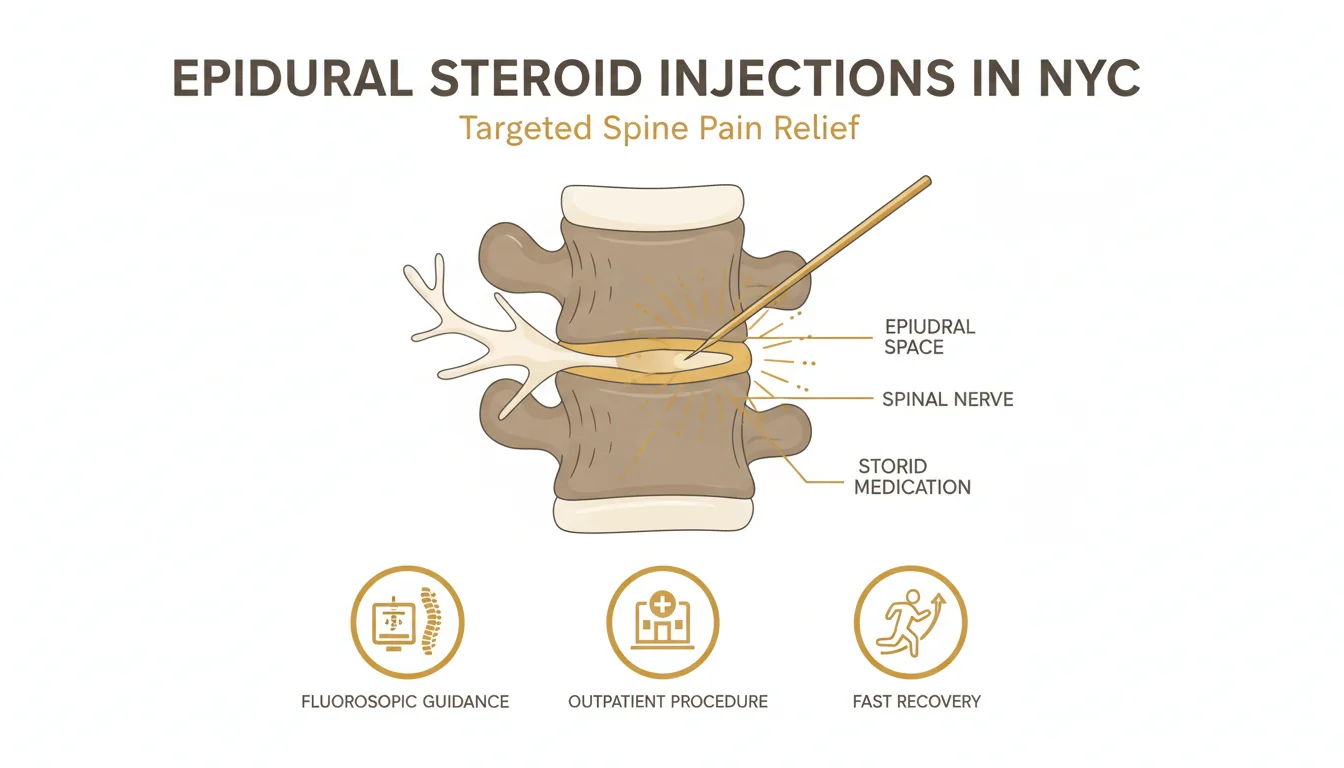
Lumbar disc with radiculopathy. Back pain plus leg pain, with the leg pain often worse than the back pain. Coughing, sneezing, or sitting reliably reproduce the radicular component. On exam, a positive straight-leg raise at 30–60° on the symptomatic side combined with a dermatomal sensory pattern (L4 to the medial foot, L5 to the dorsum of the foot, S1 to the lateral foot) localizes the offending level within one or two interspaces. If the case is acute and conservative care has failed, the procedure is a transforaminal epidural steroid injection at the affected level.
Sacroiliac joint dysfunction. Pain below the belt line, on one side, often pointed to with a single finger over the posterior superior iliac spine — what we call the “Fortin finger sign.” I’ll run three provocation maneuvers (FABER, Gaenslen’s, and thigh thrust); if two or more reproduce the pain, the SI joint goes to the top of the list. A diagnostic SI joint injection under fluoroscopy confirms it. Many patients who present with “low back pain” lasting years are SI patients who were never tested with provocation maneuvers in primary care.
Discogenic pain without radiculopathy. Midline pain that worsens with sitting, prolonged flexion, or driving — and feels marginally better with walking. The MRI shows disc desiccation, Modic changes, or a high-intensity zone, often at L4–L5 or L5–S1. This is the hardest of the five to treat with a single procedure, and the conversation usually involves a combination of physical therapy, an interventional trial, and — when appropriate — discussing the role of regenerative or surgical options.
Myofascial pain (paraspinal and quadratus lumborum). The diagnosis-of-last-resort that’s often actually the diagnosis-of-first-cause. Trigger points in the paraspinal musculature and the quadratus lumborum refer pain into the lower back and gluteal region. On exam, palpating a discrete taut band reproduces the patient’s pain. The therapy is targeted trigger-point injections — usually with a small dose of local anesthetic, sometimes with a Botox-equivalent neuromodulator for refractory cases.
These five account for the overwhelming majority of office-worker back pain I see in 10017. The differential is the work product of the first visit; the procedure is the work product of the follow-up.
What to Bring (and What I Wish More Patients Brought)
The intake email lists the standard items — insurance card, medication list, prior imaging on disc or via patient portal access, prior physician notes. Beyond that, there are three things that meaningfully accelerate the visit:
A one-page symptom timeline, in your own handwriting. Date the pain started. What you were doing. Treatments tried. What helped, what didn’t. Sleep impact. Work impact. This document — not your medical records — is the single most useful artifact a new patient can bring. It frames the visit and prevents the diagnostic loop where the same five questions get asked in five different ways.
The actual MRI on a disc or via the imaging portal, not just the radiologist’s report. Radiology reports describe what’s visible at the level of resolution they document. They routinely omit findings that are clinically relevant — modest foraminal narrowing, asymmetric facet hypertrophy, an early high-intensity zone — that change the treatment plan. I read your imaging myself during the visit. Many large NYC imaging centers (Lenox Hill Radiology, NYU Imaging, RadNet, and the hospital-based PACS systems at Mount Sinai, NewYork-Presbyterian, and NYU Langone) provide patient portal access; obtaining the actual images takes ten minutes online or one phone call.
A list of the medications you’ve actually tried for this episode of pain, with the doses. “Ibuprofen” is not enough. “Ibuprofen 400 mg three times daily for ten days with mild benefit, then meloxicam 15 mg daily for three weeks with no benefit, then a five-day course of methylprednisolone with three days of clear improvement that wore off on day six” — that’s the level of detail that changes the next step. The steroid taper response in that example, by the way, is informative: it suggests inflammation as a driver, which makes an epidural steroid injection a reasonable next move.
What the Visit Actually Looks Like, Minute by Minute
The booking slot is 45–60 minutes. Here is how it tends to unfold:
Minutes 0–10 — focused history. Pain location, character (sharp, deep ache, electric, burning), radiation, modifying factors, prior treatment response. I take handwritten notes. I’m listening for the diagnostic clues that came up in the differential section above.
Minutes 10–25 — physical and neurological examination. Standing examination first: lumbar range of motion, segmental tenderness, observation of gait. Seated: lower-extremity reflexes (patellar, Achilles), strength testing of L4 (tibialis anterior), L5 (extensor hallucis longus), and S1 (gastrocnemius), and dermatomal sensory testing. Supine: straight-leg raise, FABER, slump test if needed. Prone: facet loading, SI provocation, palpation of the paraspinal musculature for trigger points.
Minutes 25–40 — imaging review and synthesis. I bring up your MRI on the monitor, walk through the relevant levels, and tie the findings to the exam. This is where many patients have the most “I finally understand why I hurt” moments — not when looking at a report, but when looking at the actual disc, facet, or foramen on screen with someone pointing to it and explaining the mechanics in plain language.
Minutes 40–55 — diagnosis, treatment plan, written summary. A differential of the most likely pain generator(s), the diagnostic and therapeutic procedures that follow logically, expected response, expected duration, and the conservative measures that run in parallel (physical therapy referral if needed, activity modifications, a medication change). You leave with a printed care plan and a clear next step.
Minutes 55–60 — insurance and scheduling. The front desk verifies in-network status, deductible balance, and any prior-authorization requirements for the recommended procedure, and books the next appointment.
If a procedure is indicated, it is almost always scheduled separately after benefits verification — not done on the same day. We do this to give the prior-authorization process time to clear and to avoid surprise billing.
Questions Worth Asking Me (or Any Pain Specialist)
I’d rather field these in the room than answer them later by phone:
- “What specifically is causing my pain — which structure, which level, which side?” The answer should name an anatomical structure, not “your back.”
- “If we do this injection, what is the probability it helps, and how long is the relief likely to last?” Numbers matter. A diagnostic injection has a different goal than a therapeutic one; they should be distinguished.
- “What does success look like at six weeks, three months, six months?” Specific, measurable, realistic.
- “What is your plan if this doesn’t work?” There should always be a next step.
- “What is the procedure’s role in the broader plan — is this the whole treatment or part of one?” Almost always part of one.
A pain specialist who can’t answer these questions in plain language is one I’d want a second opinion from.
When the Answer Is “Don’t Wait” — Red Flags
A few signs warrant the emergency department, not a routine appointment: new bowel or bladder dysfunction, saddle anesthesia (numbness in the area that would touch a saddle), progressive lower-extremity weakness, fever with back pain, unexplained weight loss with back pain, or back pain with a known history of cancer. These can signal cauda equina syndrome, epidural abscess, vertebral osteomyelitis, or malignancy, and they need imaging the same day.
For the rest — chronic mechanical back pain that hasn’t resolved with conservative care, sciatica that’s been going for weeks, recurrent flares disrupting work and sleep — same-week is the right cadence. Routine, not urgent.
Follow-Up Cadence and What Comes Next
A typical patient course at Modal looks like:
- Visit 1 (consultation). Diagnosis and care plan as described above.
- Visit 2 (first procedure, ~1–3 weeks out). Diagnostic or therapeutic injection, typically under fluoroscopy. 20–30 minutes including positioning. Most patients return to office work the same afternoon.
- Visit 3 (follow-up, 2 weeks post-procedure). Pain-relief assessment, function check, decision on next step (additional procedure, transition to maintenance, referral if indicated).
- Maintenance cadence (every 3–6 months for procedural patients, longer for stable patients). Adjustments to the plan as your situation evolves.
Patients with workplace concerns at the Lexington-Park-Madison corridor offices benefit from a brief discussion of workstation setup — monitor height, keyboard placement, lumbar support — at the follow-up rather than the consultation, because the visit time is better spent on diagnosis on day one.
Getting to Modal Pain Management in 10017
Address: 369 Lexington Avenue, Floor 25, New York, NY 10017 — at the corner of 41st Street and Lexington Avenue.
Subway access: 4, 5, 6, 7, and S (shuttle) trains stop at Grand Central Terminal — a 2-block walk north on Lexington. The B, D, F, M, and 7 lines stop at Bryant Park / 5th Avenue, a 4-block walk west.
Metro-North: Every Hudson Line, Harlem Line, and New Haven Line train terminates at Grand Central — direct access from Westchester, Putnam, Fairfield, and the lower Hudson Valley.
Driving: Lexington Avenue runs one-way southbound. Parking garages on 41st, 42nd, 43rd, and 44th Streets between Lexington and 3rd Avenue. The office is two-way accessible from the Midtown Tunnel and the East 49th Street tunnel approach to the FDR Drive.
Building access: 369 Lexington has 24/7 staffed lobby and ADA-accessible entry. Visitor check-in is at the lobby desk; staff send badges to expected visitors in advance. Floor 25 is a single-tenant medical floor.
Insurance and Cost in 10017
Modal Pain Management accepts most major commercial PPO insurance plans. A complete and current list is on the insurance and billing page, which also explains the verification process, out-of-network policy, prior-authorization timeline for procedures, and self-pay options. The verification team confirms your specific plan’s in-network status, deductible balance, and any prior-authorization requirements before your first visit, at no charge. Modal Pain Management does not accept Medicare or Medicaid; patients with those plans should consult their plan’s directory for in-network providers in the Midtown area.
Why a 10017 Patient Should Choose Modal Pain Management
The full credential record is on the credentials & verification page — including ABA Diplomate Directory verification, NPI 1942741160, fellowship at the Icahn School of Medicine at Mount Sinai, and NYU Langone Health faculty profile. The short version:
- Dual ABA board certification in Anesthesiology and Pain Medicine subspecialty.
- ACGME-accredited interventional pain medicine fellowship at Mount Sinai — one of the most competitive pain programs in the United States.
- Every visit and every procedure performed personally by Dr. Movshis. No rotating providers, no mid-level delegation for procedural work.
- On-site fluoroscopy and ultrasound for image-guided injections — sub-millimeter precision needle placement.
- Same-week new-patient appointments and a tight follow-up cadence.
If chronic back pain is interfering with work, sleep, or activity and you live or work in 10017, the next step is a focused evaluation. Call (646) 290-6660 or book online. Most new patients are scheduled within 3–5 business days, often the same week.
Frequently Asked Questions
Modal Pain Management is located at 369 Lexington Avenue, Floor 25, New York, NY 10017 — at the corner of 41st Street and Lexington, two blocks south of Grand Central Terminal. The 4, 5, 6, 7, and S subway lines and Metro-North all stop at Grand Central, making the office accessible from anywhere in the metro area.
Office workers in 10017 most commonly present with mechanical low back pain from prolonged sitting (facet joint loading, lumbar disc symptoms), cervical radiculopathy from forward-head posture during desk work, lumbar disc herniation, sciatica, sacroiliac joint dysfunction, and chronic muscular pain in the cervical and thoracic regions. Dr. Movshis evaluates and treats all of these with interventional procedures and medical management.
Bring a current medication list, any prior MRI, CT, or X-ray imaging (digital or printed), prior physician notes or physical therapy records, your insurance card, and a written timeline of when symptoms started and what makes them better or worse. The intake form is sent in advance so paperwork is done before you arrive.
Plan on 45–60 minutes for a new-patient visit at Modal Pain Management. The visit includes a focused pain history, physical and neurological examination, review of any imaging you bring, a discussion of likely diagnosis and treatment options, and a written care plan you take home. Procedures (injections, RFA) are typically scheduled separately after insurance verification and any required prior authorization.
Same-week new-patient appointments are routinely available at Modal Pain Management. Call (646) 290-6660 or book online — the office aims to schedule new patients within 3–5 business days, often the same week.
See a pain specialist if back pain has lasted more than 3 months despite conservative care, includes radicular symptoms (sciatica, numbness, tingling, weakness in a leg), follows a specific injury that hasn't resolved, or significantly limits sleep, work, or daily activity. Red-flag symptoms — fever with back pain, unexplained weight loss, new bowel or bladder dysfunction, or saddle numbness — warrant urgent evaluation, not a routine appointment.
Modal Pain Management accepts most major commercial PPO plans including Aetna, Anthem BCBS, Blue Cross Blue Shield, Cigna, Empire Blue Cross Blue Shield, Empire Plan (NYS), Oscar Health, Oxford, UMR, and UnitedHealthcare. Medicare, Medicaid, HMO plans, and workers' compensation are not accepted. Benefits are verified before your first visit at no charge — see the [insurance and billing page](/insurance/) for the full process.