People who ask about a stellate ganglion block for PTSD have usually done a lot already. A course of prolonged exposure or cognitive processing therapy, a trial of sertraline, sometimes a second therapist after the first one didn’t fit. Somewhere along the way they read that a shot in the neck “resets” the fight-or-flight system, often with a success rate of 70 or 80 percent attached. Part of that rests on randomized trials. Part of it is clinic marketing built on case series. This post separates the two and explains how Dr. Alex Movshis does the block at Modal Pain Management in Midtown Manhattan when it is a reasonable thing to try.
What the block does, and what is still a hypothesis
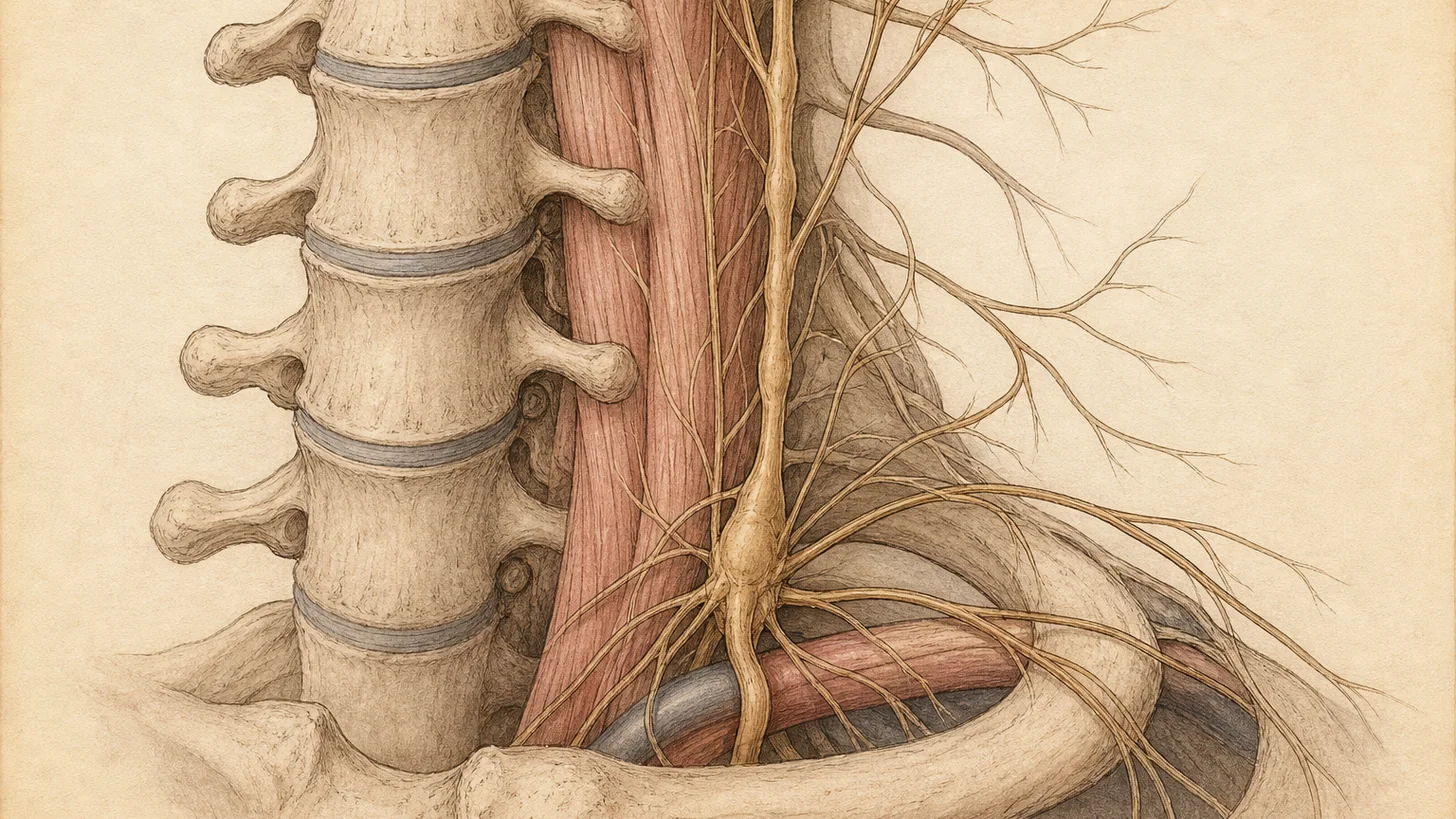
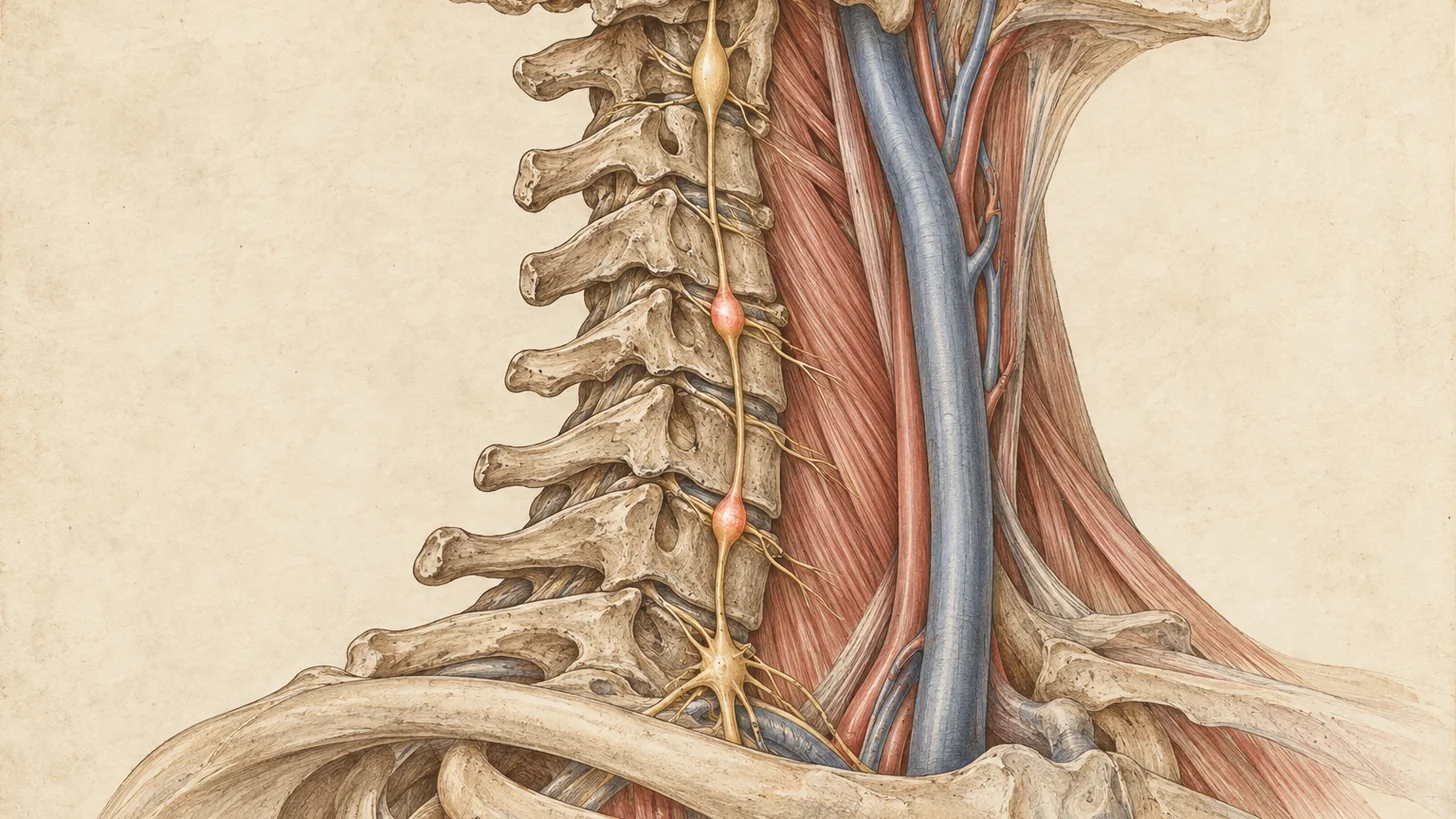
The stellate ganglion is a small cluster of sympathetic nerve cells deep at the base of the neck, in front of the spine. It belongs to a chain that runs up the side of the cervical spine toward the base of the skull and carries the sympathetic, fight-or-flight signals to the head, neck and arm. A stellate ganglion block (SGB) places local anesthetic beside that chain, usually at the C6 level just above the ganglion, so the signal quiets for some hours. On the injected side the eyelid droops and the pupil narrows, which shows the medicine reached the chain.
Why that would ease PTSD is not known. The explanation repeated most often, that the block lowers nerve growth factor and with it norepinephrine in the brain, comes from a 2009 hypothesis paper that proposed the mechanism without testing it (Lipov 2009). A 2025 study in mice found the block quieted the pathway from the locus coeruleus to the amygdala that helps lay down fear memories (Wang 2025). Those findings make the idea plausible. They do not show it works in people, and when a clinic says the block “resets your nervous system,” it is stating the hypothesis as a result.
What the randomized trials found
Three randomized trials have compared the block with a sham or placebo injection. Two tested the block on its own, both in service members, and they disagree.
- Hanling 2016, Naval Medical Center San Diego. About 40 service members with PTSD had a right-sided block or a sham procedure. PTSD, depression and anxiety scores improved in both groups over 3 months, with “no statistically or clinically relevant difference” between them. The authors concluded the evidence did not support “widespread or indiscriminant clinical use” of the block for PTSD.
- Rae Olmsted 2020, three U.S. Army pain centers. 113 active-duty service members, 100 men and 13 women on stable psychiatric medication, were randomized two to one, and 108 finished. The block group had a right-sided block at the C6 level at week 0 and again at week 2. On the CAPS-5, a clinician-rated PTSD scale from 0 to 80 on which the groups started near 38 to 40, scores fell 12.6 points with the block and 6.1 points with the sham over 8 weeks. The journal later published clarifications to the trial’s measures and analyses, and these figures are from the corrected article. The authors named their own limits: symptoms were mostly mild to moderate, and follow-up stopped at 8 weeks.
Look at the sham group in the positive trial. It improved by 6 points without a block. Expectation, the attention that comes with a procedure and the natural ups and downs of PTSD all move these scores. The droopy eyelid can also tip a patient off about which group they were in, a risk the authors acknowledged, although in their check patients guessed their group no better than chance. That background improvement is why uncontrolled reports look so much better than the trials do.
The third placebo-controlled trial tested the block as an add-on to cognitive processing therapy, one of the first-line psychotherapies for PTSD. In this pilot of 39 adults, about 70 percent of them women, both groups improved a great deal, and the block did not produce significantly larger improvement by 3 months, although self-reported scores were lower in the block group on the first day of therapy (Held 2026). An open-label trial of 86 military personnel and veterans, with no placebo arm, found that people who had the block before therapy improved faster than people who had it after (Bryan 2025). Most of what is known therefore comes from military men. The positive sham-controlled trial was 88 percent men, all on active duty, and the one placebo-controlled trial in a mostly female group found no significant added benefit.
A 2025 meta-analysis pooled the two standalone sham-controlled trials with one case-control study, found a 6-point average advantage on the clinician scale, and said more randomized trials are needed before the result can be relied on (Yang 2025). A larger Veterans Affairs trial (NCT05169190) has closed enrollment and has not yet published results.
Where the high success rates come from
They come from case series, patients treated in routine care and followed without a comparison group. The best known reported that over 70 percent of 166 service members improved by 10 points or more on a PTSD checklist, with the change lasting 3 to 6 months (Mulvaney 2014). In the records of 579 veterans treated in a VA clinical program, 68 percent had a clinically meaningful drop at one week and 60 percent at one month (Hollifield 2026). Series like these are how a treatment gets noticed. They cannot separate the block from expectation and time, and in every controlled trial both groups improved.
Durability has the same gap. No randomized comparison has run longer than about 3 months. A review of 22 studies, mostly case reports and case series covering 1,293 patients, found that symptoms coming back “was reported commonly,” leading to repeat blocks (Prasad 2023). No trial supports “permanent” or “cure.”
What the guidelines and insurers say
The 2023 VA/DoD PTSD guideline lists the stellate ganglion block among treatments with “insufficient evidence to recommend for or against” (VA/DoD 2023). The same guideline strongly recommends three trauma-focused psychotherapies, cognitive processing therapy, prolonged exposure and EMDR, and the medications paroxetine, sertraline and venlafaxine (Schnurr 2024). Aetna’s policy lists the block for PTSD as experimental and investigational (Aetna CPB 0863), and for PTSD it is a self-pay procedure here. We know of no anesthesia or pain medicine society guideline that endorses it for PTSD.
The guideline’s position is that the evidence is not strong enough either way. Dr. Movshis treats the block as an option for some people whose PTSD has not responded enough to first-line care, alongside that care and never in place of it.
Two levels, C6 and C4: what that rests on
Many clinics now inject at two levels, the usual C6 level plus a second, smaller injection higher on the chain at C4. Dr. Movshis adds C4 when the anatomy allows. The evidence for the second level is thinner than for the block itself. Both standalone sham-controlled PTSD trials blocked C6 alone. The comparisons of one level against two are non-randomized, and a 2026 review concluded that blocking both sides, or adding a block higher in the neck, may not give better or longer-lasting results than a single right-sided block. The same review noted that a second injection adds anesthetic volume and may add risk to the nerves and vessels nearby (Bielawiec 2026). A sham-controlled trial of a two-level block at NYU (NCT05391971) has closed enrollment, but it compares two levels with saline rather than with C6 alone, and its main measures are skin conductance and brain imaging, so it will not settle whether the C4 injection adds anything. For now the second level rests on clinical experience.
How Dr. Movshis does it
Who it is for. Adults with PTSD who have a therapist or psychiatrist treating it. Dr. Movshis requires that a treating clinician be involved, because the block is meant to sit alongside trauma-focused therapy or medication rather than replace them.
The procedure. Two sessions, two weeks apart, on the right side both times. That is the side and schedule used in the trial that found a benefit. The C6 level is confirmed with a brief X-ray at the start, and the injection is then done under real-time ultrasound, which shows the carotid artery, the vertebral artery and the thyroid vessels so the needle can avoid them. A C4 injection is added when the anatomy allows. The medicine is a long-acting local anesthetic with no steroid, and no sedation is used.
Afterward. You stay for 30 to 60 minutes. The droopy eyelid, a hoarse voice and a numb or heavy arm can last up to 24 hours. Get home by car with a driver, Uber or taxi, not by subway and not driving yourself. The stellate ganglion block aftercare page covers the first day and the warning signs.
Judging the result. A droopy eyelid or a warm hand shows the medicine reached the chain. Neither has been shown to predict whether PTSD symptoms will ease. Whether the block helped is judged by how your symptoms change over the following weeks.
Who should not have it, and when to call 988 instead
If you are having thoughts of suicide, call or text 988, the Suicide & Crisis Lifeline, and if you are in immediate danger, call 911. The trial that found a benefit excluded anyone with suicidal thoughts in the previous 2 months, and the others excluded people at active risk, so there is no evidence the block is safe or useful in that moment. Crisis care comes first.
Several other situations need a conversation before booking, or rule the block out. Blood thinners and bleeding disorders matter because bleeding in the neck is one of the serious risks, although it has also happened in people taking neither. Paralysis of a vocal cord or of the diaphragm on the other side, significant lung disease, earlier surgery on the front of the neck, an infection where the needle would go and an allergy to local anesthetic all change the risk. There are no trial data in pregnancy, because the trials excluded it.
The risks
The expected effects are on the injected side: a droopy eyelid, a smaller pupil, a red eye and a stuffy nose, sometimes a hoarse voice or a lump in the throat, sometimes a heavy arm. They fade within about a day. In the positive PTSD trial there were 6 adverse events and none were serious, though a trial that size is too small to show rare complications (Rae Olmsted 2020).
Serious complications are rare and real. A systematic review of reports from 1990 to 2018 found 260 cases with complications across 67 published papers (Goel 2019). Most were effects of the medicine itself. When local anesthetic enters a blood vessel it can cause a seizure or loss of consciousness within seconds, and this has happened under ultrasound too, which is why the review calls for standard monitoring and resuscitation equipment at hand. The review also includes bleeding in the neck, with one death when the bleeding blocked the airway, and infections that showed up days later, one of which caused quadriplegia.
Bleeding can appear late. In 27 published cases of a hematoma behind the throat after the block, symptoms started 2 hours or more afterward in 14, and the first signs included neck pain, shortness of breath, neck swelling and hoarseness (Higa 2006). After you leave, call 911 for neck swelling that is growing, new or worsening neck pain, trouble breathing, trouble swallowing your own saliva, or hoarseness that starts or gets worse hours after the block. Fever, or neck pain that worsens over the following days, needs medical attention the same day. Ultrasound shows the vessels and is the reason it is used, but it does not make an injection into a blood vessel impossible.
Anxiety without PTSD
The evidence here is newer and thinner. A 2026 single-center trial in India randomized 63 adults with treatment-resistant anxiety disorder, with PTSD excluded, to what the authors called dual stellate ganglion blocks or a sham procedure. Four weeks later, scores on the GAD-7 anxiety scale had fallen 9.6 points with the blocks and 3.6 with the sham (Niraj 2026). The authors noted it was one center with limited follow-up, and the result has not been confirmed in another sham-controlled trial. Dr. Movshis considers the block for anxiety without PTSD case by case, as a self-pay, off-label procedure.
Cost
For PTSD or anxiety the block is off-label and generally not covered by insurance. At Modal Pain Management it is $1,000 per session, including the C4 injection when it is added, and the PTSD protocol is two sessions. The stellate ganglion block page covers the insured use for complex regional pain syndrome and the other off-label uses.
If a therapist or psychiatrist is treating your PTSD and the two of you think a stellate ganglion block is worth trying, book a consultation or call (646) 290-6660. Dr. Movshis will go through your history and the evidence above with you, and if the block does not fit, he will say so.
References
- Rae Olmsted KL, Bartoszek M, Mulvaney S, et al. Effect of stellate ganglion block treatment on posttraumatic stress disorder symptoms: a randomized clinical trial. JAMA Psychiatry. 2020;77(2):130–138. doi:10.1001/jamapsychiatry.2019.3474 · PubMed
- Clarifications to measures, analyses, and findings in trial of stellate ganglion block treatment for posttraumatic stress disorder symptoms [correction]. JAMA Psychiatry. 2020;77(9):982. doi:10.1001/jamapsychiatry.2020.1829 · PubMed
- Hanling SR, Hickey A, Lesnik I, et al. Stellate ganglion block for the treatment of posttraumatic stress disorder: a randomized, double-blind, controlled trial. Reg Anesth Pain Med. 2016;41(4):494–500. doi:10.1097/AAP.0000000000000402 · PubMed
- Held P, Pridgen SA, Smith DL, et al. Enhancing cognitive processing therapy via stellate ganglion blocks: a pilot randomized trial. J Trauma Stress. Published online August 14, 2026. doi:10.1002/jts.70116 · PubMed
- Bryan CJ, Lynch J, Bryan AO, et al. Effectiveness of combined cognitive processing therapy with stellate ganglion block: an open-label randomized wait-list clinical trial. Psychother Psychosom. Published online December 15, 2025. doi:10.1159/000550014 · PubMed
- Yang Y, Pu R, Zhang D, et al. Stellate ganglion blockade for the treatment of post-traumatic stress disorder: a systematic review and meta-analysis. Auton Neurosci. 2025;262:103360. doi:10.1016/j.autneu.2025.103360 · PubMed
- Mulvaney SW, Lynch JH, Hickey MJ, et al. Stellate ganglion block used to treat symptoms associated with combat-related post-traumatic stress disorder: a case series of 166 patients. Mil Med. 2014;179(10):1133–1140. doi:10.7205/MILMED-D-14-00151 · PubMed
- Hollifield M, Lai-Trzebiatowski J, Alkire M, et al. The stellate ganglion block for PTSD: a retrospective clinical case series. Int J Environ Res Public Health. 2026;23(6):758. doi:10.3390/ijerph23060758 · PubMed
- Prasad S, Jain N, Umar TP, et al. Sympathetic nerve blocks for posttraumatic stress disorder: an evidentiary review for future clinical trials. Front Psychiatry. 2023;14:1309986. doi:10.3389/fpsyt.2023.1309986 · PubMed
- Schnurr PP, Hamblen JL, Wolf J, et al. The management of posttraumatic stress disorder and acute stress disorder: synopsis of the 2023 U.S. Department of Veterans Affairs and U.S. Department of Defense clinical practice guideline. Ann Intern Med. 2024;177(3):363–374. doi:10.7326/M23-2757 · PubMed
- U.S. Department of Veterans Affairs and Department of Defense. VA/DoD Clinical Practice Guideline for the Management of Posttraumatic Stress Disorder and Acute Stress Disorder, Version 4.0. Provider summary. 2023. healthquality.va.gov
- Aetna. Clinical Policy Bulletin 0863: Nerve Blocks. Reviewed July 23, 2026. aetna.com
- Bielawiec T, Melvin B, Ram BS, Anitescu M. Stellate ganglion block for post-traumatic stress disorder: a comprehensive review of evidence, technique considerations and symptom outcomes in military and non-military patients. Curr Psychiatry Rep. 2026;28(1):20. doi:10.1007/s11920-026-01666-4 · PubMed
- Goel V, Patwardhan AM, Ibrahim M, et al. Complications associated with stellate ganglion nerve block: a systematic review. Reg Anesth Pain Med. 2019;44(6):669–678. doi:10.1136/rapm-2018-100127 · PubMed
- Higa K, Hirata K, Hirota K, Nitahara K, Shono S. Retropharyngeal hematoma after stellate ganglion block: analysis of 27 patients reported in the literature. Anesthesiology. 2006;105(6):1238–1245. doi:10.1097/00000542-200612000-00024 · PubMed
- Niraj G, Karanth V, Charan N, et al. Dual stellate ganglion blocks for managing treatment-resistant anxiety disorder: a randomized, double-blind, placebo-controlled trial. Pain Physician. 2026;29(5):327–334. PubMed
- Lipov EG, Joshi JR, Sanders S, Slavin KV. A unifying theory linking the prolonged efficacy of the stellate ganglion block for the treatment of chronic regional pain syndrome (CRPS), hot flashes, and posttraumatic stress disorder (PTSD). Med Hypotheses. 2009;72(6):657–661. doi:10.1016/j.mehy.2009.01.009 · PubMed
- Wang Z, Liu Z, Yu Y, et al. Stellate ganglion block diminishes consolidation of conditioned fear memory in mice by inhibiting the locus coeruleus to the basolateral amygdala neural circuit. Transl Psychiatry. 2025;15(1):172. doi:10.1038/s41398-025-03383-7 · PubMed
Frequently Asked Questions
No. No trial has shown a cure, and the trials disagree on how much it helps. In the trial that found a benefit, clinician-rated PTSD scores fell 12.6 points over 8 weeks after two right-sided blocks and 6.1 points after a sham injection, a difference of about 6.5 points (Rae Olmsted 2020). A smaller trial found no difference from sham (Hanling 2016). The 2023 VA/DoD guideline found the evidence insufficient to recommend for or against the block. At Modal Pain Management it is offered as an off-label addition to trauma-focused therapy or medication, never in place of them.
Nobody knows from controlled data. The positive trial followed patients for 8 weeks, and no randomized comparison has run longer than about 3 months. Clinic case series describe benefits lasting 3 to 6 months in some patients, but they have no comparison group, and a review of 22 studies found that symptoms coming back was reported commonly and led to repeat blocks (Prasad 2023). Expect that the effect may fade and that repeating it is a decision made with your treating clinician.
Generally not. Using the block for PTSD is off-label, and Aetna's policy lists it as experimental and investigational. At Modal Pain Management it is $1,000 per session, including the C4 injection when it is added, and the PTSD protocol is two sessions two weeks apart.
Both standalone sham-controlled PTSD trials blocked the right side, and the trial that found a benefit gave two blocks, at week 0 and week 2 (Rae Olmsted 2020). Dr. Movshis follows that side and schedule, on the right both times. No trial has compared the right side with the left, so the choice follows the trial evidence rather than proof that one side is better.
Yes, at Modal Pain Management. Dr. Movshis requires that a therapist or psychiatrist be treating your PTSD. The 2023 VA/DoD guideline strongly recommends three trauma-focused psychotherapies, specifically cognitive processing therapy, prolonged exposure and EMDR, and the medications paroxetine, sertraline or venlafaxine, while it found the evidence insufficient to recommend for or against the block. The block is meant to sit alongside that care. If you are having thoughts of suicide, call or text 988 first, or call 911 if you are in immediate danger.
Possibly, but the evidence is early. One single-center trial of 63 adults with treatment-resistant anxiety disorder, with PTSD excluded, found anxiety scores fell 9.6 points after the blocks and 3.6 after a sham procedure at 4 weeks (Niraj 2026). Follow-up was short, and the result has not been confirmed in another sham-controlled trial. Dr. Movshis considers the block for anxiety without PTSD case by case, as a self-pay, off-label procedure.