Two people describe the same thing on the phone: the ball of the foot hurts, it is worse by the end of the day, and new insoles did nothing. On the exam table the stories split. In one, squeezing the space between the third and fourth metatarsal heads sets off a hot, electric burn into two toes. In the other, the worst spot sits right under the second toe joint, the top of that joint is puffy, and the second toe has started to lift off the floor.
The first is a nerve. The second is a failing ligament. They share a label, metatarsalgia, and they need different treatment and, when it comes to that, a different operation. Metatarsalgia only says the pain sits under the metatarsal heads [1]. The work is finding out why.
Point to it with one finger
The single most useful thing you can do before an appointment is find the exact spot.
- Between two metatarsal heads, usually the third and fourth, with burning into the facing sides of two toes: think nerve.
- Directly under one toe joint, usually the second, with swelling on top of it: think plantar plate.
- On the shaft of a metatarsal, a little back from the ball of the foot, after more running than usual: think stress fracture.
- Under several heads at once, a bruised feeling with no burning or numbness: think overload.
- Under the big toe joint, worse pushing off: the sesamoid bones, which are a separate problem from everything below.
Then notice the quality of the pain. Burning, buzzing and numbness are nerve words. Aching and bruising are joint and bone words. That split gets most people to the right section of this page.
Burning between two toes: Morton’s neuroma
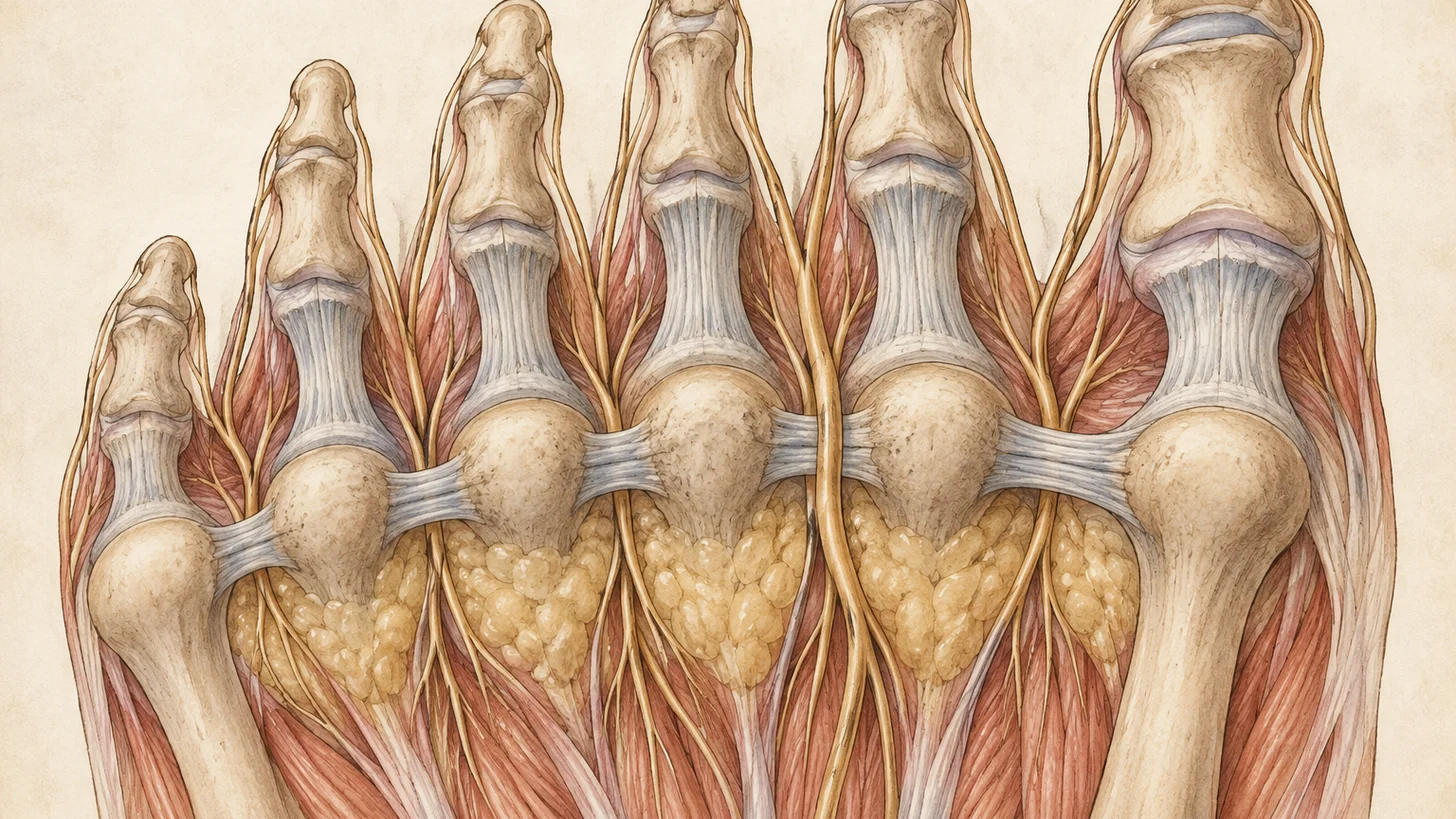
A Morton’s neuroma is not a tumor. It is a common plantar digital nerve, scarred where it runs under the ligament tying the metatarsal heads together, most often between the third and fourth. The burn shoots into the facing sides of two toes, people describe a pebble or a folded sock under the ball of the foot, and taking the shoe off helps.
The exam is quick. Pinching the web space between thumb and index finger, from top and bottom, was 96 percent sensitive against ultrasound in patients with suspected neuroma [2]. Mulder’s click, the clunk of the thickened nerve popping between the heads, was far less sensitive, so its absence rules nothing out. A typical neuroma needs no nerve conduction study or EMG, and MRI is kept for the cases where the exam and ultrasound disagree or a stress fracture is possible.
The full treatment ladder, with the evidence for each step and what we do not offer, is on our Morton’s neuroma page. In short: a wider toe box and a metatarsal pad, then an ultrasound-guided corticosteroid injection, then referral to a foot-and-ankle surgeon for neurectomy when a confirmed neuroma keeps limiting walking.
Aching under the second toe joint: the plantar plate
The plantar plate is a thick band of ligament under each lesser toe joint. It keeps the toe from bending up too far at push-off. When it wears or tears, almost always at the second toe, the pain sits under the joint itself rather than between the bones, the top of the joint swells, and over weeks to months the toe can drift toward the big toe or lift.
Three findings carry most of the diagnosis. In a review of 109 feet that went on to plantar plate repair, 95 percent of patients had a gradual onset of forefoot pain, swelling at the second metatarsal head and a positive drawer test [3]. The drawer test lifts the toe straight up while the examiner holds the metatarsal still. A positive drawer was 80.6 percent sensitive and 99.8 percent specific for a tear found at surgery [3]. Specificity that high means a clearly positive drawer is close to a diagnosis on its own.
Imaging fills in the rest. In a meta-analysis against surgical findings, dynamic ultrasound picked up 95 percent of plantar plate injuries but called more false positives (specificity 52 percent), while MRI was 89 percent sensitive and 83 percent specific [4]. So a clean ultrasound makes a tear unlikely, and MRI is the better test for grading one before surgery. Ultrasound has a practical advantage too: it happens in the exam room, with the toe moving under the probe.
It is also easily mistaken for a neuroma in the second web space, even on MRI, where the swelling around a torn plate can be read as one [5]. That is why we image the plantar plates whenever a “neuroma” sits next to the second toe.
Early on, taping the toe down, a stiffer-soled shoe and a metatarsal pad take load off the plate. A toe that is drifting, crossing over or no longer touching the ground needs a foot-and-ankle surgeon, and sooner is better than later, because the deformity is easier to fix before it becomes fixed.
One spot on the bone after more running: stop and image
A metatarsal stress fracture hurts at a single fingertip-sized point on the bone, usually the shaft of the second or third metatarsal. Hopping on that foot hurts. The top of the foot is often swollen, and the story is a recent jump in mileage, new speed work, a new shoe or a switch to a forefoot strike. Numb toes are not part of it.
The trap is a normal X-ray. In a systematic review of lower-extremity stress fractures, plain X-ray sensitivity ranged from 12 to 56 percent, while MRI was the most sensitive and specific test [6]. A clean film in the first weeks proves little. If this is your pattern, running stops today, and MRI is the next step when the X-ray is normal and suspicion stays high. This is the one ball-of-foot diagnosis where pushing through does real structural harm.
A bruised feeling under several heads: overload
Some ball-of-foot pain has no single structure to blame. The metatarsal heads are simply taking more load than they can tolerate. The usual contributors are well described [1]:
- Footwear. High heels and narrow, thin-soled shoes shift weight onto the forefoot.
- A tight calf. A short Achilles or calf forces the heel up early, so the forefoot loads sooner and longer with every step.
- Foot shape. A long second metatarsal, or a bunion that lets the big toe stop carrying its share, transfers load to the lesser heads.
- A thinning fat pad. The cushion under the metatarsal heads thins with age and can drift forward, which leaves the bone closer to the ground.
The fix is mechanical. A metatarsal pad spreads the heads and offloads them, and placement decides whether it helps. In a pressure-mapping study, pads placed 6 to 11 mm behind the line of the metatarsal heads cut peak pressure by about a third, while a pad sitting more than about 2 mm in front of that line raised pressure [7]. A stiffer or rocker-bottom sole, calf stretching and load retraining with our in-house physical therapy team do the rest. When a structural problem keeps the pain coming back despite all of that, a foot-and-ankle surgeon can change the bone mechanics.
Burning across the whole sole: look upstream
When the burning and tingling spread across the whole sole and into several toes, the forefoot is usually where the symptoms land, not where the problem starts.
A tender spot behind the inner ankle, symptoms worse after long standing and numbness on the sole point to tarsal tunnel syndrome, the tibial nerve pinched at the ankle before it divides into the plantar nerves [8]. Back or buttock pain with burning on the outer edge of the foot, or weakness lifting the big toe, points to an S1 or L5 nerve root in the spine, covered on our radiculopathy page. Numbness in both feet that starts at the toes and climbs is usually a peripheral neuropathy, which calls for blood work rather than an injection.
None of these respond to a web-space injection. Sorting them out is what a nerve conduction study and EMG are for, and Modal does both in the same office. A certified technologist runs the nerve conduction portion, and Dr. Movshis performs the needle EMG and reads the full study. When the study and the exam point to the tibial nerve, an ultrasound-guided diagnostic nerve block at the ankle confirms it. More on the nerve side is on our peripheral nerve entrapment page.
Pain under the heel rather than the ball of the foot, worst on the first steps out of bed, is a different problem altogether: plantar fasciitis.
When ball-of-foot pain cannot wait
Most forefoot pain can wait for an appointment. These cannot:
- A red, hot, swollen forefoot, especially with fever, or any open wound on the foot of someone with diabetes.
- Sudden inability to bear weight, or an obvious deformity after a fall or twist.
- Numbness that is spreading quickly, a foot that slaps or drags, or new leg weakness.
- Back pain with numbness in the groin or saddle area, or new trouble controlling the bladder or bowels.
For any of these, call 911 or go to the nearest emergency room.
Several swollen toe joints on both feet, with stiffness that lasts more than an hour in the morning, are not an emergency, but they are not a mechanical problem either. That pattern can be the first sign of an inflammatory arthritis, and it needs blood work and a rheumatologist before anyone injects anything.
What we document before you see a surgeon
Most ball-of-foot pain settles without an operation. When it does not, the surgeon needs the cause named and the conservative care documented, and so does the insurer reviewing the prior authorization. A first visit with Dr. Movshis is built to produce exactly that:
- The history and exam, including the web-space squeeze, the drawer test and a neurological exam of the leg.
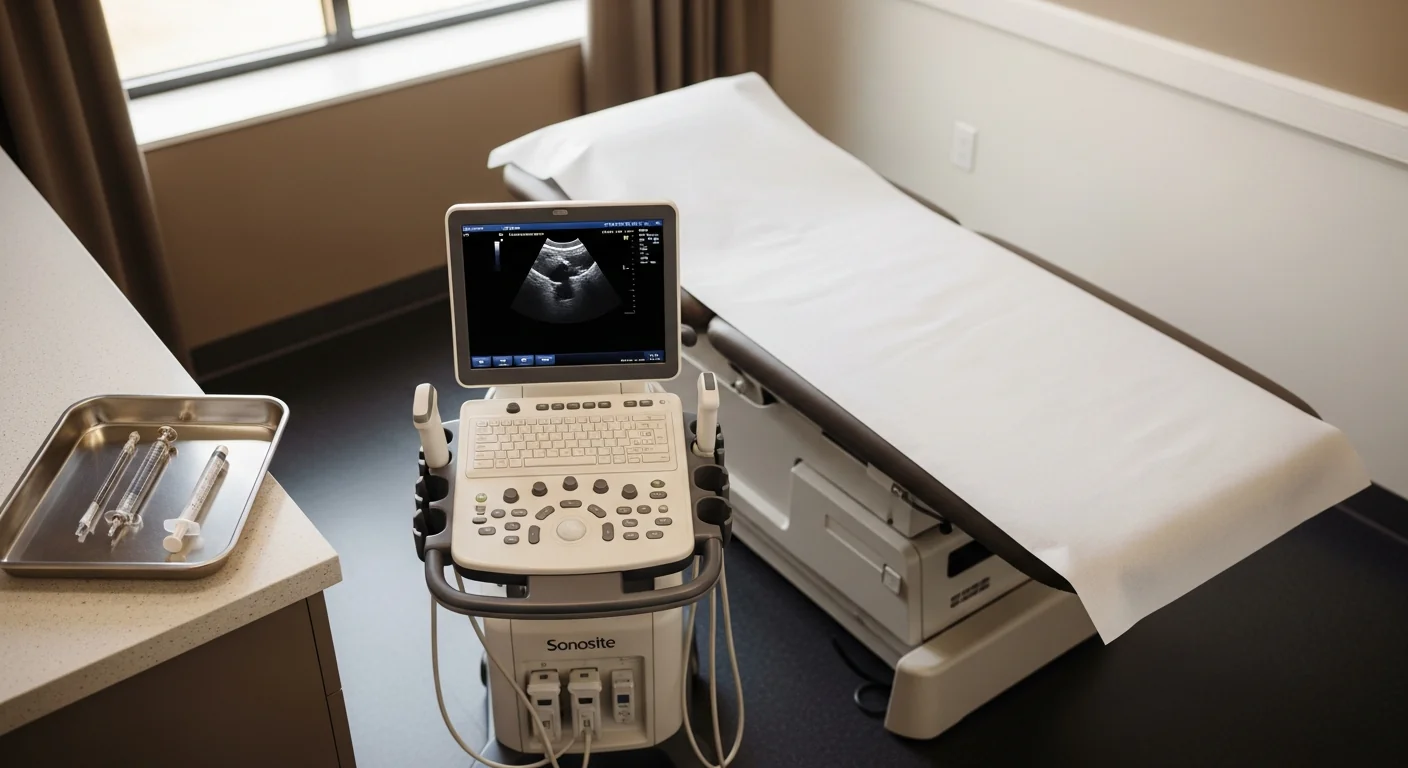
- Ultrasound of the web spaces and plantar plates in the exam room, with the findings recorded.
- A nerve conduction study and EMG when the sole burns or the pattern points upstream.
- The response to a guided injection or a diagnostic block, when one is done.
- Dated records of the shoes, pads, taping and physical therapy tried.
When the answer is a neuroma headed for neurectomy, a plantar plate tear, or a stress fracture that is not healing, he refers you to a foot-and-ankle surgeon with all of it attached, so the next visit starts from a diagnosis rather than from scratch.
References
This article is reviewed against the peer-reviewed literature. Citations retrieved from PubMed.
- Espinosa N, Maceira E, Myerson MS. Current concept review: metatarsalgia. Foot & Ankle International. 2008. · PubMed
- Mahadevan D, Venkatesan M, Bhatt R, Bhatia M. Diagnostic Accuracy of Clinical Tests for Morton's Neuroma Compared With Ultrasonography. The Journal of Foot and Ankle Surgery. 2015. doi:10.1053/j.jfas.2014.09.021 · PubMed
- Klein EE, Weil L, Weil LS, Coughlin MJ, Knight J. Clinical examination of plantar plate abnormality: a diagnostic perspective. Foot & Ankle International. 2013. doi:10.1177/1071100712471825 · PubMed
- Albright RH, Brooks BM, Chingre M, Klein EE, Weil LS, Fleischer AE. Diagnostic accuracy of magnetic resonance imaging (MRI) versus dynamic ultrasound for plantar plate injuries: A systematic review and meta-analysis. European Journal of Radiology. 2022. doi:10.1016/j.ejrad.2022.110315 · PubMed
- Linklater JM, Bird SJ. Imaging of Lesser Metatarsophalangeal Joint Plantar Plate Degeneration, Tear, and Repair. Seminars in Musculoskeletal Radiology. 2016. doi:10.1055/s-0036-1581115 · PubMed
- Wright AA, Hegedus EJ, Lenchik L, Kuhn KJ, Santiago L, Smoliga JM. Diagnostic Accuracy of Various Imaging Modalities for Suspected Lower Extremity Stress Fractures: A Systematic Review With Evidence-Based Recommendations for Clinical Practice. The American Journal of Sports Medicine. 2016. doi:10.1177/0363546515574066 · PubMed
- Hastings MK, Mueller MJ, Pilgram TK, Lott DJ, Commean PK, Johnson JE. Effect of metatarsal pad placement on plantar pressure in people with diabetes mellitus and peripheral neuropathy. Foot & Ankle International. 2007. doi:10.3113/FAI.2007.0015 · PubMed
- Bowley MP, Doughty CT. Entrapment Neuropathies of the Lower Extremity. Medical Clinics of North America. 2019. doi:10.1016/j.mcna.2018.10.013 · PubMed
Frequently Asked Questions
Because the metatarsal heads carry most of your weight at push-off, and something between them, under them or in them is objecting. The common sources are a scarred nerve between two metatarsal heads (Morton's neuroma), a worn or torn ligament under the second toe joint (the plantar plate), a stress fracture in a metatarsal shaft, and plain overload from shoes, a tight calf or a thinning fat pad. Point to the spot with one finger. Between the bones suggests the nerve, under the joint suggests the plantar plate, and on the bone itself after a jump in mileage suggests a stress fracture.
Usually not, but two causes should not be walked on. A metatarsal stress fracture can progress to a displaced break if you keep running, and a plantar plate tear can let the second toe drift into a permanent crossover deformity. A red, hot, swollen forefoot with fever, or any open wound on the foot of someone with diabetes, needs care the same day. For those, call 911 or go to the nearest emergency room.
No. In a systematic review of lower-extremity stress fractures, plain X-ray sensitivity ranged from 12 to 56 percent, so early X-rays miss most of them [6]. MRI was the most sensitive and specific test. If one spot on a metatarsal hurts and hopping on that foot hurts, a normal X-ray does not clear you to run. The next step is MRI.
They can, when they sit in the right place. In a pressure-mapping study, pads placed 6 to 11 mm behind the line of the metatarsal heads lowered peak forefoot pressure by about a third, while a pad that crept forward past the heads raised it [7]. That study was in people with diabetic neuropathy, but the mechanics carry over. The pad goes behind the sore spot, never on it. We place the first one in the office and mark where it goes.
Someone who can examine the foot, image it in the room and test the nerves, so the cause is named before treatment starts. Dr. Movshis does the exam, ultrasound of the web spaces and plantar plates, and nerve conduction studies with EMG in the same office. When the answer is a plantar plate tear, a stress fracture or a neuroma that needs removal, he refers to a foot-and-ankle surgeon with those findings attached.
Most commercial PPO plans cover the evaluation, the ultrasound, nerve testing and injections, with prior authorization handled by our office when a procedure needs it. Modal Pain Management NYC accepts most commercial PPO plans, including Aetna, Anthem Blue Cross Blue Shield, Cigna, Empire Blue Cross Blue Shield, the Empire Plan, Oscar, Oxford, UMR and UnitedHealthcare, and does not accept Medicare, Medicaid, HMO plans, or workers' compensation. Check your plan or call (646) 290-6660.