A patient three days out from her first Botox cycle sends a photo. Her left upper eyelid is sitting lower than the right, and she wants to know whether it is permanent, whether it means the treatment is not for her, and whether the neck ache she has had since the session is the same problem. None of those three things is true, but every one of them is a reasonable question, and the trial data answer them better than reassurance does.
Botox™ (onabotulinumtoxinA) for chronic migraine has been studied in more patients, for longer, than almost any other headache preventive: two placebo-controlled trials, a 56-week extension, a two-year open-label study of nine cycles, and a two-year real-world registry. The side effects are well counted. What is less often explained is why each one happens, which is what tells you whether it is preventable.
The numbers, and where they come from
The PREEMPT program randomized 1,384 adults with chronic migraine to onabotulinumtoxinA or placebo for two 12-week cycles, then treated everyone in an open-label extension to 56 weeks (Dodick 2010, Aurora 2011). Any adverse event occurred in 62.4% of Botox™ patients and 51.7% of placebo patients in the double-blind phase, and 3.8% versus 1.2% discontinued because of one (Dodick 2010). The FDA label’s table for those two trials (687 patients on Botox™, 692 on placebo) lists the reactions that were more frequent with treatment: neck pain (9% versus 3%), headache (5% versus 3%), migraine (4% versus 3%), eyelid ptosis (4% versus under 1%), musculoskeletal stiffness (4% versus 1%), muscular weakness (4% versus under 1%), myalgia (3% versus 1%), musculoskeletal pain (3% versus 1%), injection-site pain (3% versus 2%), bronchitis (3% versus 2%), facial paresis (2% versus 0%), muscle spasms (2% versus 1%), and hypertension (2% versus 1%). The same label notes that severe worsening of migraine requiring hospitalization occurred in about 1% of treated patients, usually within the first week, against 0.3% on placebo.
The pooled safety analysis of four placebo-controlled trials — two phase 2 and two phase 3, 1,997 patients who received at least one dose at 75 to 260 units — put neck pain at 12.6%, muscle weakness at 8.0%, musculoskeletal stiffness at 6.1%, and ptosis at 4.6% of treated patients, serious adverse events at 5.4% versus 3.0% on placebo, and discontinuation for an adverse event at 3.4% (Diener 2014). Two longer studies matter for anyone planning years of treatment. COMPEL followed 716 patients through nine cycles over 108 weeks: 18.3% reported a treatment-emergent adverse event, neck pain the most common at 4.1%, and one patient had a serious treatment-related event, a rash (Blumenfeld 2018). REPOSE followed 641 patients in routine European practice for two years and 3,499 treatment sessions: 18.3% reported an adverse drug reaction, mostly mild to moderate, and 1.3% a serious one (Ahmed 2019).
The Cochrane review pooled 28 trials with 4,190 participants and put the risk of an adverse event about 30% higher with botulinum toxin than placebo — roughly 60 per 100 treated patients against 47 per 100 — on moderate-quality evidence, with the events predominantly mild and self-limited (Herd 2018). That is the whole safety picture. What follows is the mechanism behind each item on the list, because the mechanism is what makes most of them preventable.
Neck pain, stiffness, and a heavy head
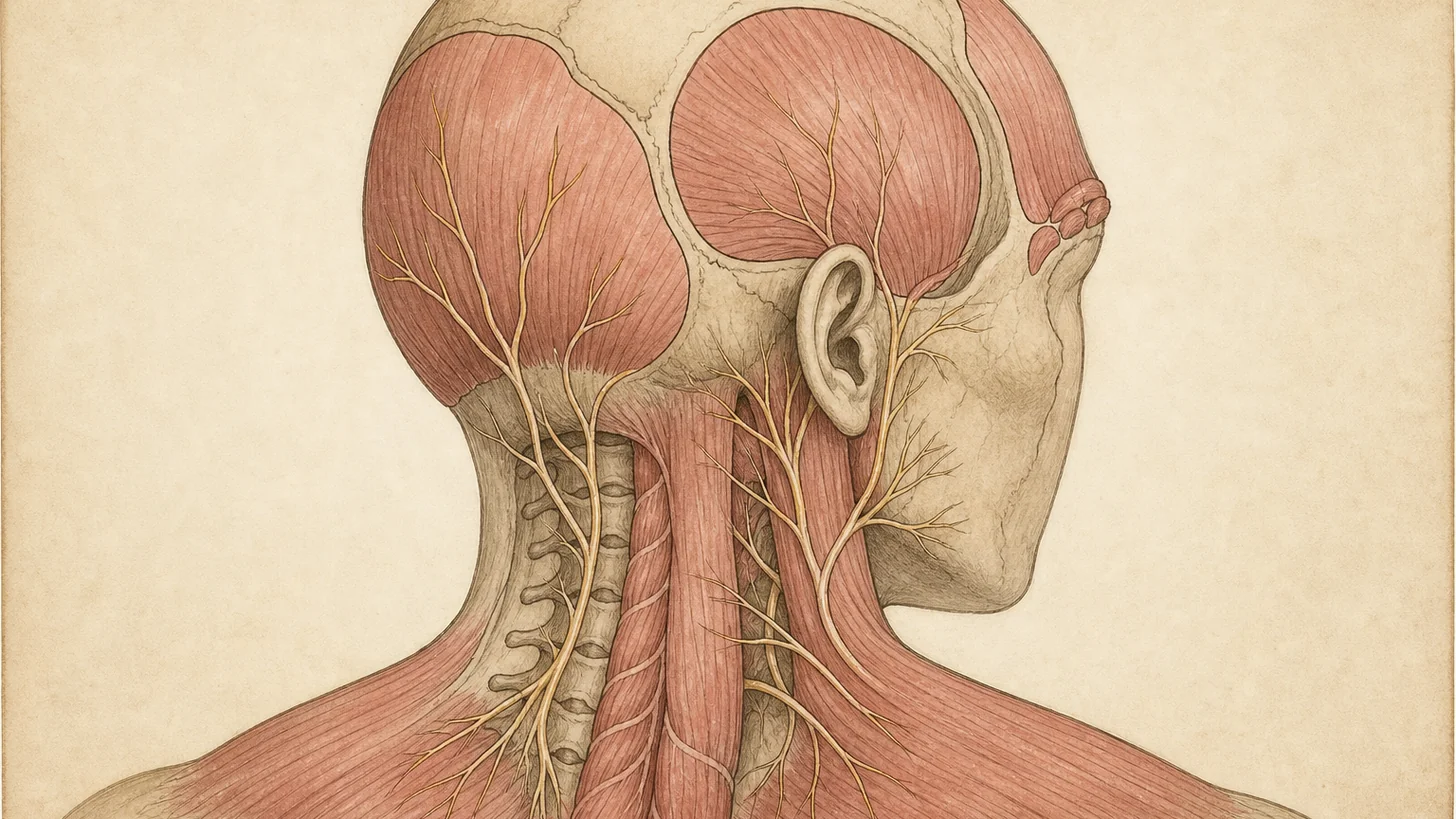
This is the most common complaint and the one most tied to technique. Of the 31 sites in the PREEMPT map, 4 are in the cervical paraspinal muscles at the back of the neck and 6 are in the upper trapezius. The paraspinal injections are specified as superficial and high, close to the base of the skull, because the goal is the sensory nerve endings in the upper neck, not the postural muscles below them (Blumenfeld 2010, Blumenfeld 2017). An injection placed too deep or too low weakens the muscles that hold the head up. The patient feels it as a dull ache, stiffness, or a head that is hard to hold up at a screen by mid-afternoon, starting a few days after the session, peaking in weeks two and three, and easing as the effect wears off.
The fix is at the next cycle, not the next day. The paraspinal dose can be reduced within the protocol, the sites kept at the upper edge of the neck, and the trapezius sites moved away from the muscle bulk for a patient with a slender neck. Patients who do heavy desk work are warned in advance and told to raise the monitor for the first three weeks. Injection-site soreness, which is separate, lasts a day or two and responds to ice.
Eyelid droop: why it happens and how it is avoided
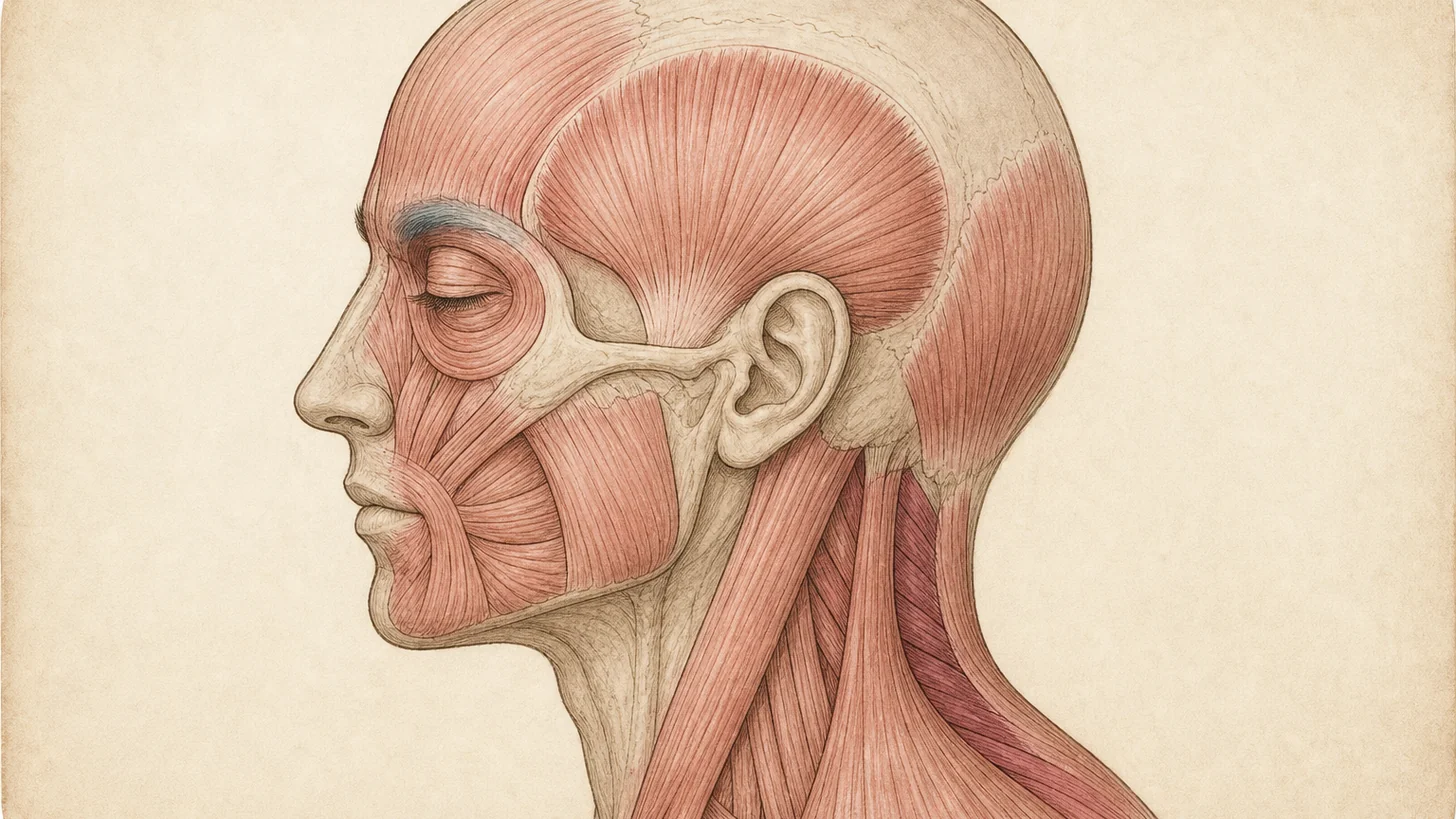
Ptosis is the side effect patients fear most, and it is the one with the clearest mechanism. The three forehead muscles in the protocol — frontalis, corrugator, procerus — sit a short distance above the orbit, and beneath the brow is the levator palpebrae superioris, the small muscle that lifts the upper lid. If toxin diffuses down into the levator, or a corrugator injection is placed low or angled toward the eye, the lid drops on that side (Blumenfeld 2017). It appears 3–10 days after the session, looks worse than it is, and resolves over 2–6 weeks as the effect wanes. Vision is not affected beyond the heavy lid.
Prevention is placement: corrugator sites at the upper margin of the brow with the needle directed upward and away from the orbit, procerus in the midline, and the frontalis sites in the upper third of the forehead at the protocol dose, not more. A patient who had ptosis at one cycle gets a re-mapped forehead, not a discontinued treatment. When a drooping lid is bothersome in the meantime, an alpha-agonist eye drop that tightens the lid’s small accessory muscle can lift it a millimeter or two for a few hours, and we prescribe it when asked.
A related, less-discussed effect is brow heaviness or an altered brow shape from the frontalis sites, which is cosmetic and resolves the same way. The forehead is also where muscle thinning becomes visible after years of treatment, a change some patients like and some do not, and it is worth knowing before the first cycle.
Muscle weakness beyond the neck
Muscle weakness appeared in 4% of treated patients against under 1% on placebo in the controlled trials, by the label’s count. In chronic migraine it means weakness in the injected muscles: the trapezius sites can leave the shoulders feeling heavy when shrugging or carrying a bag, and the temporalis sites occasionally make chewing tough food tire the jaw. Facial weakness, reported in about 2%, is asymmetry of the forehead or brow from uneven frontalis effect. All of it tracks the 12-week cycle. Weakness that spreads to muscles that were not injected is a different category and is covered below.
Headache and “migraine” as side effects
The odd-looking lines on the label, headache at 5% and migraine at 4%, describe patients whose headache was recorded as an adverse event in the days after injection. Some of this is the underlying disease continuing while the effect builds, some is injection-site soreness on the scalp read as headache, and some patients do describe a short run of worse or different headache in the first week. The label also records severe worsening of migraine requiring hospitalization in about 1% of treated patients, usually within the first week, against 0.3% on placebo, which is why a first-week flare that is unlike your usual attacks gets a phone call rather than a wait. A rough first week does not predict a failed cycle. The preventive effect builds over two to four weeks and is judged at the 4–6 week mark, and the trial data show the benefit continuing to grow across the first two or three cycles (Aurora 2011), which is why the decision to continue or stop is made after cycle two or three rather than after a rough first week.
The boxed warning: distant spread of toxin effect
Every botulinum toxin product carries an FDA boxed warning: weakness, difficulty swallowing, or difficulty breathing appearing hours to weeks after injection, when the toxin acts beyond the injected area. The cases behind the warning came predominantly from high-dose treatment of spasticity, particularly in children with cerebral palsy, and from unapproved or compounded products. At the 155-unit chronic migraine dose, delivered as 5-unit aliquots into superficial scalp and neck muscles, the exposure per site is small. Dysphagia appears on the label’s list of reactions at under 1%, and across the 56-week PREEMPT program, COMPEL, and REPOSE, serious treatment-related events stayed in the low single digits of percent with no cluster of distant-spread cases reported (Aurora 2011, Blumenfeld 2018, Ahmed 2019).
Rare does not mean ignorable. New trouble swallowing, trouble breathing, a change in voice, or weakness in muscles that were not injected, at any point after a session, is a same-day call to the office or an urgent care visit. The patients at higher risk are those with a neuromuscular disorder such as myasthenia gravis or ALS, pre-existing swallowing or breathing problems, or medications that act at the neuromuscular junction, including aminoglycoside antibiotics and some muscle relaxants. All of those are asked about before the first cycle, and a neuromuscular disorder is a reason not to proceed.
Allergic reaction, pregnancy, and what is not known
True hypersensitivity to botulinum toxin products is rare and is a contraindication to further treatment, as is infection at any planned site. Pregnancy and breastfeeding are settings where there are no adequate controlled data. The registry evidence on inadvertent exposure in early pregnancy is reassuring but small, and the decision is made case by case, usually by deferring the cycle. The other unknown patients ask about is interaction with the CGRP monoclonal antibodies, which are increasingly combined with Botox™ in patients who respond incompletely to either alone: the combination has not shown additive side effects in the observational reports so far, and it is a co-management conversation with neurology rather than a contraindication.
Neutralizing antibodies and the reason cycles are 12 weeks
The immune system can form antibodies that bind and inactivate the toxin, after which the injections stop working. With the current formulation of onabotulinumtoxinA the rate is low, and the risk rises with larger doses, booster injections, and intervals shorter than three months (Naumann 2013). That is the pharmacological reason the interval is held at 12 weeks even when a patient’s benefit fades at week ten, and the reason a “top-up” between cycles is declined. A patient whose response has faded across two or three well-executed cycles is assessed for antibodies and for the more common explanation, a map that needs updating.
What is done at Modal Pain Management to keep the list short
The injection map follows the PREEMPT paradigm exactly, with the modifications the anatomy studies support: brow sites at the upper margin and angled away from the orbit, paraspinal sites high and superficial, trapezius sites adjusted to the patient’s build (Blumenfeld 2017). Every side effect from a previous cycle is recorded against the site that caused it and the map is changed before the next. Neuromuscular disease, swallowing or breathing problems, pregnancy, and interacting medications are screened at the consultation. Patients get the mechanism explained before the first session, which is the single thing that most reduces the phone calls in week one, because a heavy lid or a stiff neck that was predicted is a nuisance rather than an alarm.
If you are working out whether Botox™ is right for your headaches, the chronic migraine Botox eligibility check takes two minutes, the coverage guide explains what the authorization needs, and the full treatment guide covers the protocol from first visit to results.
References
- Dodick DW, Turkel CC, DeGryse RE, et al. OnabotulinumtoxinA for treatment of chronic migraine: pooled results from the double-blind, randomized, placebo-controlled phases of the PREEMPT clinical program. Headache. 2010;50(6):921–936. doi:10.1111/j.1526-4610.2010.01678.x · PubMed 20487038
- Diener HC, Dodick DW, Turkel CC, et al. Pooled analysis of the safety and tolerability of onabotulinumtoxinA in the treatment of chronic migraine. Eur J Neurol. 2014;21(6):851–859. doi:10.1111/ene.12393 · PubMed 24628923
- Aurora SK, Winner P, Freeman MC, et al. OnabotulinumtoxinA for treatment of chronic migraine: pooled analyses of the 56-week PREEMPT clinical program. Headache. 2011;51(9):1358–1373. doi:10.1111/j.1526-4610.2011.01990.x · PubMed 21883197
- Blumenfeld AM, Stark RJ, Freeman MC, Orejudos A, Manack Adams A. Long-term study of the efficacy and safety of onabotulinumtoxinA for the prevention of chronic migraine (COMPEL): a multicenter, open-label study. J Headache Pain. 2018;19(1):13. doi:10.1186/s10194-018-0840-8 · PubMed 29404713
- Ahmed F, Gaul C, García-Moncó JC, Sommer K, Martelletti P. An open-label prospective study of the real-life use of onabotulinumtoxinA for the treatment of chronic migraine: the REPOSE study. J Headache Pain. 2019;20(1):26. doi:10.1186/s10194-019-0976-1 · PubMed 30845917
- Herd CP, Tomlinson CL, Rick C, et al. Botulinum toxins for the prevention of migraine in adults. Cochrane Database Syst Rev. 2018;6(6):CD011616. doi:10.1002/14651858.CD011616.pub2 · PubMed 29939406
- Blumenfeld A, Silberstein SD, Dodick DW, Aurora SK, Turkel CC, Binder WJ. Method of injection of onabotulinumtoxinA for chronic migraine: a safe, well-tolerated, and effective treatment paradigm based on the PREEMPT clinical program. Headache. 2010;50(9):1406–1418. doi:10.1111/j.1526-4610.2010.01766.x · PubMed 20958294
- Blumenfeld AM, Silberstein SD, Dodick DW, Aurora SK, Brin MF, Binder WJ. Insights into the functional anatomy behind the PREEMPT injection paradigm: guidance on achieving optimal outcomes. Headache. 2017;57(5):766–777. doi:10.1111/head.13074 · PubMed 28387038
- Naumann M, Boo LM, Ackerman AH, Gallagher CJ. Immunogenicity of botulinum toxins. J Neural Transm. 2013;120(2):275–290. doi:10.1007/s00702-012-0893-9 · PubMed 23008029
Frequently Asked Questions
In the two placebo-controlled PREEMPT trials (687 patients on Botox, 692 on placebo), the adverse reactions the FDA label lists as more frequent with Botox were neck pain (9% versus 3%), headache (5% versus 3%), migraine (4% versus 3%), eyelid droop or ptosis (4% versus under 1%), musculoskeletal stiffness (4% versus 1%), muscle weakness (4% versus under 1%), and myalgia, musculoskeletal pain, injection-site pain, bronchitis, facial weakness, and muscle spasms each at 2–3%. Any adverse event occurred in 62.4% of Botox patients against 51.7% on placebo, and 3.8% versus 1.2% stopped because of one (Dodick 2010). In the pooled safety analysis of four placebo-controlled trials, 1,997 patients who received at least one dose, neck pain was reported by 12.6%, muscle weakness by 8.0%, stiffness by 6.1%, and ptosis by 4.6%, with 3.4% discontinuing because of a side effect (Diener 2014). Almost all of these were mild to moderate and resolved as the toxin wore off.
The forehead sites of the PREEMPT map — the frontalis, corrugator, and procerus muscles — sit a few centimeters above the levator palpebrae superioris, the small muscle that lifts the upper eyelid. If toxin diffuses downward into the levator, or a corrugator injection is placed too low or angled toward the orbit, the lid droops on that side. It appears 3–10 days after the session and resolves in 2–6 weeks as the effect wears off. It is not dangerous and does not affect vision beyond a heavy lid. It is also largely preventable: the corrugator sites are placed at the upper edge of the brow with the needle directed up and away from the eye, and the medial frontalis dose is kept to the protocol amount. A patient who has had ptosis once has the map adjusted, not the treatment stopped.
It can. Of the 31 protocol sites, 4 are in the cervical paraspinal muscles at the back of the neck and 6 are in the upper trapezius, and those are the sites responsible for the neck pain, stiffness, and head-heaviness that were the most common side effects in the trials. The paraspinal injections are meant to be superficial and high, near the base of the skull, and injecting too deep or too low weakens the muscles that hold the head up (Blumenfeld 2017). A patient with a slender neck, or one who does a lot of desk work, notices it more. The symptom peaks in the first two to three weeks and eases as the effect wanes. At the next cycle the paraspinal dose and depth are adjusted and the trapezius sites re-mapped, which resolves it for nearly everyone.
For a minority, briefly. In the placebo-controlled trials, headache was reported as an adverse event in about 5% of Botox-treated patients against 3% on placebo, and some patients describe a few days of more frequent or different-feeling headache in the first week after the session, before the preventive effect builds over the following two to four weeks (Dodick 2010). Injection-site soreness on the scalp and neck contributes. It is not a sign the treatment is failing, and the cycle is judged at the 4–6 week mark, when the effect is at its peak, not in the first week.
Every botulinum toxin product carries an FDA boxed warning for distant spread of toxin effect: weakness, trouble swallowing, or trouble breathing appearing hours to weeks after injection when the toxin acts beyond the injected muscles. At the 155-unit dose used for chronic migraine, injected superficially into scalp and neck muscles, these events are rare. Over nine cycles and two years in the COMPEL study of 716 patients, 18.3% reported a treatment-emergent adverse event, neck pain the most common at 4.1%, with one serious treatment-related event, a rash (Blumenfeld 2018). In the two-year real-world REPOSE study of 641 patients and 3,499 treatment sessions, 18.3% reported an adverse drug reaction, mostly mild to moderate, and 1.3% a serious one (Ahmed 2019). In the pooled placebo-controlled trials, serious adverse events occurred in 5.4% of treated patients and 3.0% on placebo (Diener 2014), and the Cochrane review put non-serious adverse events at about 60 per 100 treated patients against 47 per 100 on placebo, moderate-quality evidence (Herd 2018). One label item deserves its own line: severe worsening of migraine requiring hospitalization occurred in about 1% of treated patients, usually within the first week, against 0.3% on placebo. The risk rises with pre-existing neuromuscular disease, swallowing or breathing problems, and drugs that affect the neuromuscular junction, which is why those are screened for before the first session.
No cumulative toxicity has been identified. The toxin is degraded locally, the nerve endings recover over roughly 12 weeks, and each cycle starts from the same baseline. Over nine cycles and two years in the COMPEL study, 18.3% of 716 patients reported a treatment-emergent adverse event, neck pain the most common at 4.1%, and the investigators reported the long-term profile as consistent with the shorter trials (Blumenfeld 2018). The one long-term issue worth knowing about is neutralizing antibodies, which can make the toxin stop working: with the current formulation of onabotulinumtoxinA the rate is low, and it rises with higher doses and shorter intervals, which is one reason cycles are held at 12 weeks rather than compressed (Naumann 2013). Muscle thinning at the injected sites after years of treatment is real but cosmetic, and the forehead sites are the ones patients notice.