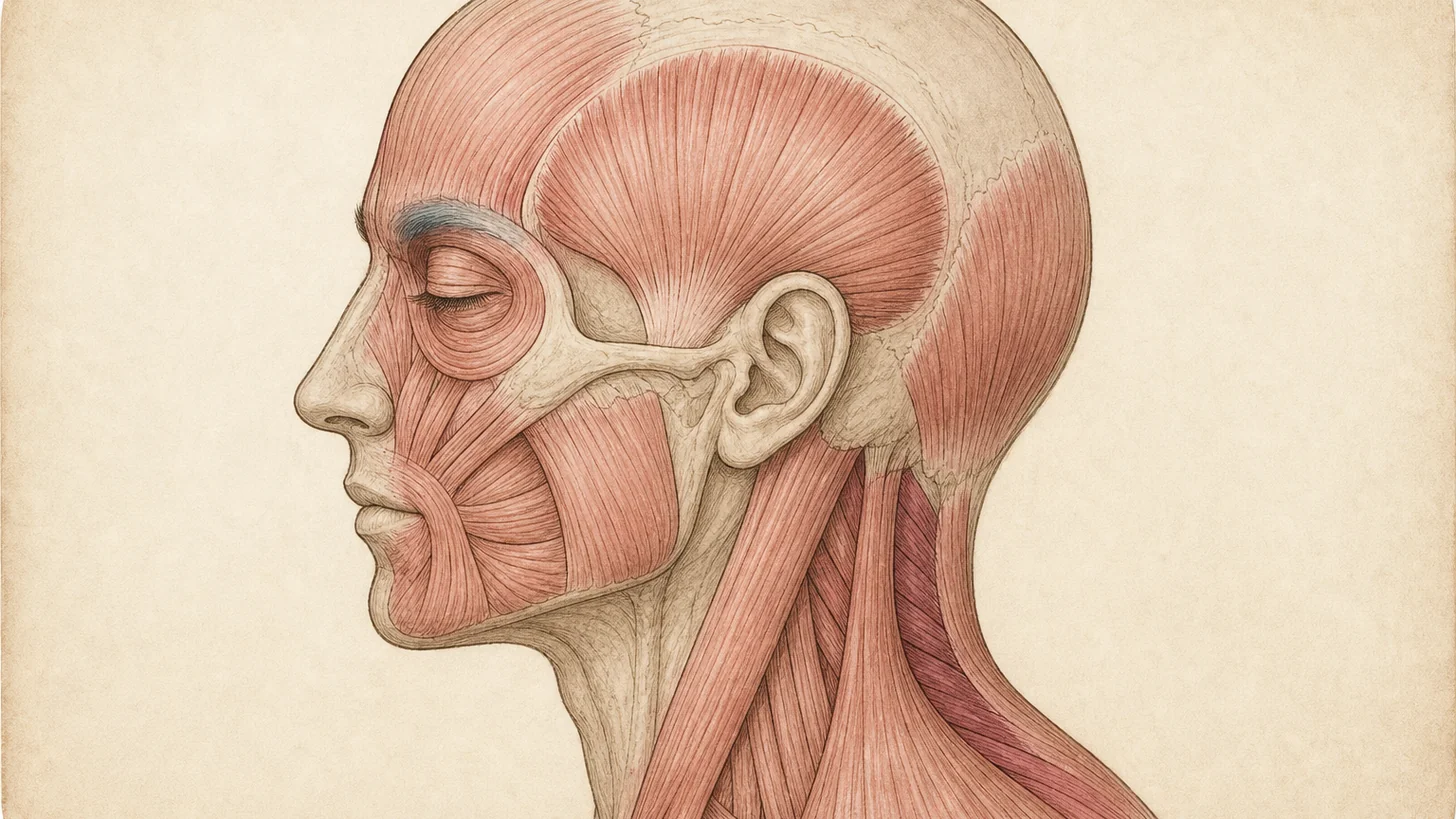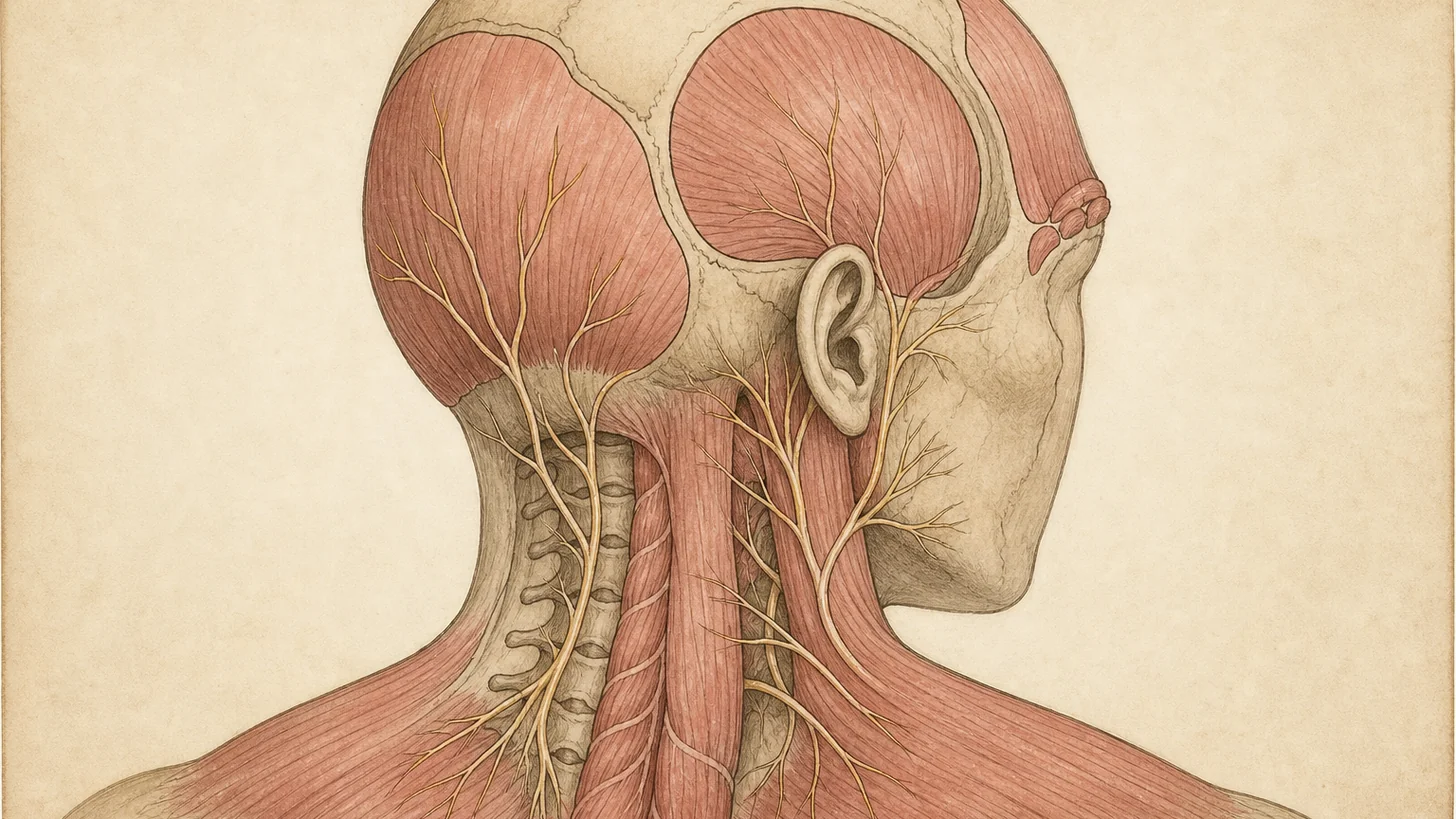
The first question at almost every Botox™ consultation for migraine is not whether it works. It is where the needles go and how many there are. The answer is more specific than most patients expect: 31 injections, 155 units, seven muscle areas, the same map for everyone, repeated every 12 weeks. It is one of the few treatments in headache medicine where the protocol was fixed by two large trials and then written into the FDA label unchanged, which means the map you receive should be the map the evidence was built on.
This post lays out that map site by site, explains why each area is in it, and covers the two things that vary between patients: the optional follow-the-pain sites and the injector’s technique.
Why the map is fixed, and where it came from
Two earlier generations of migraine Botox™ trials failed. They injected where the patient’s head hurt, at doses and sites that varied, and could not separate the drug from placebo. The PREEMPT program was designed to fix that: a set of sites and doses chosen to cover the sensory nerve territories of the head and neck, given identically to every patient, in two placebo-controlled trials totaling 1,384 adults with chronic migraine (Dodick 2010). That paradigm reduced headache days by about two more per month than placebo at 24 weeks, with the difference widening over the 56-week extension (Aurora 2011), and the FDA approved it in 2010 as written. When a physician quotes “155 units at 31 sites,” that is the map.
The anatomical logic was spelled out afterward by the same investigators (Blumenfeld 2017). Migraine pain arrives through two systems that meet in the brainstem: the trigeminal nerve, whose supraorbital, supratrochlear, and auriculotemporal branches supply the forehead, brow, and temple, and the upper cervical nerves, whose greater and lesser occipital branches supply the back of the head and the neck. Botox™ quiets the sensory nerve endings it is injected near, blocking the release of the neuropeptides that keep the whole network sensitized (Burstein 2020). Each of the seven muscle areas in the map sits over one of those nerve territories. The muscles are the address, not the target.
The 31 sites, area by area
Every injection is 5 units in 0.1 mL of saline, given with a 30-gauge half-inch needle into the superficial part of the muscle, and the map is symmetrical, so each area is injected on both sides (Blumenfeld 2010).
Corrugator — 10 units, 2 sites. One injection into each corrugator, the small muscle that pulls the brow inward when you frown, placed at the upper margin of the brow above the inner third of the eyebrow. This covers the supratrochlear nerve. The needle is directed upward and away from the orbit, because the eyelid-lifting muscle sits just below.
Procerus — 5 units, 1 site. A single midline injection at the bridge of the nose, into the muscle that pulls the brows down. The only site that is not paired.
Frontalis — 20 units, 4 sites. Two injections into each side of the forehead muscle, in the upper half of the forehead, roughly above the corrugator site and above the mid-pupil line. These cover the supraorbital nerve. Placing them high keeps the effect off the brow and the eyelid.
Temporalis — 40 units, 8 sites. Four injections fanned across each temporalis, the broad muscle above and behind the ear that you feel bulge when you clench your jaw. This is the largest single dose in the map because the temple is where the auriculotemporal nerve and its branches run, and because temple pain is the most common site of migraine pain. The sites run from just above the ear toward the hairline.
Occipitalis — 30 units, 6 sites. Three injections into each occipitalis, along the ridge at the base of the skull, covering the greater and lesser occipital nerves as they emerge. This is the back-of-the-head territory, and it is the area most often skipped by a cosmetic-style injector, which is one reason a cut-down course fails.
Cervical paraspinal — 20 units, 4 sites. Two injections into each side of the upper neck muscles, just below the skull, deliberately high and superficial. The neck is the site of most of the protocol’s side effects — neck pain and a heavy head — and depth is the variable that produces them, so the needle stays shallow.
Trapezius — 30 units, 6 sites. Three injections into each upper trapezius, spaced from the base of the neck toward the point of the shoulder, covering the cervical branches that feed the neck-and-shoulder component of the headache. The sites are adjusted to the patient’s build, and a slender patient gets them closer to the neck.
Ten, five, twenty, forty, thirty, twenty, thirty: 155 units. Two, one, four, eight, six, four, six: 31 sites.
Follow the pain: the optional 40 units
The 31 fixed sites are given to everyone. On top of them, the PREEMPT protocol allows up to 40 additional units at up to 8 extra sites, placed where the individual patient’s pain concentrates: up to 10 units more in the temporalis, up to 10 more in the occipitalis, and up to 20 more in the trapezius, on one side or both. That takes the maximum to 195 units at 39 sites, and the trial patients were randomized to 155 to 195 units, so the results cover both the fixed map and the map with additions (Dodick 2010).
The follow-the-pain paradigm is written into the product labeling in a number of countries outside the United States. In the U.S. the label carries the 155-unit map, and the additional units are used at the physician’s discretion, documented, and authorized separately. The practical rule is simple: the fixed map first, for at least two cycles, and follow-the-pain sites when the response is real but a specific area — one temple, the back of the head, a shoulder — keeps breaking through.
Why fewer sites, or the wrong sites, fails
Three things go wrong with courses that did not work elsewhere, and each is visible in the anatomy paper (Blumenfeld 2017). The first is an incomplete map: forehead and temples only, which covers the trigeminal half of the network and leaves the occipital half untouched. The second is depth, mostly in the neck, where injections placed into the deeper postural muscles produce weakness and a heavy head without adding benefit. The third is timing: judging the treatment after one cycle. In the 56-week analysis the reduction in headache days kept growing through the second and third cycles (Aurora 2011), which is why the decision to continue or stop is made after cycle two or three, and why a first course with fewer than 31 sites is not a fair test of whether Botox™ works for you.
Units are the other source of confusion. Botox™ units are specific to onabotulinumtoxinA. Dysport™ and Xeomin™ units are not equivalent, no conversion factor is reliable, and neither product is FDA-approved for chronic migraine. A patient who was told they received “100 units” or “300 units” of another product for headache was not given the PREEMPT protocol.
What the session is like
The 31 injections take about ten minutes once the map is drawn. The needle is short and fine, each injection is a brief sting, and the forehead and temple sites are the ones patients feel most. There is no sedation and no downtime. Small bumps at the forehead sites settle within an hour. Patients drive themselves, return to work, and are asked not to rub the injected areas or lie face-down for the rest of the day, which reduces the chance of the toxin moving where it is not wanted. The preventive effect builds over two to four weeks, is judged at four to six weeks, and lasts about twelve. The side effects, and the technique that prevents most of them, are covered in the side-effects guide.
The map is reproduced exactly at Modal Pain Management, with the adjustments the anatomy work supports: brow sites high and angled away from the orbit, paraspinal sites shallow, trapezius sites fitted to the patient’s build, and follow-the-pain units added where the pain lives once the fixed protocol has had two cycles. Prior authorization for commercially insured patients is submitted at the first visit, and the coverage guide explains what it needs. The full treatment guide covers everything from the first visit to results, and the 72-second animation shows what the toxin does at the nerve ending.
References
- Blumenfeld A, Silberstein SD, Dodick DW, Aurora SK, Turkel CC, Binder WJ. Method of injection of onabotulinumtoxinA for chronic migraine: a safe, well-tolerated, and effective treatment paradigm based on the PREEMPT clinical program. Headache. 2010;50(9):1406–1418. doi:10.1111/j.1526-4610.2010.01766.x · PubMed 20958294
- Blumenfeld AM, Silberstein SD, Dodick DW, Aurora SK, Brin MF, Binder WJ. Insights into the functional anatomy behind the PREEMPT injection paradigm: guidance on achieving optimal outcomes. Headache. 2017;57(5):766–777. doi:10.1111/head.13074 · PubMed 28387038
- Dodick DW, Turkel CC, DeGryse RE, et al. OnabotulinumtoxinA for treatment of chronic migraine: pooled results from the double-blind, randomized, placebo-controlled phases of the PREEMPT clinical program. Headache. 2010;50(6):921–936. doi:10.1111/j.1526-4610.2010.01678.x · PubMed 20487038
- Aurora SK, Winner P, Freeman MC, et al. OnabotulinumtoxinA for treatment of chronic migraine: pooled analyses of the 56-week PREEMPT clinical program. Headache. 2011;51(9):1358–1373. doi:10.1111/j.1526-4610.2011.01990.x · PubMed 21883197
- Burstein R, Blumenfeld AM, Silberstein SD, Manack Adams A, Brin MF. Mechanism of action of onabotulinumtoxinA in chronic migraine: a narrative review. Headache. 2020;60(7):1259–1272. doi:10.1111/head.13849 · PubMed 32602955
- Diener HC, Dodick DW, Turkel CC, et al. Pooled analysis of the safety and tolerability of onabotulinumtoxinA in the treatment of chronic migraine. Eur J Neurol. 2014;21(6):851–859. doi:10.1111/ene.12393 · PubMed 24628923
Frequently Asked Questions
155 units per session, divided into 31 injections of 5 units each across seven muscle areas: corrugator (10 units, 2 sites), procerus (5 units, 1 site), frontalis (20 units, 4 sites), temporalis (40 units, 8 sites), occipitalis (30 units, 6 sites), cervical paraspinal (20 units, 4 sites), and trapezius (30 units, 6 sites). That is the fixed-site, fixed-dose paradigm tested in the PREEMPT trials and written into the FDA label, repeated every 12 weeks (Blumenfeld 2010). The trials also allowed up to 40 additional units at up to 8 more sites in the temporalis, occipitalis, and trapezius, placed where the patient's pain concentrates, for a maximum of 195 units at 39 sites. Botox units are specific to Botox: Dysport and Xeomin units are not interchangeable, and neither product is FDA-approved for chronic migraine.
Seven muscle areas on the head and neck, injected on both sides. Between the eyebrows: one site in each corrugator and one in the procerus at the bridge of the nose. Forehead: two sites in each frontalis, in the upper half of the forehead. Temples: four sites in each temporalis, fanned over the muscle above and behind the ear. Back of the head: three sites in each occipitalis, along the ridge at the base of the skull. Neck: two sites in each cervical paraspinal muscle, high and superficial, just below the skull. Shoulders: three sites in each upper trapezius, from the neck toward the point of the shoulder. Every site is a 5-unit, 0.1 mL injection with a short, fine needle placed superficially into the muscle (Blumenfeld 2010).
Because the map follows nerves, not pain. Chronic migraine pain is carried by the trigeminal nerve at the front of the head and by the upper cervical nerves at the back, and those two systems converge in the same brainstem nucleus. Botox works in migraine by quieting the sensory nerve endings in the skin and muscle it is injected near, which stops them from releasing the peptides that keep the pain system sensitized (Burstein 2020). The occipitalis, paraspinal, and trapezius sites cover the greater and lesser occipital nerves and the cervical branches that feed the back half of that network. Leaving them out is the most common reason a cut-down map fails, and the PREEMPT investigators found the full map, including the neck and shoulder sites, was what separated the successful protocol from the earlier trials that missed (Blumenfeld 2017).
Both. The 31 fixed sites are given to every patient and never skipped, because the trials that produced the evidence used all of them. On top of that, the PREEMPT protocol allows follow-the-pain injections: up to 40 additional units at up to 8 extra sites in the temporalis (up to 10 units), occipitalis (up to 10 units), and trapezius (up to 20 units), placed on the side and in the muscle where the patient's pain concentrates. Patients in the trials were randomized to 155 to 195 units, which is the range that allowance creates (Dodick 2010). The follow-the-pain paradigm is written into the labeling in some countries outside the United States, and in the U.S. it is used at the physician's discretion, with the additional units billed and authorized separately.
Yes, in three ways that the anatomy studies make explicit. Depth: the injections are superficial, into the muscle just under the skin, and an injection that is too deep in the neck weakens the muscles that hold the head up. Angle: the corrugator and frontalis sites are placed high and angled away from the eye to keep the toxin out of the eyelid muscle, which is what prevents a drooping lid. Completeness: all 31 sites, every time, with follow-the-pain sites added where the pain is, rather than a reduced forehead-and-temple map (Blumenfeld 2017). A first course judged after one cycle, or given at fewer sites, is not a fair test. The trial data show the benefit growing across the first two to three cycles (Aurora 2011), which is why the decision to continue is made after cycle two or three.
At Modal Pain Management the self-pay price for the 155-unit PREEMPT protocol is $2,000 per session, all-inclusive — the physician fee, the 31 injections, and the drug — repeated every 12 weeks. For commercially insured patients with chronic migraine the drug and the procedure are usually covered with prior authorization, and what you pay depends on your deductible and coinsurance. <a href="/blog/does-insurance-cover-botox-for-migraines/">The coverage guide</a> explains what the authorization needs, and the current prices are on our <a href="/self-pay-pricing/">self-pay pricing page</a>.