Prefer to watch? An 88-second 3D animation of a pinched nerve in the neck — the root’s bony doorway, the finger map, why looking up makes it worse, and the signs that the spinal cord is involved — with the full transcript and PubMed-verified references.
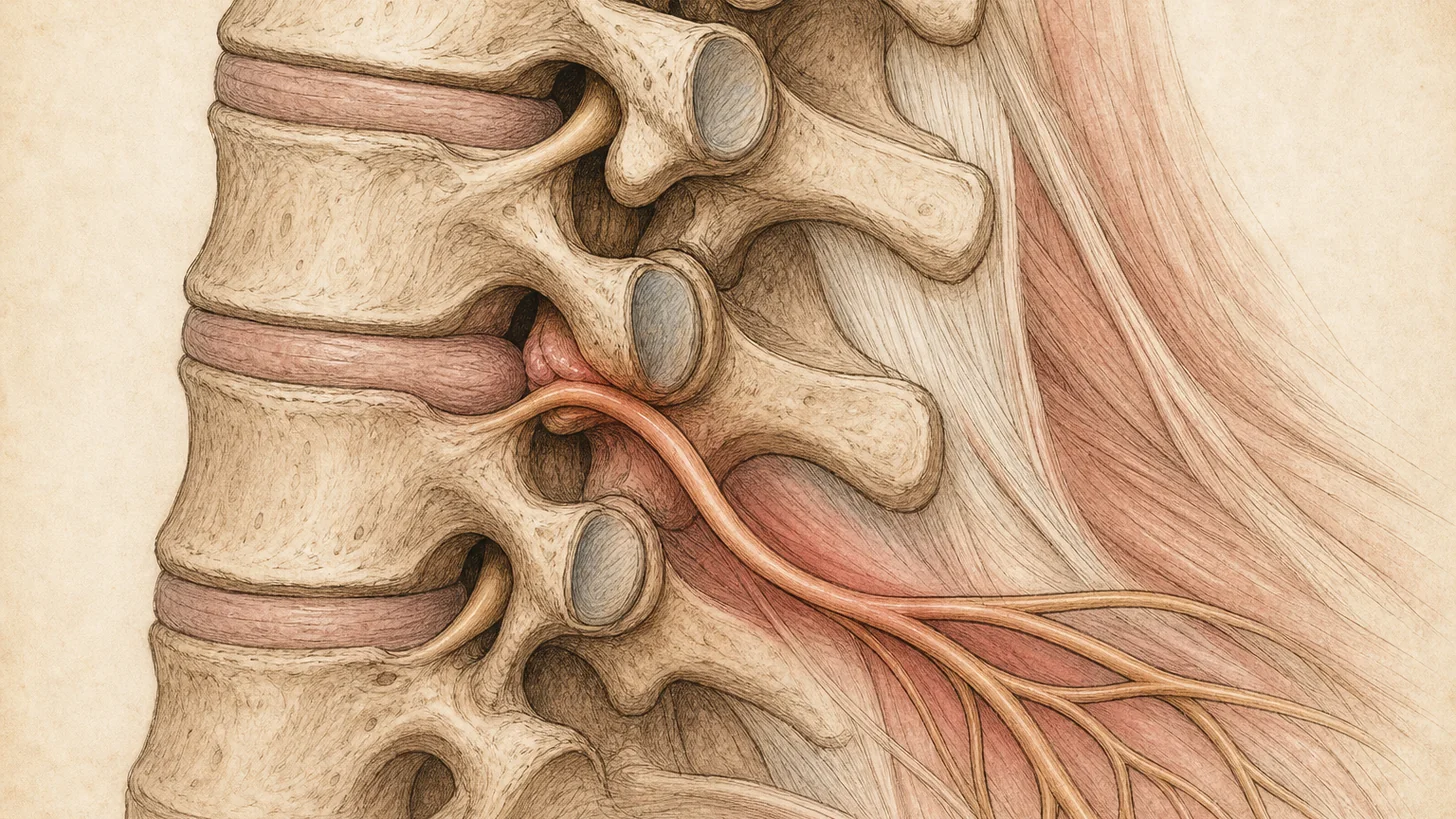
“Pinched nerve” is the phrase patients use for almost any bad neck pain — but in the exam room it means something specific, and the distinction decides the treatment. Cervical radiculopathy affects roughly 83 per 100,000 people per year, peaking between ages 50 and 54, and in the classic Rochester population study the C7 nerve root was involved most often, followed by C6 [1]. Two mechanisms dominate. In younger patients it is usually a soft disc herniation pressing on the root. In older patients it is spondylosis, bony and disc degeneration narrowing the foramen the root exits through. A history of exertion or trauma preceded symptoms in only about 15% of cases [1]. Most people are simply doing nothing unusual when it starts.
Is it actually a pinched nerve? Follow the symptoms
Neck pain has four common sources, and each routes to a different treatment. The sorting rule is where the symptoms go.
Symptoms running below the shoulder, into the arm or fingers — think nerve root. Electric, shooting, or burning pain along a strip of the arm, pins-and-needles or numbness in particular fingers, or weakness (a weak triceps or grip) is the radiculopathy pattern. Which fingers are involved points to the level — thumb-side for C6, middle finger for C7, ring and small fingers for C8.
Pain that stays in the neck and is one-sided, worse with looking up or turning — think facet joint. Cervical facet pain is axial: it sits over the joint column, refers to the shoulder blade region or up toward the head, and does not produce true arm numbness or weakness. When it refers upward it becomes a cervicogenic headache — a side-locked headache generated in the upper neck. Facet pain is tested with a diagnostic medial branch block, and in people whose pain clearly responds, radiofrequency ablation can give months of relief. That is a completely different pathway than a nerve-root problem.
A tight, tender band that hurts to press — think muscle. Trapezius and levator scapulae trigger points ache locally, limit motion, and reproduce pain when pressed, without any arm symptoms. That pattern responds to targeted stretching and, when stubborn, trigger point injections — see the dedicated guide to neck cramps and muscle-driven neck pain.
Involuntary pulling, tilting, or tremor of the head — think movement disorder, not pain generator. A head that drifts or jerks toward one side, especially with a “sensory trick” where touching the chin corrects it, points toward cervical dystonia — frequently missed for years because it gets treated as ordinary neck stiffness.
The neck pain service page covers how we work a patient through this differential in the office.
Which level is pinched? C5, C6, C7, and C8 by symptom
Each cervical nerve root supplies its own strip of skin, its own set of muscles, and, for three of them, its own reflex. The strip is where the pain and tingling run, the muscles are where the weakness shows, and the reflex is what the examiner taps. The root is named for the vertebra above the disc that pinches it at most levels, so the C6–7 disc pinches the C7 root. In the Rochester population study, a C7 monoradiculopathy was the most frequent presentation, followed by C6 [1].
| Root (disc) | Where the pain and tingling run | What gets weak | Reflex |
|---|---|---|---|
| C5 (C4–5) | Neck to the top of the shoulder and the outer upper arm, with numbness over the deltoid | Lifting the arm out to the side (deltoid), some elbow bending | Biceps, reduced |
| C6 (C5–6) | Down the outer forearm to the thumb and index finger | Bending the elbow (biceps), cocking the wrist back | Biceps and brachioradialis, reduced |
| C7 (C6–7) | Down the back of the arm and forearm to the middle finger | Straightening the elbow (triceps), pushing the wrist down, straightening the fingers | Triceps, reduced |
| C8 (C7–T1) | Down the inner forearm to the ring and small fingers | Grip, making a fist, spreading the fingers | None to test |
Three cautions keep the table honest. The skin strips overlap from person to person, so which fingers tingle narrows the level but does not settle it, and weakness or a dropped reflex is the more reliable localizer. A C6 root problem is regularly mistaken for carpal tunnel syndrome, because both numb the thumb and index finger, and a C8 root problem for an ulnar nerve entrapment at the elbow, because both numb the ring and small fingers. The tiebreakers are neck movement, which reproduces a root problem and not a wrist or elbow one, and pain above the elbow, which a peripheral entrapment does not produce. The level matters for where an epidural steroid injection is placed and for reading the MRI against the symptoms, since a scan usually shows changes at several levels and only one of them is the one that hurts.
When the neck problem is actually an emergency
A nerve root and the spinal cord are neighbors, and the cord takes priority. Clumsiness in both hands, deteriorating handwriting, trouble with buttons, unsteady walking, or new bladder or bowel symptoms suggest cervical myelopathy — cord compression from cervical stenosis — and warrant prompt imaging rather than a trial of conservative care. When they are new or getting worse, call 911 or go to the nearest emergency room. The same applies to neck pain with fever or after significant trauma. Neck pain with unexplained weight loss or a cancer history needs a prompt evaluation by a doctor. Call 911 or go to the nearest emergency room only if the pain is severe or rapidly worsening or one of the signs above appears. Radiculopathy hurts — myelopathy disables. The two need to be separated on day one.
How the diagnosis is confirmed
For most patients the diagnosis is made in the exam room, with imaging reserved for decision points. MRI earns its place when symptoms are severe or progressive, when measurable weakness is present, or when an injection or surgery is on the table and the level needs confirmation. It always gets read alongside the exam, because degenerative findings are common in necks that do not hurt. When the picture stays ambiguous — arm symptoms with an unclear level, or overlap with carpal tunnel syndrome or suprascapular nerve entrapment — electrodiagnostics (EMG/nerve conduction) or a diagnostic selective nerve root block helps narrow the source. If numbing one root switches the familiar pain off, that root becomes the likely generator.
What actually gets people better
The natural history is on your side. In the Rochester population data, 90% of patients were asymptomatic or only mildly affected at last follow-up, and about 26% ever came to surgery [1]. Treatment’s job in the first weeks is to control pain while the biology cools down.
Early phase: active treatment beats waiting. A randomized trial in recent-onset cervical radiculopathy found that either a semi-hard collar with rest for three to six weeks, or twice-weekly physiotherapy with home exercises, reduced neck and arm pain substantially more than a wait-and-see policy over the first six weeks [5]. We use a short collar trial sparingly and lean on structured physical therapy — deep cervical flexor and scapular work, nerve glides, and graded return to activity.
Persistent radicular pain: image-guided epidural steroid injection. When six or more weeks of conservative care has not controlled arm-dominant pain, a cervical epidural steroid injection delivers anti-inflammatory medication to the inflamed root. The honest evidence summary: a systematic review and meta-analysis of fluoroscopically guided cervical transforaminal injections found about half of patients achieve at least 50% relief at one to three months, with the caveat that no studies had a control group and the overall evidence quality is rated very low [6]. In practice the injection has two jobs: relief during the window when natural recovery is happening, and information about which level is causing the symptoms.
Surgery: for the right patient, not the impatient one. Progressive weakness, myelopathy, or pain that has failed months of structured care are surgical conversations. The randomized data is clarifying: anterior cervical decompression and fusion plus physiotherapy improved patients faster than physiotherapy alone in year one, but the difference between groups shrank by two years [7], with the longer 5- to 8-year follow-up showing better neck pain and disability scores after surgery while arm pain outcomes were statistically similar [8]. The trial authors’ own conclusion — structured physiotherapy should be tried before surgery is chosen — matches how we sequence care.
When to see a specialist
Three situations justify skipping the wait: arm symptoms with measurable weakness, symptoms that are worsening rather than plateauing, or pain that has not meaningfully improved after six weeks of real conservative care. An interventional evaluation sorts the nerve root from the facet joint and the muscle at the first visit, narrows the level with a diagnostic block when it matters, and keeps the escalation path — therapy, injection, surgical referral — in the correct order.
References
This article is reviewed against the peer-reviewed literature. Citations retrieved from PubMed.
- Radhakrishnan K, Litchy WJ, O’Fallon WM, Kurland LT. Epidemiology of cervical radiculopathy. A population-based study from Rochester, Minnesota, 1976 through 1990. Brain. 1994;117(Pt 2):325-35. doi:10.1093/brain/117.2.325 · PubMed
- Wainner RS, Fritz JM, Irrgang JJ, Boninger ML, Delitto A, Allison S. Reliability and diagnostic accuracy of the clinical examination and patient self-report measures for cervical radiculopathy. Spine. 2003;28(1):52-62. doi:10.1097/00007632-200301010-00014 · PubMed
- Thoomes EJ, van Geest S, van der Windt DA, et al. Value of physical tests in diagnosing cervical radiculopathy: a systematic review. The Spine Journal. 2018;18(1):179-189. doi:10.1016/j.spinee.2017.08.241 · PubMed
- Thoomes EJ, Arvanitidis M, van Geest S, et al. Diagnostic accuracy of physical examination tests for painful cervical radiculopathy: update of a systematic review and meta-analysis. BMC Musculoskeletal Disorders. 2026;27(1). doi:10.1186/s12891-026-09551-0 · PubMed
- Kuijper B, Tans JT, Beelen A, Nollet F, de Visser M. Cervical collar or physiotherapy versus wait and see policy for recent onset cervical radiculopathy: randomised trial. BMJ. 2009;339:b3883. doi:10.1136/bmj.b3883 · PubMed
- Conger A, Cushman DM, Speckman RA, Burnham T, Teramoto M, McCormick ZL. The Effectiveness of Fluoroscopically Guided Cervical Transforaminal Epidural Steroid Injection for the Treatment of Radicular Pain; a Systematic Review and Meta-analysis. Pain Medicine. 2020;21(1):41-54. doi:10.1093/pm/pnz127 · PubMed
- Engquist M, Löfgren H, Öberg B, et al. Surgery versus nonsurgical treatment of cervical radiculopathy: a prospective, randomized study comparing surgery plus physiotherapy with physiotherapy alone with a 2-year follow-up. Spine. 2013;38(20):1715-22. doi:10.1097/BRS.0b013e31829ff095 · PubMed
- Engquist M, Löfgren H, Öberg B, et al. A 5- to 8-year randomized study on the treatment of cervical radiculopathy: anterior cervical decompression and fusion plus physiotherapy versus physiotherapy alone. Journal of Neurosurgery: Spine. 2016;26(1):19-27. doi:10.3171/2016.6.SPINE151427 · PubMed
Frequently Asked Questions
The defining feature is that the symptoms travel: sharp or electric pain, tingling, or numbness that runs from the neck through the shoulder blade and down the arm, often into specific fingers. The C7 nerve root — the most commonly affected — typically sends symptoms toward the middle finger, while C6 runs toward the thumb and index finger. Weakness can appear in the muscles that root supplies. Pain that stays in the neck without arm symptoms usually is not a pinched nerve — it is more often a facet joint or muscular problem.
Most cases improve without surgery. In the largest population study of cervical radiculopathy, 90% of patients were asymptomatic or only mildly affected at long-term follow-up, though about a third had a recurrence at some point. Meaningful improvement usually happens over weeks. A randomized trial found that a semi-hard collar with rest, or physiotherapy with home exercises, reduced arm pain faster than waiting it out during the first six weeks. Symptoms that are severe, progressive, or unimproved after roughly six weeks deserve escalation.
Follow the symptoms. A pulled muscle hurts locally — in the neck, upper trapezius, or along the shoulder blade — and feels worse with stretch or pressure on the muscle itself, without tingling, numbness, or weakness in the arm. A pinched nerve produces symptoms below the shoulder in a nerve-root pattern: pain or pins-and-needles running past the elbow, often into specific fingers. Turning or tilting the head toward the painful side and adding gentle downward pressure (what an examiner does in Spurling's test) tends to reproduce nerve pain, not muscle pain.
Not immediately, in most cases. The diagnosis is clinical — history plus a physical examination using tests like Spurling's and upper limb neurodynamic tests. Imaging earns its place when symptoms are severe or progressive, when weakness is present, when red flags appear, or when an injection or surgery is being considered and the exact level needs to be pinned down. MRI findings also need interpretation alongside the exam, because degenerative changes are common in people with no symptoms at all.
When six or more weeks of conservative care — activity modification, a short collar trial, physical therapy — has not controlled radicular pain, an image-guided cervical epidural steroid injection is the usual next step. A systematic review and meta-analysis found roughly half of patients achieve at least 50% pain relief at one to three months after a fluoroscopically guided cervical transforaminal injection. Surgery is reserved for progressive weakness, myelopathy, or persistent pain that has failed structured nonsurgical care. In a randomized trial, surgery improved patients faster than physiotherapy in the first year, but the difference had narrowed by two years.
A pinched C6 root (the C5–6 disc) sends pain and tingling down the outer forearm into the thumb and index finger, weakens elbow bending and cocking the wrist back, and dulls the biceps and brachioradialis reflexes. A pinched C7 root (the C6–7 disc) runs down the back of the arm into the middle finger, weakens straightening the elbow and the fingers, and dulls the triceps reflex. C7 is the most common level and C6 the next. The finger pattern narrows the level but overlaps between people, so weakness or a lost reflex is the more reliable sign. A C6 pattern is often mistaken for carpal tunnel, and neck movement reproducing the symptoms is the tiebreaker.
Signs that the spinal cord itself is compressed need prompt attention: clumsiness in both hands, trouble with buttons or handwriting, unsteady walking, new bladder or bowel changes, or symptoms in both arms or in the legs. If these come on suddenly or are getting worse, call 911 or go to the nearest emergency room. The same applies to neck pain after significant trauma, and neck pain with fever, unexplained weight loss or a history of cancer needs same-day medical evaluation. These are not pinched-nerve patterns, and they need imaging and evaluation rather than a trial of home care.