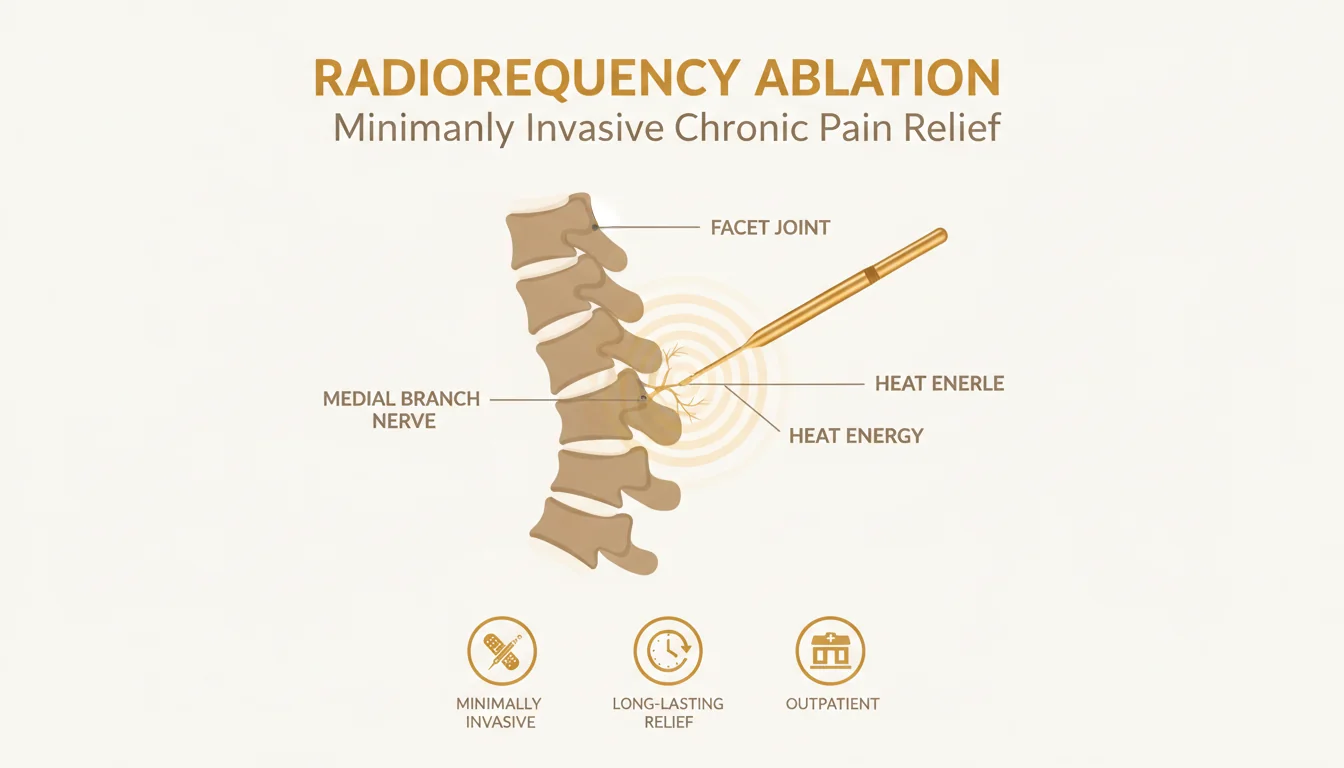
At Modal Pain Management in Midtown Manhattan, Dr. Alex Movshis performs image-guided sacroiliac (SI) joint radiofrequency ablation — lateral branch RFA of the L5 dorsal ramus and the S1–S3 lateral branches — as the durable treatment step for confirmed SI joint pain. The sacroiliac joint accounts for an estimated 15–30% of chronic low back pain, and for many of those patients the treatment story follows the same arc: a diagnostic SI joint injection finally identifies the pain source after months of unrevealing lumbar MRIs, the steroid works — and then it wears off in 6 to 12 weeks, again and again. Lateral branch radiofrequency ablation breaks that cycle. By interrupting the small sensory nerves that carry pain from the joint rather than repeatedly medicating the joint itself, a single 45–60 minute procedure produces 6–12+ months of relief per cycle, is safely repeatable, and adds no cumulative steroid exposure. Located at 369 Lexington Avenue Floor 25 in NYC 10017, we perform the procedure under live fluoroscopy using lesion techniques matched to the published evidence — and at a flat, all-inclusive self-pay price of $1,500 for patients paying directly.
Why the SI Joint Needs Its Own Ablation Technique
The sacroiliac joint is not innervated like the lumbar facet joints, and that anatomic difference is the single most important fact about this procedure. A lumbar facet joint receives its pain supply from two medial branch nerves that sit in predictable bony grooves — which is why facet radiofrequency ablation after a positive medial branch block is so reproducible. The posterior SI joint, by contrast, is supplied by the L5 dorsal ramus and the lateral branches of the S1, S2, and S3 dorsal sacral rami — a fan of small nerves that exit the sacral foramina and vary in number, depth, and position from person to person, and even from side to side in the same person.
That variability killed the naive version of this procedure. A single conventional lesion placed where the lateral branches “should” be will miss them in a meaningful fraction of patients. The techniques that produced the positive randomized-trial results solve the coverage problem in one of two ways. Cooled-tip radiofrequency circulates saline through the electrode, allowing more energy delivery without charring at the tip, which produces a large spherical lesion at each target — big enough to capture a lateral branch even when its position is atypical. Bipolar “palisade” strip lesioning places a row of closely spaced cannulae along the dorsal sacrum lateral to the foramina and creates a continuous strip lesion that the variable branches cannot slip through. Dr. Movshis selects the lesion strategy for each patient based on their sacral anatomy on imaging and the pattern of their diagnostic block response.
The Diagnostic Gateway: No Ablation Without a Positive Block
SI joint RFA is only as good as the diagnosis in front of it, and Modal Pain does not perform the procedure without block confirmation. Two pathways lead in. The first is the image-guided intra-articular SI joint injection — if the local anesthetic phase relieves 50–80% of the typical buttock and low-back pain during the anesthetic window, the joint is confirmed as the dominant pain generator. The second, used when RFA is the likely next step or when the insurer’s policy requires it, is a set of diagnostic lateral branch blocks: small volumes of local anesthetic placed directly on the L5 dorsal ramus and S1–S3 lateral branches — the exact nerves the ablation would treat. Relief during the block predicts relief from the ablation, because both act on the same wires.
This gateway is not bureaucratic caution. In every positive trial of the procedure, patients were selected by block response, and block-selected patients are the population in which the 57–79% success rates were observed. Skipping the diagnostic step means operating on a guess.
The Evidence, Honestly Read
The randomized evidence for lateral branch RFA is genuinely good — and it comes with a lesson about technique that an honest clinic should explain rather than hide.
Cohen 2008 (Anesthesiology). The first placebo-controlled randomized trial: 28 patients with injection-confirmed SI joint pain received either cooled-probe lateral branch denervation of L4–L5 dorsal rami and S1–S3 lateral branches or a sham procedure. At 1, 3, and 6 months, 79%, 64%, and 57% of ablated patients had 50%+ pain relief with significant functional improvement, versus 14% of placebo patients at 1 month and none at 3 months.
Patel 2012 (Pain Medicine) and the 12-month follow-up (Pain Practice). Fifty-one patients with dual-positive lateral branch blocks were randomized 2:1 to cooled lateral branch neurotomy or sham. At 3 months, 47% of treated patients versus 12% of sham patients met the composite treatment-success criteria, with statistically significant gains in pain, disability, physical function, and quality of life — and the treated group’s success rate rose to 59% at 9 months. The 12-month follow-up publication documented durable improvement a full year after a single procedure: a mean 2.7-point drop in pain scores and a 13.9-point improvement in Oswestry disability score.
The negative trial — and why it strengthens the case for technique. The 2017 Dutch MINT trials (Juch, JAMA) found no meaningful benefit of radiofrequency denervation added to exercise for SI joint pain. The interventional pain community’s critique of that result has been consistent and specific: the protocol used a simplified conventional monopolar technique that lesion-mapping studies predict will miss a substantial share of sacral lateral branches, and patient selection used a single block with a low relief threshold. In other words, the trial tested a version of the procedure that the anatomy says should fail — and it did. The practical conclusion is not that SI joint RFA doesn’t work; it is that outcomes depend on doing the procedure the way the positive trials did it: strict block-based selection, and a lesion strategy (cooled-tip or bipolar palisade) that actually covers the lateral branch territory.
Bipolar palisade data. A randomized comparison by Cánovas Martínez and colleagues (2016) found that bipolar palisade RFA of the S1–S3 lateral branches outperformed intra-articular steroid injection, with roughly half of ablated patients maintaining improvement at 12 months while the injection group’s relief had faded by 3 months — consistent with the strip-lesion logic above.
What the Procedure Is Like
Before. You arrive without needing to fast (unless IV sedation is planned), medications reviewed in advance — blood thinners are managed per ASRA periprocedural guidelines, most patients staying on aspirin. The skin over the sacrum is prepped and numbed with lidocaine.
During. Under live fluoroscopy, Dr. Movshis positions the radiofrequency cannulae at the L5 dorsal ramus and along the lateral border of the S1–S3 posterior sacral foramina. Sensory testing at each target confirms the electrode sits on a sensory branch and safely away from anything that matters for movement — the lateral branches carry no motor fibers to the legs. Each lesion cycle runs about 90 seconds (150 seconds for cooled-tip). You’ll feel deep pressure or a brief ache over the sacrum during the cycles; patients who chose light sedation typically remember little of it. Total room time is 45–60 minutes.
After. A short observation period, then home — with a driver if you had sedation, on your own if not. Soreness over the treated area lasts 3–7 days and responds to ice and acetaminophen. About one patient in ten has a temporary neuritis flare in the first two weeks; it resolves without treatment. Normal activity resumes in 24–48 hours, and the real benefit declares itself over 2–4 weeks. We formally measure the response at a 4–6 week follow-up and then track durability at 3, 6, and 12 months so the repeat cycle — if one is ever needed — is planned rather than improvised.
Cost: $1,500 Flat, or Most PPO Insurance
For patients paying directly, SI joint radiofrequency ablation at Modal Pain Management is a flat, all-inclusive $1,500 per session — physician fee, fluoroscopic guidance, and medication included, no separate facility fee. It sits alongside every other procedure price on our self-pay pricing page, and 0%-interest monthly payment plans through Cherry can spread the cost. The arithmetic worth doing: a $700 steroid injection delivering 6–12 weeks of relief costs more per month of relief than a $1,500 ablation delivering 6–12+ months — which is why patients on a repeat-injection cycle so often come out ahead by escalating.
For insured patients, most major commercial PPO plans (United Healthcare, Aetna, Cigna, BlueCross BlueShield, Oxford, Empire BCBS) cover lateral branch RFA after positive diagnostic blocks, with prior authorization that Modal Pain obtains on your behalf. We do not accept Medicare, Medicaid, HMO plans, or workers’ compensation. Verify your benefits before deciding which route costs you less.
Who Should — and Shouldn’t — Have This Procedure
The strongest candidates share three features: SI joint pain confirmed by a positive diagnostic block; a good but short-lived response to steroid injection (or a desire to avoid repeated steroid exposure altogether); and chronic mechanical pain — including the common post-lumbar-fusion pattern, where the SI joint absorbs extra load after the spine above it is fixed and becomes painful in 30–40% of multilevel fusion patients within five years.
The procedure is the wrong tool for inflammatory sacroiliitis from ankylosing spondylitis or psoriatic arthritis, where the driver is systemic and the foundation of care is rheumatologic disease-modifying therapy, not denervation. It is also not first-line for acute SI joint pain — most recent-onset cases settle with physical therapy and, when needed, a single injection. And patients with true structural instability on imaging may need a surgical fusion conversation instead; Modal Pain coordinates that referral when the ladder points there.
If your low-back or buttock pain has already been traced to the SI joint — or you suspect it should be — the consultation visit sorts out where you are on that ladder and whether ablation is your next step. Book online or call (646) 290-6660.
References
- Cohen SP, Hurley RW, Buckenmaier CC 3rd, Kurihara C, Morlando B, Dragovich A. Randomized placebo-controlled study evaluating lateral branch radiofrequency denervation for sacroiliac joint pain. Anesthesiology. 2008;109(2):279–88. doi:10.1097/ALN.0b013e31817f4c7c · PubMed
- Patel N, Gross A, Brown L, Gekht G. A randomized, placebo-controlled study to assess the efficacy of lateral branch neurotomy for chronic sacroiliac joint pain. Pain Med. 2012;13(3):383–98. doi:10.1111/j.1526-4637.2012.01328.x · PubMed
- Patel N. Twelve-Month Follow-Up of a Randomized Trial Assessing Cooled Radiofrequency Denervation as a Treatment for Sacroiliac Region Pain. Pain Pract. 2016;16(2):154–67. doi:10.1111/papr.12269 · PubMed
- Juch JNS, Maas ET, Ostelo RWJG, et al. Effect of Radiofrequency Denervation on Pain Intensity Among Patients With Chronic Low Back Pain: The Mint Randomized Clinical Trials. JAMA. 2017;318(1):68–81. doi:10.1001/jama.2017.7918 · PubMed
- Cánovas Martínez L, Orduña Valls J, Paramés Mosquera E, Lamelas Rodríguez L, Rojas Gil S, Domínguez García M. Sacroiliac joint pain: Prospective, randomised, experimental and comparative study of thermal radiofrequency with sacroiliac joint block. Rev Esp Anestesiol Reanim. 2016;63(5):267–72. doi:10.1016/j.redar.2015.08.003 · PubMed
- Simopoulos TT, Manchikanti L, Gupta S, et al. Systematic Review of the Diagnostic Accuracy and Therapeutic Effectiveness of Sacroiliac Joint Interventions. Pain Physician. 2015;18(5):E713–56. PubMed
- Cohen SP, Chen Y, Neufeld NJ. Sacroiliac joint pain: a comprehensive review of epidemiology, diagnosis and treatment. Expert Rev Neurother. 2013;13(1):99–116. doi:10.1586/ern.12.148 · PubMed
- Schwarzer AC, Aprill CN, Bogduk N. The sacroiliac joint in chronic low back pain. Spine (Phila Pa 1976). 1995;20(1):31–7. doi:10.1097/00007632-199501000-00007 · PubMed
- Maigne JY, Aivaliklis A, Pfefer F. Results of sacroiliac joint double block and value of sacroiliac pain provocation tests in 54 patients with low back pain. Spine (Phila Pa 1976). 1996;21(16):1889–92. doi:10.1097/00007632-199608150-00012 · PubMed