The complaint is specific and common: a deep ache in the buttock that builds the longer you sit, eases when you stand and walk, and turns a long meeting, a flight, or a drive into something you dread. Most people assume it’s sciatica and start stretching. Sometimes that’s right. Often it isn’t — the pain is coming from a structure in the buttock itself, and which one decides the treatment. The single most useful move is to figure out where the pain actually sits.
Where it hurts tells you what it is
Two locations split the differential: the deep mid-buttock versus the sit bone.
Deep mid-buttock, often with leg symptoms — piriformis / deep gluteal syndrome. When the pain is deep in the center of the buttock and can send tingling or aching down the back of the leg, the likely source is the sciatic nerve being irritated in the deep gluteal space — classically by the piriformis muscle, but also by nearby muscles, fibrous bands, or the hamstring origin. “Deep gluteal syndrome” is the umbrella term for this group, because the same buttock pain has several possible generators in that one space [1][3]. Piriformis syndrome is the best-known of them: a recent review describes its core triad as buttock pain, tenderness over the greater sciatic notch, and aggravation by sitting, and estimates it accounts for roughly 5-6% of low-back, buttock, and leg pain [2]. The tell is deep, central buttock pain, reproduced when the hip is flexed, drawn across the body, and rotated inward (the FAIR test), often with some sciatic-type radiation [1].
Right on the sit bone — proximal hamstring tendinopathy. If you can put a finger on exactly where it hurts and it’s the bony sit bone, especially in a runner, think proximal hamstring tendinopathy. The hamstring tendons attach at the ischial tuberosity, and the condition produces deep, localized pain right there — characteristically worse with running on slopes and with prolonged sitting on hard surfaces, particularly while driving [4]. It’s an overuse tendon problem, not a nerve problem.
Right on the sit bone, after lots of sitting — ischiogluteal bursitis. The same sit-bone location, but driven by sitting itself: the ischiogluteal bursa between the tuberosity and the gluteus maximus can become inflamed from prolonged pressure (the old name was “weaver’s bottom”). In a clinical series, the most common presenting symptom was buttock pain with tenderness over the ischial tuberosity, and about 80% of patients settled with conservative care while a minority needed an injection [5].
What this is usually not: pain that clearly starts in the low back and shoots down the leg is more likely spinal sciatica, a different problem treated at the spine. And a band of pain across the upper buttock and iliac crest rather than deep or at the sit bone points instead to cluneal nerve entrapment.
How it’s diagnosed
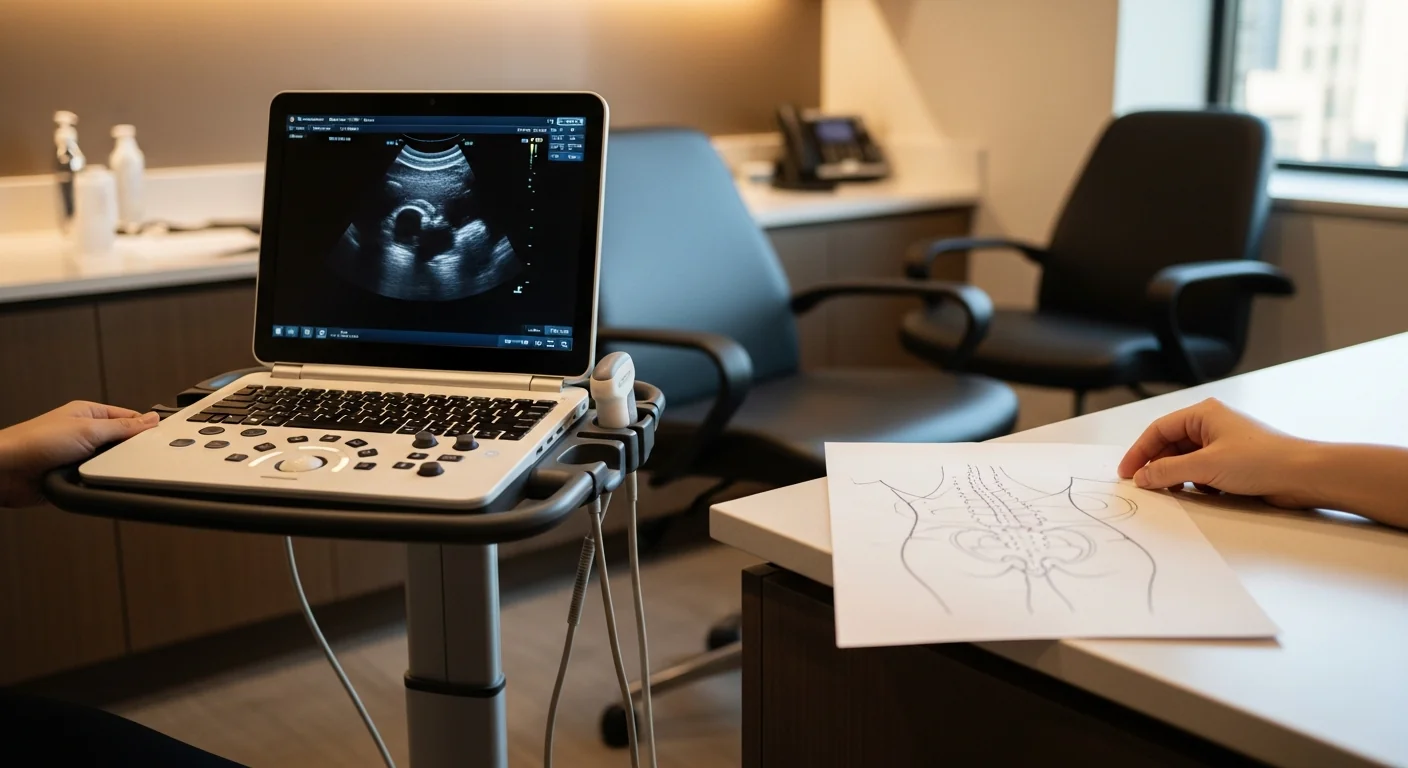
After a quick screen for the things that aren’t a buttock problem — true radicular sciatica from the spine, and the rare red flags below — the diagnosis is clinical and confirmed by response to a targeted injection. The exam localizes the pain (deep mid-buttock versus the sit bone), runs provocative tests like the FAIR test for the piriformis, and presses the ischial tuberosity for hamstring and bursal sources [1][2]. Imaging has a supporting role: ultrasound can show piriformis thickening, a fluid-filled bursa, or hamstring tendon change, and MRI is used mainly to exclude spinal and hip causes — but no scan reliably confirms piriformis syndrome on its own [2][3]. The most specific test is an image-guided injection: numbing the suspected structure and watching the familiar pain disappear both identifies the generator and predicts what will treat it [3].
Evidence-based treatment
Treatment is matched to the cause, which is exactly why pinning the cause down comes first.
Proximal hamstring tendinopathy — load it, don’t rest it. Tendons respond to graded loading. A progressive hamstring-loading program (isometrics, then heavier slow loading, then energy-storage work) reduces pain and restores function, whereas rest alone tends to stall [4]. Our physical therapy program is built around that kind of staged loading.
Piriformis and deep gluteal syndrome — targeted therapy, then a precise injection. First-line is focused physical therapy: hip external-rotator and lumbopelvic strengthening and piriformis-specific mobility [2]. When pain persists, an image-guided injection of corticosteroid plus local anesthetic — or botulinum toxin for stubborn, recurrent cases — is supported in the literature and delivered through our trigger point injections and nerve blocks [2][3]. Image guidance matters here, because the sciatic nerve runs right beside the target.
Ischiogluteal bursitis — modify, then inject if needed. Most cases settle with activity and seat modification (a cutout cushion, standing breaks, off hard surfaces); the minority that don’t respond well to an image-guided injection [5].
The common thread is mechanical relief while the specific cause is treated: a cutout cushion under the painful side, standing and walking for a couple of minutes every 30-45 minutes, and staying off hard seats.
When to see a specialist
See an interventional pain physician if buttock pain has lasted more than a few weeks, keeps returning after stretching or generic therapy, or is clearly worse the longer you sit — that pattern is the signal that a specific structure in the buttock can be identified and treated. Bring what makes it better and worse and exactly where it hurts; that localization does most of the diagnostic work. Two things override everything else and belong in urgent care, not a clinic: new leg weakness, numbness in the groin, or any change in bladder or bowel control (a spinal emergency), and constant pain that is present at rest and at night with unexplained weight loss or a history of cancer.
Verify your insurance covers a buttock pain workup Book a same-week evaluation
Or call (646) 290-6660.
For the deep-buttock, sciatic-type pattern specifically, see the piriformis syndrome page.
References
This article is reviewed against the peer-reviewed literature. Citations retrieved from PubMed.
- Hu YE, Ho GWK, Tortland PD. Deep Gluteal Syndrome: A Pain in the Buttock. Current Sports Medicine Reports. 2021;20(6):279-285. doi:10.1249/JSR.0000000000000848 · PubMed
- Lo JK, Robinson LR. Piriformis syndrome. Handbook of Clinical Neurology. 2024;201:203-226. doi:10.1016/B978-0-323-90108-6.00002-8 · PubMed
- Hernando MF, Cerezal L, Pérez-Carro L, Abascal F, Canga A. Deep gluteal syndrome: anatomy, imaging, and management of sciatic nerve entrapments in the subgluteal space. Skeletal Radiology. 2015;44(7):919-34. doi:10.1007/s00256-015-2124-6 · PubMed
- Campos-Villegas C, Ortega-Pérez de Villar L, Gámez-Payá J, Alarcón-Jiménez J, de Bernardo N. Clinical Progression and Load Management For Proximal Hamstring Tendinopathy In A Long-Distance Runner: A Case Report. International Journal of Sports Physical Therapy. 2024;19(5):609-617. doi:10.26603/001c.116578 · PubMed
- Roh YH, Yoo SJ, Choi YH, Yang HC, Nam KW. Effects of Inflammatory Disease on Clinical Progression and Treatment of Ischiogluteal Bursitis: A Retrospective Observational Study. Malaysian Orthopaedic Journal. 2020;14(3):32-41. doi:10.5704/MOJ.2011.007 · PubMed
Frequently Asked Questions
Most often one of three things, and where it hurts tells them apart. Deep in the middle of the buttock, sometimes with tingling down the leg, points to piriformis syndrome or the broader deep gluteal syndrome — irritation of the sciatic nerve in the deep gluteal space. Pain right on the sit bone (the ischial tuberosity you feel when you sit on a hard chair) points to either proximal hamstring tendinopathy, common in runners, or ischiogluteal bursitis from prolonged sitting on hard surfaces. Sitting aggravates all of them because it compresses these structures directly. True spinal sciatica — pain that starts in the back and shoots down the leg — is a separate cause that needs a different treatment.
Because sitting puts direct, sustained pressure on exactly the structures involved. In piriformis and deep gluteal syndrome, sitting compresses the piriformis muscle against the sciatic nerve underneath it. In proximal hamstring tendinopathy and ischiogluteal bursitis, your body weight presses straight down on the ischial tuberosity where the hamstring tendon attaches and the bursa sits. Hard seats, long drives, and a wallet in the back pocket all make it worse. Standing up and walking usually relieves it within a minute or two — that pattern (worse sitting, better moving) is itself a useful diagnostic clue.
No. Sciatica is a symptom — pain traveling along the sciatic nerve — and it has many causes. Buttock pain when sitting is frequently NOT spinal sciatica at all, but a local problem in the buttock: the piriformis or deep gluteal space, the hamstring origin, or the bursa. Piriformis syndrome is estimated to account for roughly 5-6% of low-back, buttock, and leg pain. The practical difference: spinal sciatica radiates from the back down the leg and is treated at the spine, whereas these buttock causes are tender to direct pressure on the buttock and are treated locally.
Location and a focused exam separate them, and a diagnostic injection confirms when there's doubt. Piriformis and deep gluteal pain is deep in the mid-buttock, reproduced by the FAIR test (flexing, adducting, and internally rotating the hip), and may send symptoms down the leg. Proximal hamstring tendinopathy is felt right on the sit bone, worse with running, lunging, and prolonged sitting, and is tender exactly at the ischial tuberosity. Ischiogluteal bursitis is also at the sit bone but follows lots of hard-surface sitting and is tender there. Ultrasound and MRI help, but an image-guided injection of local anesthetic into the suspected structure — if it abolishes the pain — is the most specific confirmation.
It depends on the cause, which is the whole reason to identify it first. Proximal hamstring tendinopathy responds best to a progressive tendon-loading exercise program, not rest. Piriformis and deep gluteal syndrome respond to targeted physical therapy (hip external-rotator and lumbopelvic work) plus, when needed, an image-guided injection of corticosteroid and local anesthetic — or botulinum toxin for stubborn cases. Ischiogluteal bursitis usually settles with activity and seat modification, with an injection reserved for cases that don't. Across all of them: a cutout cushion, standing breaks every 30-45 minutes, and avoiding hard seats reduce the daily aggravation.
Use a firm seat with a cushion that has a cutout under the painful side, so your weight isn't pressing directly on the sore sit bone or deep buttock. Sit with both feet flat, hips slightly higher than the knees, weight even across both sit bones rather than leaned to one side, and a small lumbar support. Avoid crossing your legs, sitting on a wallet, and low soft couches or deep car seats that drop the pelvis into a painful position. Most importantly, stand and walk for a couple of minutes every half hour — these structures tighten and load up with sustained sitting no matter how good the posture.
Most major commercial PPO plans cover an evaluation for buttock and deep gluteal pain and the associated diagnostic injections, often with prior authorization. Modal Pain verifies your benefits before the first visit. We accept most major commercial PPO plans and do not participate with Medicare or Medicaid. <a href="/verify-insurance/">Check your plan</a> or call (646) 290-6660.