The story is familiar in interventional pain medicine: someone has a discectomy, laminectomy, or fusion, gets better for a while or never quite does, and months later is living with the same leg pain or a new band of back pain. They are told it is “scar tissue,” handed a longer opioid prescription, or offered a revision operation. What is missing from that path is the one question that changes everything — which of the several distinct problems under the “failed back surgery” umbrella is actually generating the pain.
It is not one diagnosis — it is at least five
The single most useful reframe for post-laminectomy syndrome is to stop treating it as one disease. The current review literature breaks persistent pain after spine surgery into mechanistically separate categories, and each has its own diagnostic anchor and its own treatment [1].
Recurrent or residual disc herniation. A disc can re-herniate at the same level and side after a discectomy. Recurrence is estimated at around 5%, and it is more likely in smokers and in patients who are overweight or have diabetes — all modifiable [3]. This produces a return of the original radicular (leg) pain.
Adjacent-segment disease. After a fusion, the levels above and below carry more load and degenerate faster, producing new radicular pain from a new disc or foraminal narrowing [1].
Sacroiliac joint pain. Fusion to the sacrum shifts stress onto the sacroiliac joints, and a meaningful share of fusion patients develop SI joint pain — felt in the buttock and posterior thigh, and confirmed with an SI joint block.
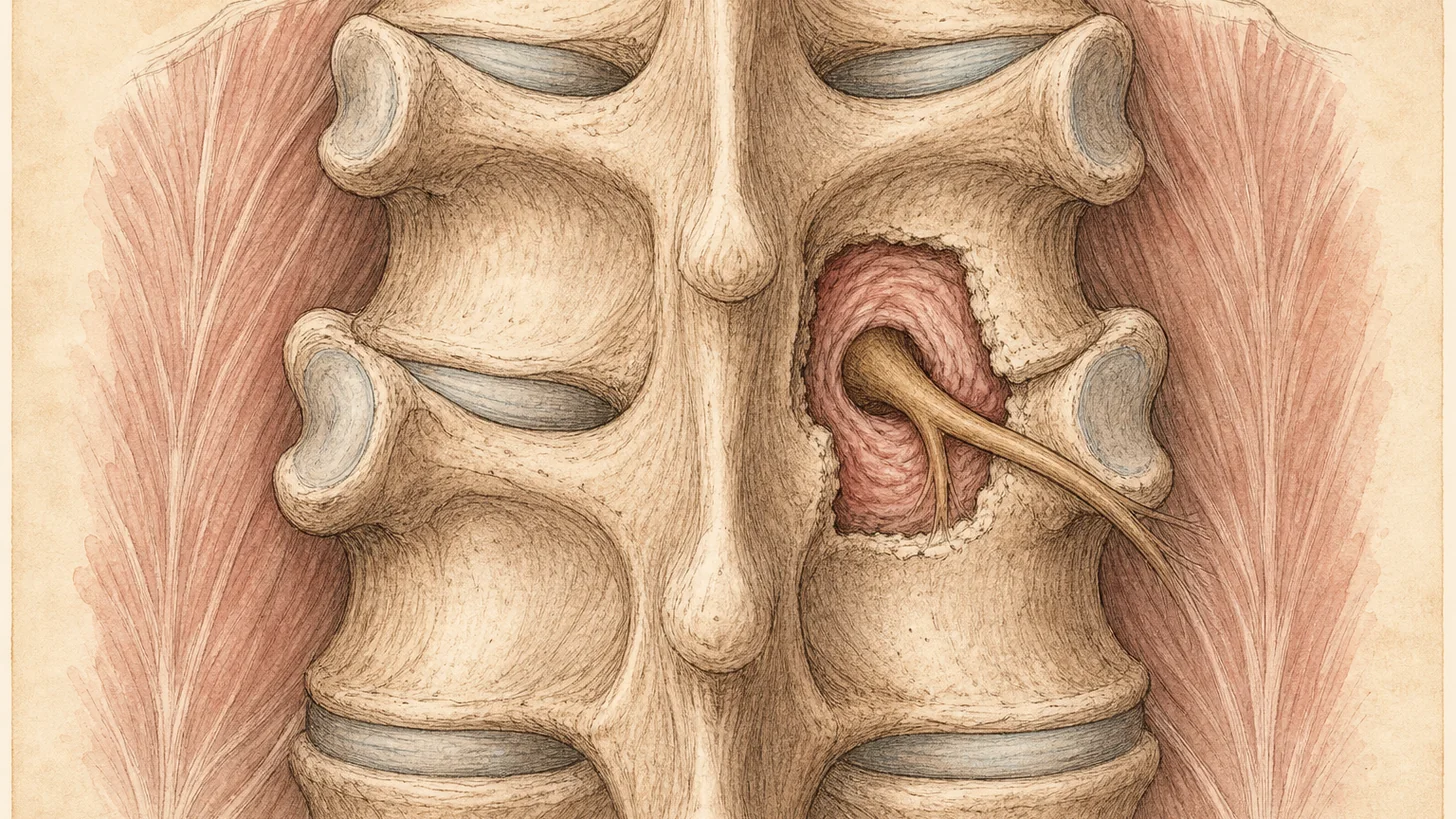
Epidural fibrosis. Scar tissue can tether a nerve root, producing persistent radicular pain. It is thought to account for 20-36% of all failed back surgery syndrome and is identified on MRI with contrast [2].
Wrong-level or technical failure, and complications. Sometimes the original procedure was done at the wrong level, or for a generator (such as the SI joint) it was never going to fix; sometimes a fragment was retained or a fusion did not heal; and a minority develop arachnoiditis or a “battered root” [1]. These are distinct again.
The practical consequence is simple: a treatment aimed at the wrong one of these will fail, which is exactly why “failed back surgery syndrome,” treated as a single label, so often does.
Why a second surgery usually isn’t the answer
The instinct after a surgery that didn’t work is another surgery. For most post-laminectomy pain, that instinct is wrong. Revision in the same field carries a real risk of generating additional nerve injury, and the outcomes are sobering: for recurrent disc herniation specifically, reoperation results are consistently inferior to those of the first operation, and patient satisfaction is lower [3]. Fusion belongs to genuine instability or deformity, not to pain alone. Before agreeing to revision, the higher-yield path is a focused interventional evaluation that identifies the pain generator — because if the generator is a facet joint, the SI joint, or a scar-tethered nerve root, another operation on the disc or canal will not touch it.
How it’s diagnosed
Diagnosis combines the surgical history, a focused neurological exam, and targeted imaging — an MRI with contrast is what distinguishes recurrent disc from epidural fibrosis, since scar enhances with contrast and disc material does not [2]. But imaging rarely settles it alone, because post-surgical spines look abnormal whether or not they hurt. The decisive step is the diagnostic block sequence: a medial branch block to test a facet generator, a sacroiliac joint block for buttock-dominant pain, and a selective nerve root block for radicular pain from scar or recurrent disc. Each block both identifies the generator and predicts which longer-term treatment will work.
Evidence-based treatment
Treatment follows the cause, and honest framing matters here because the evidence is uneven.
Conservative care and medication have only limited evidence as standalone treatments for established post-laminectomy syndrome [1]. They are a reasonable foundation, not a solution.
Epidural steroid injections help radicular pain in the shorter term; the evidence is strongest for short-term relief of radicular pain and more limited specifically in post-laminectomy syndrome [4]. Our epidural steroid injection program is used when a nerve root is the confirmed generator.
Percutaneous epidural adhesiolysis is the targeted treatment when epidural fibrosis is tethering the nerve root, with Level I to II evidence in post-lumbar-surgery syndrome [2][4].
Radiofrequency treatment addresses a confirmed facet generator (after a positive medial branch block) or, in some protocols, the dorsal root ganglion for radicular pain [1]. A sacroiliac joint injection and, when indicated, radiofrequency treats post-fusion SI joint pain.
Spinal cord stimulation — the honest version. SCS is the most-discussed option for refractory neuropathic leg pain after surgery, and the evidence cuts both ways. A multicenter randomized trial found that adding multicolumn SCS to medical management improved pain, function, and quality of life versus medical management alone, sustained to two years [5]. But a more recent placebo-controlled trial — real burst stimulation versus sham, in patients with chronic radicular pain after lumbar surgery — found no significant difference between active stimulation and placebo [6]. The reasonable reading is that stimulation helps some carefully selected patients, that a trial period before any permanent implant is essential, and that anyone promising a guaranteed result is overstating the evidence.
The thread through all of it: treat the specific generator you have confirmed, not the label.
When to see a specialist
See an interventional pain physician if back or leg pain has persisted beyond the expected recovery window after spine surgery, if it has returned after an initial improvement, or — especially — if you are being offered a revision operation before any diagnostic block has been done. Get the operative report from the index surgery and your prior imaging, and bring them. One caution that overrides everything else: new leg weakness, numbness in the groin, or loss of bladder or bowel control after spine surgery is a surgical emergency and belongs in an emergency room, not a clinic.
Verify your insurance covers a post-laminectomy syndrome workup Book a same-week evaluation
Or call (646) 290-6660.
For the broader framework on pain after surgery, see the post-surgical and iatrogenic nerve pain page.
References
This article is reviewed against the peer-reviewed literature. Citations retrieved from PubMed.
- van de Minkelis J, Peene L, Cohen SP, et al. Persistent spinal pain syndrome type 2. Pain Practice. 2024;24(7):919-936. doi:10.1111/papr.13379 · PubMed
- Epter RS, Helm S, Hayek SM, Benyamin RM, Smith HS, Abdi S. Systematic review of percutaneous adhesiolysis and management of chronic low back pain in post lumbar surgery syndrome. Pain Physician. 2009;12(2):361-78. PubMed
- Zileli M, Oertel J, Sharif S, Zygourakis C. Lumbar disc herniation: Prevention and treatment of recurrence: WFNS spine committee recommendations. World Neurosurgery: X. 2024;22:100275. doi:10.1016/j.wnsx.2024.100275 · PubMed
- Boswell MV, Trescot AM, Datta S, et al. Interventional techniques: evidence-based practice guidelines in the management of chronic spinal pain. Pain Physician. 2007;10(1):7-111. PubMed
- Rigoard P, Basu S, Desai M, et al. Multicolumn spinal cord stimulation for predominant back pain in failed back surgery syndrome patients: a multicenter randomized controlled trial. Pain. 2019;160(6):1410-1420. doi:10.1097/j.pain.0000000000001510 · PubMed
- Hara S, Andresen H, Solheim O, et al. Effect of Spinal Cord Burst Stimulation vs Placebo Stimulation on Disability in Patients With Chronic Radicular Pain After Lumbar Spine Surgery: A Randomized Clinical Trial. JAMA. 2022;328(15):1506-1514. doi:10.1001/jama.2022.18231 · PubMed
Frequently Asked Questions
Post-laminectomy syndrome is chronic back and/or leg pain that persists or returns after spine surgery. It goes by several names — failed back surgery syndrome (FBSS) and, in the current classification, persistent spinal pain syndrome type 2. The name is a description, not a diagnosis: it tells you the pain continued after surgery, but not why. The 'why' is what matters, because persistent post-surgical spine pain is not one condition — it is several distinct problems that happen to share a starting point, and each one has a different treatment.
Because the original operation either did not address the true pain generator, or created or unmasked a new one. The recognized causes group into a few buckets: an inappropriate or wrong-level procedure; a technical issue such as a retained disc fragment or a non-healed fusion; biomechanical sequelae like adjacent-segment disease or sacroiliac joint pain after a fusion; and complications such as excessive epidural fibrosis (scar around the nerve root) or arachnoiditis. Recurrent disc herniation at the same level is another common cause. Sorting out which one is present is the whole task.
Scar tissue — epidural fibrosis tethering a nerve root — is one real cause, and it is estimated to account for roughly 20% to 36% of failed back surgery syndrome cases. But it is not the whole story, and labeling all persistent post-surgical pain as 'just scar tissue' is the mistake that stalls treatment. Adjacent-segment disease, sacroiliac joint pain, recurrent disc, and a wrong-level original procedure are all common and are treated completely differently. Epidural fibrosis is diagnosed on MRI with contrast and, when it is the driver, has its own targeted treatment (percutaneous adhesiolysis).
Often not — at least not before the specific pain generator has been identified. Revision surgery in the same field carries real risk of creating additional nerve injury, and for recurrent disc herniation the outcomes of reoperation are consistently inferior to those of the first operation. Fusion is reserved for genuine instability or deformity, not for pain alone. The higher-yield move is usually a focused interventional pain evaluation — diagnostic blocks to pinpoint whether the generator is a facet joint, the sacroiliac joint, a nerve root tethered by scar, or an adjacent segment — before committing to another operation.
There is no single best treatment, because the right one depends on the cause. Conservative care and medication have only limited evidence on their own. When a specific generator is identified, targeted interventions apply: epidural steroid injections for radicular pain, percutaneous epidural adhesiolysis for scar-tethered nerve roots, radiofrequency treatment for facet or dorsal root ganglion pain, and a sacroiliac joint injection when that joint is the source. Spinal cord stimulation is an option for refractory neuropathic leg pain, with the important caveat that its evidence is mixed. The first step is always identifying which problem you actually have.
Sometimes, but the evidence is genuinely mixed and worth understanding before committing to an implant. A multicenter randomized trial found that adding spinal cord stimulation to medical management improved pain and function compared with medical management alone in FBSS patients with predominant back pain. However, a more recent placebo-controlled trial — comparing real burst stimulation against sham stimulation in patients with chronic radicular pain after lumbar surgery — found no significant difference. The takeaway is that stimulation can help selected patients, but a trial period before permanent implant is essential, and expectations should be realistic.
Most major commercial PPO plans cover an evaluation for post-laminectomy syndrome and the associated diagnostic injections, often with prior authorization. Modal Pain verifies your benefits before the first visit. We accept most major commercial PPO plans and do not participate with Medicare or Medicaid. <a href="/verify-insurance/">Check your plan</a> or call (646) 290-6660.