A patient who has finally been diagnosed with cervical dystonia after three years of “stiff neck” wants four things before her first injection: to know what the visit involves, how much toxin she will get, how long it will last, and what it costs. Those are the right questions, and the answers are more specific than most first appointments provide.
Why the map matters more than the brand
Botulinum toxin blocks the release of acetylcholine at the junction between nerve and muscle. Injected in small volumes into an overactive muscle, it weakens that muscle for about three months and leaves the muscles around it alone. In cervical dystonia that is exactly what is needed: quiet the muscles pulling the head, spare the ones pulling the other way, and let the head return toward midline. The Cochrane review of nine randomized trials with 1,144 participants found that a single session improved the Toronto Western Spasmodic Torticollis Rating Scale by about 8 points against placebo at four weeks, with moderate-certainty evidence and no efficacy difference between the approved type-A products (Rodrigues 2020).
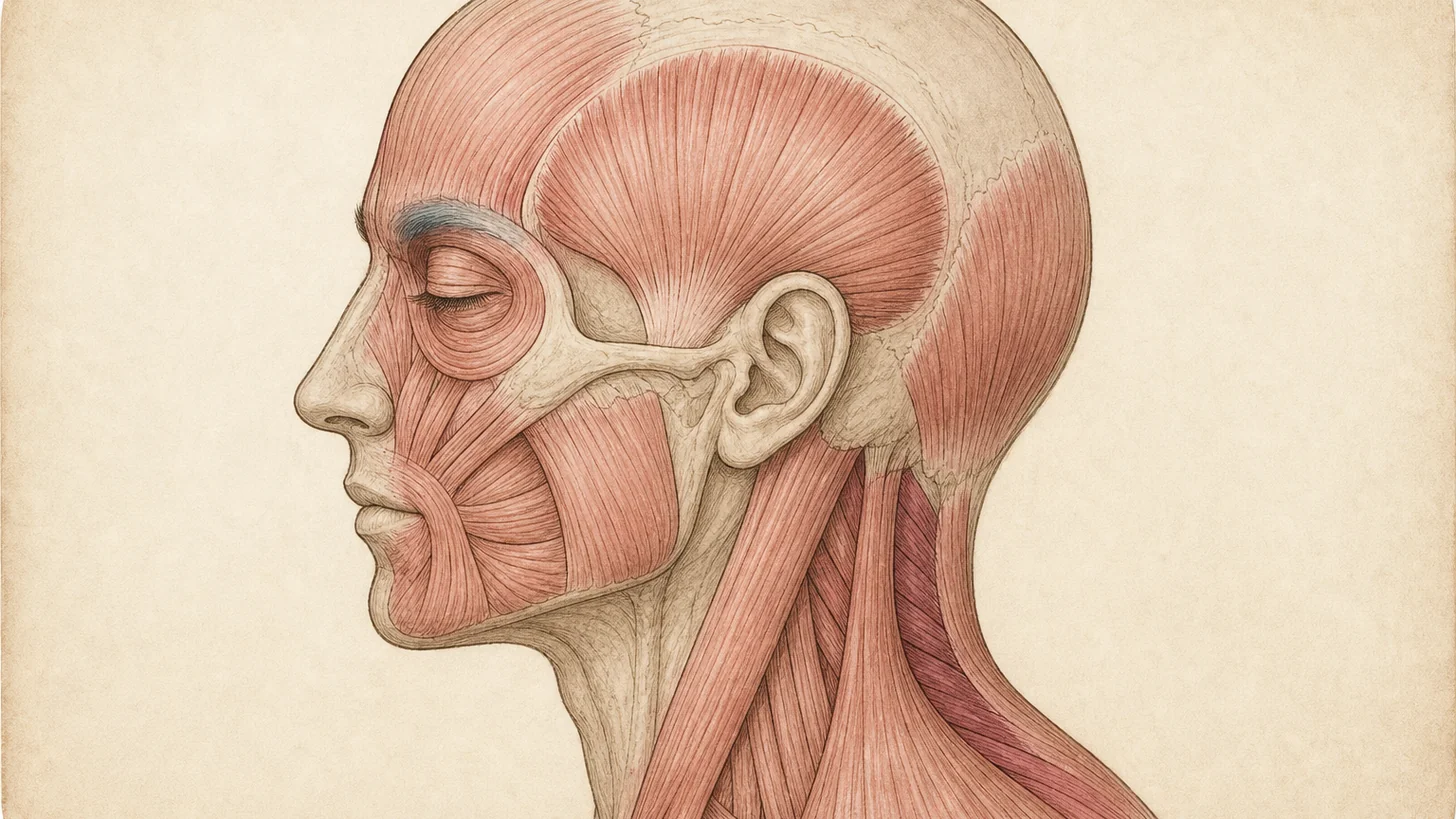
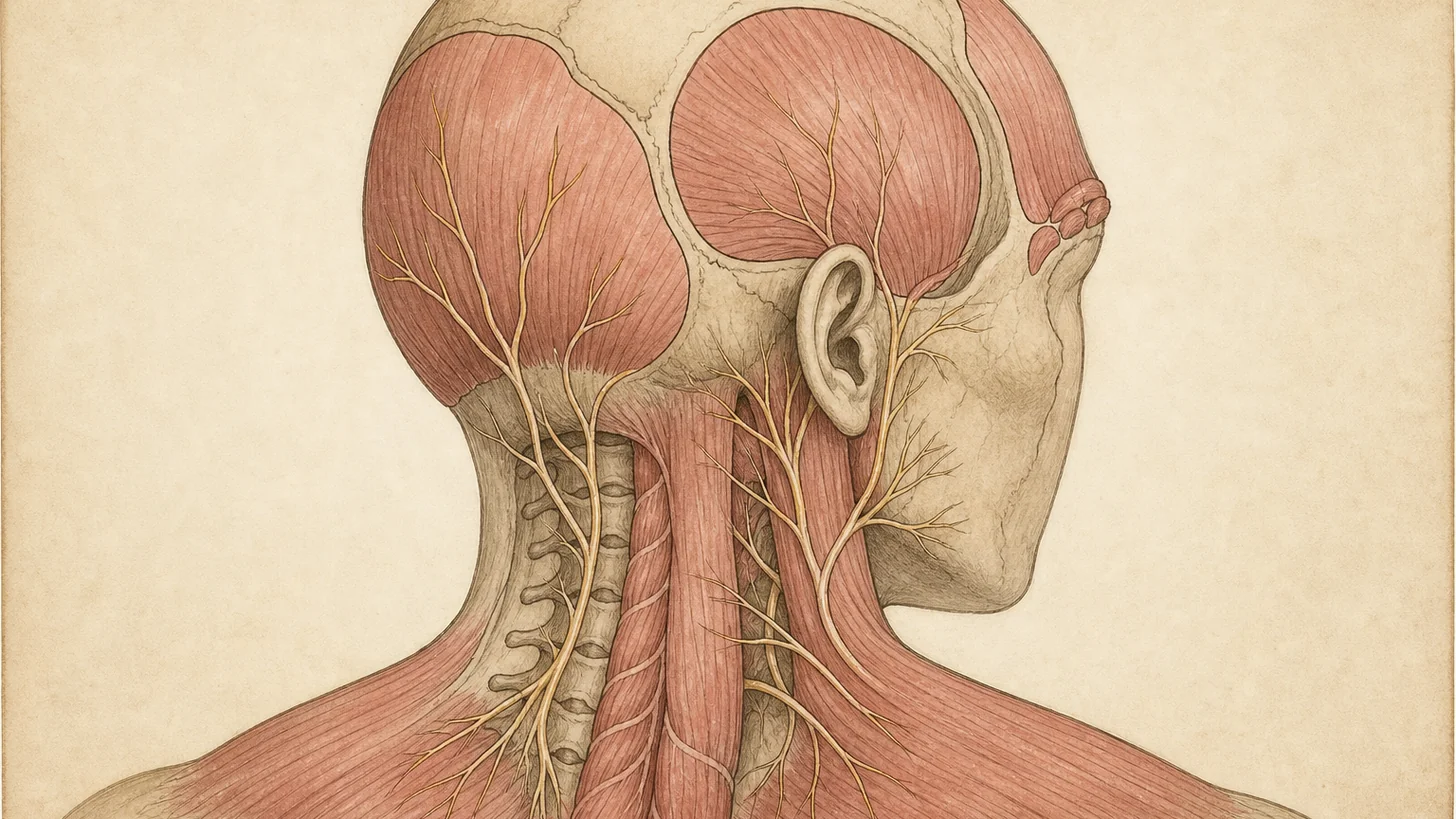
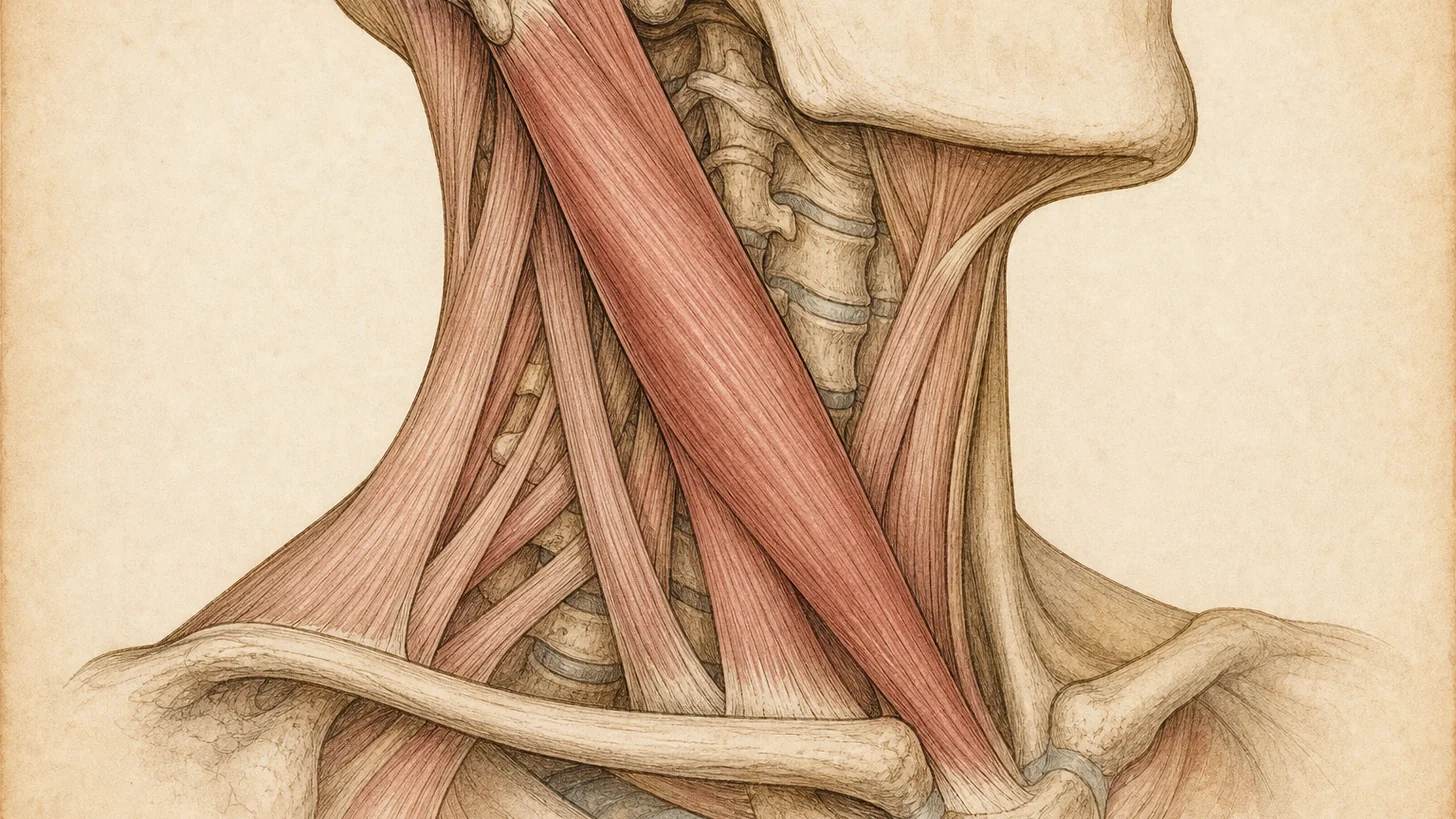
That last clause is the important one. Botox™, Dysport™, and Daxxify™ all work. What separates a good result from a disappointing one is whether the right muscles were injected at the right dose, and whether the needle was confirmed in the target. The head position tells you the muscles (Albanese 2013). Rotation of the chin toward one shoulder — torticollis, the most common pattern — is driven mainly by the sternocleidomastoid on the side opposite the chin and the splenius capitis on the same side as the chin. A tilt of the ear toward the shoulder, laterocollis, involves the sternocleidomastoid, splenius, levator scapulae, and scalenes on the side the ear drops toward. A forward pull, anterocollis, involves both sternocleidomastoids, the scalenes, and the deep longus colli, and is the hardest to treat. A backward pull, retrocollis, involves the splenius and semispinalis on both sides and the upper trapezius. Most patients have a combination, and the map changes over the years, which is why it is re-drawn at every visit rather than copied from the last one.
The first visit
The consultation is 45 minutes. Dr. Movshis watches the head at rest, in conversation, while you walk, and while you try to hold it straight, then asks you to use your sensory trick and watches what changes. The neck muscles are palpated one by one for tone and thickening. Range of motion is measured against the pull and with it. The tremor, if present, is characterized. The rest of the body is checked for dystonia elsewhere and for parkinsonism, because either changes the plan. Severity, disability, and pain are scored on the TWSTRS, which is the scale every trial cited on this page used and the one we use to measure your response cycle over cycle. Your medication list is reviewed for dopamine-blocking drugs, and anyone under 40 is screened for Wilson disease.
If the diagnosis is cervical dystonia, you leave with a product, a map, and a submitted prior authorization. The full diagnostic examination and what excludes look-alikes is on the cervical dystonia treatment page, and the symptoms guide covers what the condition looks like from the inside.
How many units
Cervical dystonia does not have a fixed protocol the way chronic migraine does. The dose is the sum of the doses into each muscle on the map, and each muscle’s dose depends on how strongly it is pulling and how much it can be weakened without a side effect. The U.S. prescribing information for Botox™ reports a mean total dose of 236 units in the pivotal study, with a range of roughly 200 to 300 units, and advises starting lower in patients who have never had toxin, then adjusting. Dysport™ is dosed on its own unit scale, with a recommended initial total of 500 units divided among the affected muscles, and Daxxify™ was studied at 125 and 250 units in ASPEN-1, with both doses beating placebo (Comella 2024).
Two rules follow. The units of one product are not convertible to another, so a patient told they received “300 units” elsewhere needs to know which product. And the first cycle is deliberately conservative, particularly into the sternocleidomastoid, because the one side effect that matters — swallowing difficulty — comes from toxin spreading from that muscle to the swallowing muscles behind it. The label advises keeping the total into the sternocleidomastoid at or below 100 units for that reason. A first cycle that gives 70% of the benefit and no side effect is a good first cycle. The second cycle adjusts up.
The injection visit
The injection visit takes 20–30 minutes. The map is re-examined, because the pattern shifts. The needle is fine and connected to an EMG monitor, so each injection goes into a muscle that is audibly firing rather than a quiet neighbor. In a 52-patient randomized comparison, EMG-assisted selection and injection produced a greater magnitude of improvement than clinical examination alone, most clearly in retrocollis, head tilt, and shoulder elevation (Comella 1992), although the Cochrane review found no clear variation in trial-level efficacy with EMG guidance (Rodrigues 2020), so the case for guidance rests on the deep-muscle patterns rather than on every injection. Ultrasound is used for every deep muscle — the longus colli, the scalenes, the levator scapulae, the obliquus capitis inferior — because those sit next to the carotid sheath and the brachial plexus and cannot be reached safely by feel. Anterocollis in particular fails when the longus colli is left alone, and it cannot be injected without ultrasound.
The injections are brief stings. There is no sedation. You drive yourself home, return to work the next day, and are asked not to massage the injected muscles for the rest of the day.
Prefer to watch? A 93-second narrated animation of cervical dystonia — the order without a brake, the touch that eases it, and what botulinum toxin does at the nerve ending — with the full transcript and PubMed-verified references.
How long it lasts, and the shape of a cycle
Botox™ and Dysport™ begin to work within one to two weeks, peak at four to six weeks, and wear off at ten to fourteen. Pain usually improves before the posture does: in the Cochrane pooled analysis the TWSTRS pain subscore was 2.1 points better than placebo at week four alongside the 8-point improvement in total score (Rodrigues 2020), and in the CD PROBE registry the patients with moderate or severe pain were the ones with higher severity and disability scores, who received higher doses into more muscles (Charles 2014). Cycles are scheduled at twelve weeks, and most plans will not authorize re-injection sooner, which is also the pharmacological interval that keeps the risk of neutralizing antibodies low (Naumann 2013). In ASPEN-1, Daxxify™‘s median duration of effect was about 24 weeks at the 125-unit dose and 20 weeks at 250 units (Comella 2024), which is why it is the product we reach for when a patient’s Botox™ benefit reliably runs out at week nine or ten.
A follow-up at four to six weeks after the first cycle records the TWSTRS, any side effect and which muscle caused it, and how long the benefit held. The map and dose are adjusted before cycle two. Most patients reach their steady result by the second or third cycle, and from there the visits are quarterly.
What else is done between cycles
Physical therapy changes the arithmetic. In a randomized trial, patients who received botulinum toxin plus a structured neuromotor rehabilitation program improved more and needed lower toxin doses over successive cycles than patients on toxin alone (Tassorelli 2006). The program is built around the pattern — active correction toward midline using the sensory trick as a cue, strengthening of the antagonist muscles, posture and breathing work — and starts in the second or third week after an injection, when the treated muscles are quiet enough to retrain. The referral is written at the first visit. The secondary pain from years of one-sided pull — trapezius trigger points, facet arthritis on the side of rotation — has its own treatments, and treating it improves the response to everything else.
When it does not work
A meaningful minority of cycles deliver less than expected, and the reason is almost always mechanical. The pattern has shifted since the last map. A deep muscle is contributing and has never been injected. The dose in the main mover is too low, or the injection landed at the wrong level of a two-level rotation. Neutralizing antibodies are rare with current formulations and more likely with high doses and short intervals (Naumann 2013). The response is a re-map under EMG and ultrasound, a dose adjustment, and a switch of product if two well-mapped cycles of one product fail. Patients who do not respond to two products over two cycles each are candidates for deep brain stimulation, and we coordinate that referral rather than continuing to inject.
What it costs
For commercially insured patients, cervical dystonia is an FDA-approved indication for Botox™, Dysport™, and Daxxify™, and most PPO plans cover the drug and the injection procedure with prior authorization. Our office submits it after the consultation, approval typically takes 7–14 business days, and the first injection is generally scheduled within two to three weeks. What you pay is your deductible and coinsurance, and the manufacturers of all three products run savings programs for eligible commercially insured patients. We do not participate with Medicare or Medicaid.
Self-pay is priced per unit, and the current rates are on the self-pay pricing page: at the listed $15 per unit of Botox™, a 200-unit session is $3,000, with the physician fee, the EMG and ultrasound guidance, and the drug included. Daxxify™ is listed at $10 per unit and Dysport™ at $13 per three units, so which product is least expensive for you depends on the dose your pattern needs and how long you need each cycle to last. Verify your insurance before the visit and we will tell you what to expect.
If your head does not stay where you put it, that is the visit to book.
References
This article is reviewed against the peer-reviewed literature. Citations retrieved from PubMed.
- Rodrigues FB, Duarte GS, Marques RE, et al. Botulinum toxin type A therapy for cervical dystonia. Cochrane Database of Systematic Reviews. 2020. doi:10.1002/14651858.CD003633.pub4 · PubMed
- Comella CL, Jankovic J, Hauser RA, et al. Efficacy and Safety of DaxibotulinumtoxinA for Injection in Cervical Dystonia: ASPEN-1 Phase 3 Randomized Controlled Trial. Neurology. 2024. doi:10.1212/WNL.0000000000208091 · PubMed
- Comella CL, Buchman AS, Tanner CM, Brown-Toms NC, Goetz CG. Botulinum toxin injection for spasmodic torticollis: increased magnitude of benefit with electromyographic assistance. Neurology. 1992. doi:10.1212/wnl.42.4.878 · PubMed
- Albanese A, Bhatia K, Bressman SB, et al. Phenomenology and classification of dystonia: a consensus update. Movement Disorders. 2013. doi:10.1002/mds.25475 · PubMed
- Tassorelli C, Mancini F, Balloni L, et al. Botulinum toxin and neuromotor rehabilitation: an integrated approach to idiopathic cervical dystonia. Movement Disorders. 2006. doi:10.1002/mds.21145 · PubMed
- Naumann M, Boo LM, Ackerman AH, Gallagher CJ. Immunogenicity of botulinum toxins. Journal of Neural Transmission. 2013. doi:10.1007/s00702-012-0893-9 · PubMed
- Charles PD, Adler CH, Stacy M, et al. Cervical dystonia and pain: characteristics and treatment patterns from CD PROBE (Cervical Dystonia Patient Registry for Observation of OnabotulinumtoxinA Efficacy). Journal of Neurology. 2014. doi:10.1007/s00415-014-7343-6 · PubMed
Frequently Asked Questions
It depends on which muscles are pulling and how strongly, so there is no single number the way there is for migraine. The U.S. prescribing information for Botox reports that patients in the pivotal cervical dystonia study received a mean total dose of 236 units, split among the muscles involved, with a range from roughly 200 to 300 units, and it advises starting lower in patients who have never had toxin. Dysport is dosed on a different unit scale, with a recommended starting dose of 500 units divided among the affected muscles. Daxxify was studied at 125 and 250 units in its phase 3 trial (Comella 2024). The units of one product are not convertible to another. What determines the dose is the muscle map — a rotation driven by one sternocleidomastoid and one splenius needs less toxin than a combined pattern involving five muscles — and the dose is adjusted at each cycle based on the response and any side effects.
Botox and Dysport begin to work within one to two weeks, peak at four to six weeks, and wear off at ten to fourteen weeks, which is why cycles are scheduled at twelve weeks and most plans will not authorize earlier re-injection. In the ASPEN-1 trial, Daxxify's median duration of effect was about 24 weeks at the 125-unit dose and 20 weeks at 250 units (Comella 2024), which is the reason we offer it to patients whose benefit runs out before the next Botox cycle is allowed. The first cycle is often not the best cycle, because the map is refined from the response, and most patients reach their steady result by the second or third.
The one that matters is difficulty swallowing, which happens when toxin from the sternocleidomastoid spreads to the swallowing muscles behind it. The Botox prescribing information reports dysphagia in 19% of cervical dystonia patients across its double-blind and open-label studies, with upper respiratory infection at 12% and neck pain and headache at 11% each, and it advises keeping the total dose into the sternocleidomastoid at or below 100 units to reduce it. Across the nine placebo-controlled trials in the Cochrane review, the treatment-related effects were neck weakness in 14%, dysphagia in 11%, and diffuse weakness or tiredness in 8% (Rodrigues 2020). The swallowing difficulty is mild and resolves over two to six weeks in nearly all cases. In ASPEN-1, dysphagia occurred in 1.6% of patients at the 125-unit Daxxify dose (Comella 2024). All botulinum toxin products carry a boxed warning for distant spread of toxin effect, and trouble breathing or weakness spreading beyond the neck is a same-day call.
The injections are brief stings with a fine needle, six to twelve of them depending on the map, and the visit takes 20–30 minutes. EMG guidance means the needle is connected to a monitor that plays the electrical activity of the muscle it is in, so the injection goes into a muscle that is actively firing rather than a quiet neighbor. The evidence is mixed and worth stating plainly: in a 52-patient randomized comparison, injections selected and placed with EMG assistance produced a greater magnitude of improvement than injections placed by clinical examination alone, with the extra benefit concentrated in retrocollis, head tilt, and shoulder elevation, the patterns that involve deep muscles (Comella 1992), while the Cochrane review found no clear variation in trial-level efficacy with EMG guidance across the nine placebo-controlled trials (Rodrigues 2020). The practical reading is that guidance matters most when deep muscles are on the map. Ultrasound shows the deep muscles — the longus colli, the scalenes, the levator scapulae, the obliquus capitis inferior — and the carotid sheath and brachial plexus that sit next to them, which is what makes injecting those muscles safe. Anterocollis in particular fails without ultrasound because the longus colli cannot be reached otherwise.
Per-unit self-pay pricing at Modal Pain Management is published on our <a href="/self-pay-pricing/">self-pay pricing page</a>. At the currently listed rate of $15 per unit of Botox, a 200-unit session is $3,000, and the physician fee, the EMG and ultrasound guidance, and the drug are all included. Daxxify is listed at $10 per unit and Dysport at $13 per three units, so the comparison depends on the dose your pattern needs. Most patients with commercial PPO insurance do not pay these amounts: cervical dystonia is an FDA-approved indication for all three products and the drug and the procedure are covered with prior authorization, and the manufacturers run savings programs for eligible commercially insured patients.
The cause is almost always mechanical rather than biological. The pattern has shifted and the muscle map is out of date. A deep muscle is contributing and was never injected. The dose in the main mover is too low, or the injection went into the wrong level of a two-level rotation. Neutralizing antibodies, which make the toxin stop working, are rare with current formulations and more likely with high doses and short intervals (Naumann 2013). The response is a re-examination under EMG and ultrasound and a new map, then a product switch if two well-mapped cycles of one product fail. Patients who do not respond to two products are referred for a deep brain stimulation evaluation.