The knee has been arthritic for three years. Lately the pain runs into the thigh and shin, the other knee aches, and pressing on the shin, well away from the joint, hurts in a way it never used to. The X-ray has barely changed. The pain has.
That mismatch, more and wider pain than the tissue explains, is central sensitization from the patient’s side. It can be measured, and in many people it is not permanent.
What central sensitization is
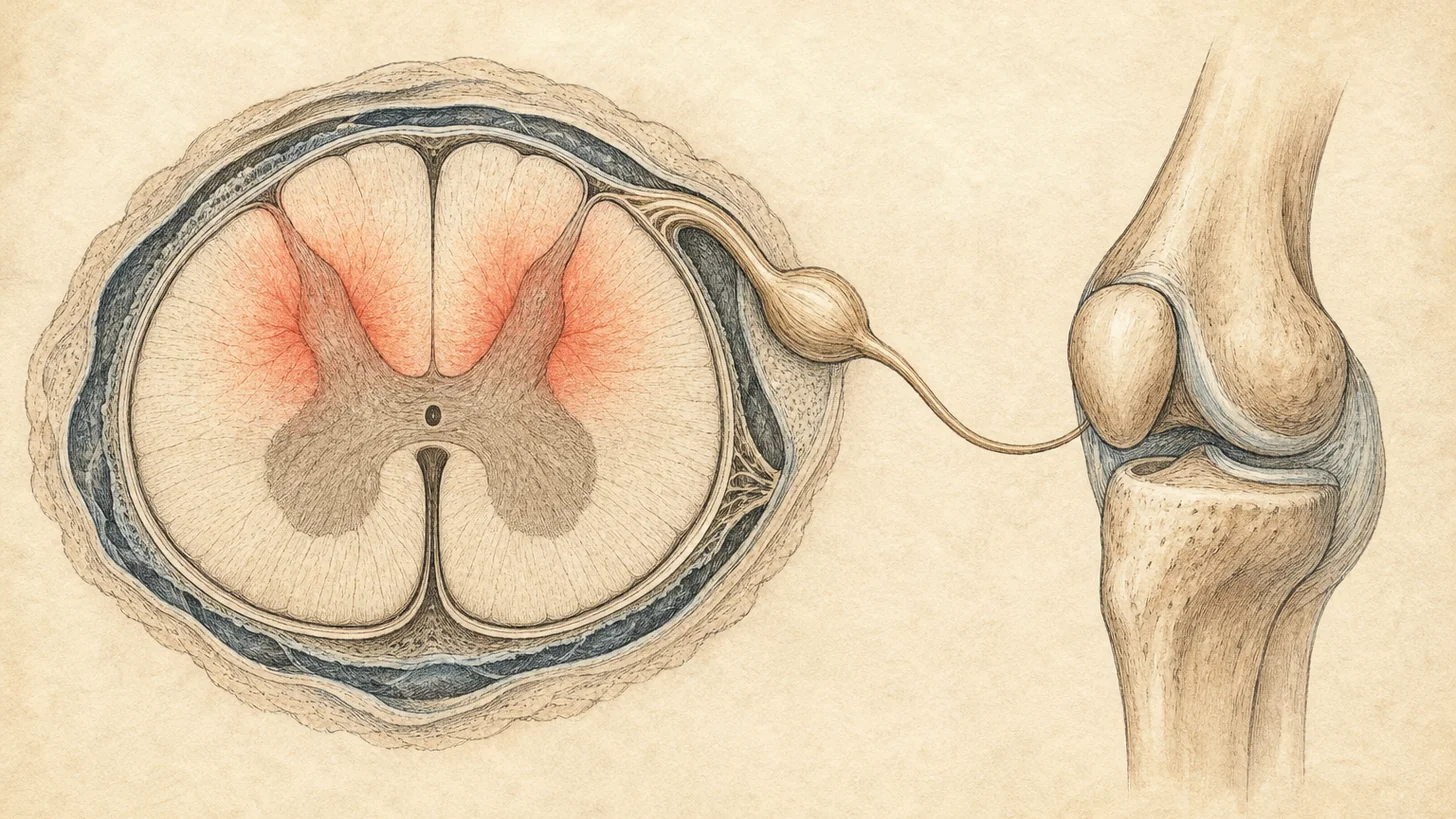
In 1983 Clifford Woolf showed, in an animal model, that injury also raises the excitability of the spinal cord, so the same input produces a bigger response [1]. The term describes that central change: a prolonged but reversible increase in the excitability and synaptic strength of neurons in the pain pathways [2]. Once it is established, pain is no longer tied to the presence, intensity, or duration of a painful stimulus, and inputs that normally register as touch start to register as pain [3]. The problem is not only the signal from the tissue. It is the gain on it.
In the clinic it shows up as specific findings [2]:
- Allodynia. Pain from something that should not hurt, such as light touch or clothing.
- Spreading hyperalgesia. Pressure hurts more than it should, including away from the original problem.
- Aftersensations. Pain that lingers after the touch has stopped.
- Temporal summation. Repeated identical pokes, such as a pinprick, that hurt more with each repetition.
It has been documented in fibromyalgia, osteoarthritis, headache, jaw disorders, neuropathic and visceral pain, and pain after surgery [2], and in rheumatoid arthritis, upper-limb tendinopathies, and spinal pain [4]. Within each condition, people vary widely in whether it is present and how strong it is [4]. Having osteoarthritis does not mean you are sensitized.
Four terms that get confused
They are not interchangeable, and the difference changes treatment.
| Term | What it means |
|---|---|
| Central sensitization | A mechanism: amplified signaling in the spinal cord and brain. Not a diagnosis by itself [2]. Example: widespread tenderness around an arthritic knee. |
| Nociplastic pain | The International Association for the Study of Pain (IASP) category, proposed in 2016 and adopted in 2017, for pain from altered pain processing without enough tissue or nerve damage to explain it [5][6]. Example: fibromyalgia. |
| Central sensitization syndrome | The popular name for “central sensitivity syndromes,” an umbrella proposed for overlapping conditions such as fibromyalgia, irritable bowel syndrome, chronic fatigue syndrome, and headaches. Evidence of shared sensitization exists for several and is weak or missing for others [7]. Example: fibromyalgia with irritable bowel syndrome. |
| Central pain syndrome | Pain from damage to the brain or spinal cord itself. After a stroke it is a neuropathic pain syndrome, felt in the body area served by the injured region [8]. Example: burning pain down one side after a stroke. |
Nociplastic pain can exist on its own, as in fibromyalgia, or on top of tissue or nerve pain in a mixed state, and chronic low back pain is a common mixed example [6]. For how the three pain types relate to acute and chronic pain, see types of pain: acute, chronic, and nerve.
Signs that the pain system is involved, not only the tissue
The 2021 IASP clinical criteria for nociplastic musculoskeletal pain start with pain for more than three months, spread across a region or several regions rather than one spot, that tissue or nerve findings do not fully explain [9]. They then require pain hypersensitivity the examiner can provoke in the painful area. History features that make it more likely, and that patients rarely mention:
- Touch, pressure, movement, cold, or heat in the painful area hurts more than it should
- Sensitivity to noise, bright light, or smells
- Sleep broken by frequent waking
- Fatigue, and trouble concentrating or remembering
These symptoms are thought to reflect the same changes in central processing [6][9]. A list like this raises the question. The exam answers it.
How it is measured, and what a questionnaire cannot tell you
There is no blood test or scan for central sensitization [2]. Research labs use quantitative sensory testing, including conditioned pain modulation, which checks whether one pain dampens another as it does in a healthy nervous system.
The questionnaire designed for it is the Central Sensitization Inventory, with 25 items scored out of 100 [10]. In its cutoff study, a score of 40 separated patients with central sensitivity syndromes from a nonpatient comparison group with 81% sensitivity and 75% specificity [11]. Two limits matter. Separating pain-clinic patients from non-patients is easier than telling apart two patients who both hurt. And all four factors in the inventory relate to somatic and emotional symptoms [10]. A high score means a heavy symptom burden that fits sensitization. It does not measure the spinal cord.
Sensitization can reverse when the pain source is removed
The strongest evidence comes from people whose pain source was taken away.
In healthy people, a painful stimulus on the arm raises pressure pain thresholds elsewhere, the nervous system’s built-in dampening. In 15 patients with painful hip osteoarthritis, it did not [12]. Thirteen were retested 6 to 14 months after surgery, once pain-free, and the dampening was back to normal.
In knee osteoarthritis, 48 patients had lower pressure pain thresholds than 21 controls, both at the knee and away from it, and no conditioned pain modulation [13]. In the 20 who had knee replacement, the widespread tenderness decreased, spatial summation normalized, and conditioned pain modulation returned. Brain imaging points the same way: 16 patients with painful hip arthritis had less gray matter in the thalamus than controls, and 9 months after hip replacement it had returned to control levels [14].
The principle holds beyond joints. In 28 women with fibromyalgia, lidocaine injected into tender trapezius muscle reduced heat hyperalgesia in the forearm, far from the injection, while placebo saline did not [15]. Overall pain ratings did not change, which the authors attributed to the low dose. A second randomized trial treated myofascial trigger points (68 patients) or painful joints (56) in people with fibromyalgia. Active treatment lowered fibromyalgia pain and raised pain thresholds at tender points and at a non-painful site, and placebo did not [16]. Both trials were small and short, but even in fibromyalgia, local input helped keep the system turned up.
It does not reverse for everyone. Among 223 patients having knee replacement, those whose results stayed abnormal on several measures, especially the inventory questionnaire and local sensory tests, improved less and had worse pain at one year than those whose results were normal throughout [17]. The authors suggest that in these patients the sensitization no longer depends on the knee. In several patient groups, sensitization predicts a poorer response to treatment [4], which is why it is worth checking for before a procedure.
When to treat the source, and when a procedure is the wrong tool
Nociplastic pain responds poorly to treatments aimed at the periphery: anti-inflammatories, opioids, surgery, and injections [6]. The studies above show the opposite when a peripheral source maintains the sensitization. The decision at a visit is which situation you are in.
Treat the source when the exam finds one that reproduces your usual pain: an arthritic knee or hip, the facet joints of the lower back, or an active trigger point in myofascial pain. A diagnostic block is the key test: if numbing the suspected source takes away your typical pain for as long as the anesthetic lasts, that source is likely feeding it. For some sources, such as the facet joints, a second block confirms it. Trigger point injections follow the same logic.
Widespread pain with no dominant source, once other causes are ruled out, is usually nociplastic pain on its own, and the next section is its treatment. Many people with long-standing pain are in between and need both.
What turns the gain down when there is no single source
The best evidence comes from fibromyalgia. The European League Against Rheumatism (EULAR) guideline reviewed 107 systematic reviews and meta-analyses and gave one therapy a strong recommendation: exercise [18]. It rated most treatment effects as modest.
Exercise. Regular and graded, through a physical therapy program that raises the load slowly enough to avoid flares.
Sleep. In a sleep-lab study of 32 healthy women, those woken once an hour for three nights lost their pain inhibition and reported more spontaneous pain, while those who got the same total sleep without interruptions did not [19]. Broken sleep weakens the brake on pain, so treating insomnia or sleep apnea is part of treating the pain.
Medicines that act on pain processing. EULAR gives weak recommendations for low-dose amitriptyline, duloxetine or milnacipran, pregabalin, cyclobenzaprine, and tramadol, and advises against anti-inflammatories and, more firmly, against strong opioids [18]. They support exercise and sleep rather than replace them. Our practice is built around non-opioid pain management.
Psychological therapy. Cognitive behavioral therapy carries a weak recommendation, aimed at the mood problems and coping patterns that keep pain going [18].
When to see a pain physician
See a pain physician when pain has spread beyond where it started, when light touch hurts, or when a treatment that used to help has stopped working. For back pain with fever, new leg weakness, or new loss of bowel or bladder control, go to the closest emergency department or call 911.
Sensitization is not a reason to skip the workup. Inflammatory arthritis, thyroid disease, and nerve disorders can look similar, so an exam and blood tests come first. A good evaluation ends with two answers: whether a source is still driving the pain, and how turned up the pain system is.
Modal Pain Management sees patients at 369 Lexington Avenue, Floor 25, in Midtown Manhattan, with same-week appointments. We accept commercial PPO plans (see accepted insurance) and do not accept Medicare, Medicaid, HMO plans, or workers’ compensation.
References
This article is reviewed against the peer-reviewed literature. Citations retrieved from PubMed.
- Woolf CJ. Evidence for a central component of post-injury pain hypersensitivity. Nature. 1983;306(5944):686-688. doi:10.1038/306686a0 · PubMed
- Woolf CJ. Central sensitization: implications for the diagnosis and treatment of pain. Pain. 2011;152(3 Suppl):S2-S15. doi:10.1016/j.pain.2010.09.030 · PubMed
- Latremoliere A, Woolf CJ. Central sensitization: a generator of pain hypersensitivity by central neural plasticity. J Pain. 2009;10(9):895-926. doi:10.1016/j.jpain.2009.06.012 · PubMed
- Nijs J, George SZ, Clauw DJ, Fernández-de-las-Peñas C, Kosek E, Ickmans K, et al. Central sensitisation in chronic pain conditions: latest discoveries and their potential for precision medicine. Lancet Rheumatol. 2021;3(5):e383-e392. doi:10.1016/S2665-9913(21)00032-1 · PubMed
- Kosek E, Cohen M, Baron R, Gebhart GF, Mico JA, Rice ASC, et al. Do we need a third mechanistic descriptor for chronic pain states? Pain. 2016;157(7):1382-1386. doi:10.1097/j.pain.0000000000000507 · PubMed
- Fitzcharles MA, Cohen SP, Clauw DJ, Littlejohn G, Usui C, Häuser W. Nociplastic pain: towards an understanding of prevalent pain conditions. Lancet. 2021;397(10289):2098-2110. doi:10.1016/S0140-6736(21)00392-5 · PubMed
- Yunus MB. Fibromyalgia and overlapping disorders: the unifying concept of central sensitivity syndromes. Semin Arthritis Rheum. 2007;36(6):339-356. doi:10.1016/j.semarthrit.2006.12.009 · PubMed
- Klit H, Finnerup NB, Jensen TS. Central post-stroke pain: clinical characteristics, pathophysiology, and management. Lancet Neurol. 2009;8(9):857-868. doi:10.1016/S1474-4422(09)70176-0 · PubMed
- Kosek E, Clauw D, Nijs J, Baron R, Gilron I, Harris RE, et al. Chronic nociplastic pain affecting the musculoskeletal system: clinical criteria and grading system. Pain. 2021;162(11):2629-2634. doi:10.1097/j.pain.0000000000002324 · PubMed
- Mayer TG, Neblett R, Cohen H, Howard KJ, Choi YH, Williams MJ, et al. The development and psychometric validation of the central sensitization inventory. Pain Pract. 2012;12(4):276-285. doi:10.1111/j.1533-2500.2011.00493.x · PubMed
- Neblett R, Cohen H, Choi Y, Hartzell MM, Williams M, Mayer TG, et al. The Central Sensitization Inventory (CSI): establishing clinically significant values for identifying central sensitivity syndromes in an outpatient chronic pain sample. J Pain. 2013;14(5):438-445. doi:10.1016/j.jpain.2012.11.012 · PubMed
- Kosek E, Ordeberg G. Lack of pressure pain modulation by heterotopic noxious conditioning stimulation in patients with painful osteoarthritis before, but not following, surgical pain relief. Pain. 2000;88(1):69-78. doi:10.1016/S0304-3959(00)00310-9 · PubMed
- Graven-Nielsen T, Wodehouse T, Langford RM, Arendt-Nielsen L, Kidd BL. Normalization of widespread hyperesthesia and facilitated spatial summation of deep-tissue pain in knee osteoarthritis patients after knee replacement. Arthritis Rheum. 2012;64(9):2907-2916. doi:10.1002/art.34466 · PubMed
- Gwilym SE, Filippini N, Douaud G, Carr AJ, Tracey I. Thalamic atrophy associated with painful osteoarthritis of the hip is reversible after arthroplasty: a longitudinal voxel-based morphometric study. Arthritis Rheum. 2010;62(10):2930-2940. doi:10.1002/art.27585 · PubMed
- Staud R, Nagel S, Robinson ME, Price DD. Enhanced central pain processing of fibromyalgia patients is maintained by muscle afferent input: a randomized, double-blind, placebo-controlled study. Pain. 2009;145(1-2):96-104. doi:10.1016/j.pain.2009.05.020 · PubMed
- Affaitati G, Costantini R, Fabrizio A, Lapenna D, Tafuri E, Giamberardino MA. Effects of treatment of peripheral pain generators in fibromyalgia patients. Eur J Pain. 2011;15(1):61-69. doi:10.1016/j.ejpain.2010.09.002 · PubMed
- Vervullens S, Meert L, Smeets RJEM, Verbrugghe J, Verdonk P, Meeus M. Does pain intensity after total knee arthroplasty depend on somatosensory functioning in knee osteoarthritis patients? A prospective cohort study. Clin Rheumatol. 2024;43(6):2047-2059. doi:10.1007/s10067-024-06976-7 · PubMed
- Macfarlane GJ, Kronisch C, Dean LE, Atzeni F, Häuser W, Fluß E, et al. EULAR revised recommendations for the management of fibromyalgia. Ann Rheum Dis. 2017;76(2):318-328. doi:10.1136/annrheumdis-2016-209724 · PubMed
- Smith MT, Edwards RR, McCann UD, Haythornthwaite JA. The effects of sleep deprivation on pain inhibition and spontaneous pain in women. Sleep. 2007;30(4):494-505. doi:10.1093/sleep/30.4.494 · PubMed
Frequently Asked Questions
Often, yes. It is defined as a reversible change. In studies of hip and knee osteoarthritis, the nervous system's own pain dampening returned and widespread tenderness eased after the painful joint was replaced, with patients retested 6 to 14 months after surgery in one study and thalamic changes on brain MRI reversed at 9 months in another. It does not reverse for everyone. After knee replacement, patients whose sensitization measures stayed abnormal had worse pain a year later. The best odds come from treating any source that is still feeding it, and from exercise and better sleep when there is none.
Ongoing pain input is the classic trigger: an injury, an arthritic joint, surgery, or a nerve problem sending signals long enough that neurons in the spinal cord and brain become more excitable. Things that weaken the nervous system's own pain control make it more likely. In a sleep-lab experiment, healthy women woken once an hour for three nights lost their pain inhibition and reported more spontaneous pain. Whether some people inherit a higher tendency to sensitize is still an open research question.
There is no blood test or scan for it. It is recognized from the history and the physical examination. The IASP criteria for nociplastic pain require pain for more than three months over a region rather than one spot, that tissue or nerve findings do not fully explain, plus pain hypersensitivity the examiner can provoke. The Central Sensitization Inventory is a screening questionnaire: a score of 40 or higher (out of 100) is the published cutoff that best separated patients with central sensitivity syndromes from people who were not patients, but it measures symptom burden, not the nervous system directly. Quantitative sensory testing is used mainly in research.
Medicines that act on pain processing in the nervous system rather than on inflammation. For fibromyalgia, the most studied example, the EULAR guideline gives weak recommendations for low-dose amitriptyline, duloxetine or milnacipran, pregabalin, cyclobenzaprine, and tramadol. It advises against anti-inflammatories and, more firmly, against strong opioids. The benefit of any of them is modest, and they are meant to be used alongside exercise, the only treatment with a strong recommendation, and treatment of broken sleep.
Fibromyalgia is the clearest example of nociplastic pain and the anchor of the central sensitivity syndrome concept, which also groups irritable bowel syndrome, chronic fatigue syndrome, and some headaches. Even in fibromyalgia, input from the body matters. In randomized trials, numbing a tender muscle reduced pain sensitivity at a distant site, the forearm, and treating painful trigger points or joints lowered fibromyalgia pain, while placebo did neither. That is why an exam for treatable local sources belongs in a fibromyalgia evaluation.
No. Central pain syndrome is pain caused by damage to the brain or spinal cord, such as a stroke or spinal cord injury, and it is felt in the part of the body served by the damaged area. It is a form of neuropathic pain. Central sensitization is an increase in the excitability of pain pathways that can happen with or without nerve damage, is often driven by ongoing pain somewhere in the body, and can reverse. The two are evaluated and treated differently.
No. The pain is real and the changes are physical. Sensitization is an increase in the excitability of neurons in the spinal cord and brain. In people it is detected with sensory testing, and chronic pain can also leave changes visible on research brain scans. In one study, patients with painful hip arthritis had reduced gray matter in the thalamus that was back to normal 9 months after hip replacement relieved the pain. Recognizing sensitization changes which treatments are likely to help. It does not mean the pain is imagined.