Two people call the office the same week with “numb fingers.” The first wakes at 4 a.m. with her right thumb, index and middle fingers asleep, shakes the hand until they tingle back, and has started dropping her keys. The second has had a numb little finger for a month, worse on long calls with his phone at his ear, and his left hand feels clumsy on the keyboard.
Both are nerves, and in different places. The first is the median nerve at the wrist. The second is the ulnar nerve at the elbow. Each has its own test, its own first treatment and, if it comes to that, its own operation. The fingers told us where to look before anyone touched a reflex hammer.
Start with which fingers go numb
Each nerve in the hand owns a patch of skin, and the patches barely overlap. Before anything else, Dr. Movshis asks patients to point to exactly which fingers, which side of the finger, and whether the palm or the back of the hand is involved.
| Which fingers | When it is worse | Most likely source | Where to read more |
|---|---|---|---|
| Thumb, index, middle, half the ring finger (palm side) | At night, holding a phone or steering wheel | Median nerve at the wrist: carpal tunnel | Carpal tunnel syndrome |
| Little finger, half the ring finger, and the back of the hand on that side | With the elbow bent, leaning on the elbow | Ulnar nerve at the elbow: cubital tunnel | Cubital tunnel syndrome |
| Little and ring fingers, back of the hand normal, or a weak grip without numbness | After cycling, pressure on the heel of the hand | Ulnar nerve at the wrist: Guyon’s canal | Guyon’s canal |
| One or two fingers plus tingling down the forearm, with neck or shoulder-blade pain | Turning or tilting the head | A pinched nerve root in the neck (C6, C7 or C8) | Pinched nerve in the neck |
| Back of the hand and the thumb, burning rather than numb | After a tight watch, cast or wrist injury | Superficial radial nerve: Wartenberg’s syndrome | Wartenberg’s syndrome |
| All the fingertips of both hands, feet first | Constant, slowly creeping upward | Peripheral neuropathy from a whole-body cause | Blood work with your primary care doctor |
| Fingers that turn white, then blue, then red | In the cold or under stress | Raynaud’s phenomenon, a circulation problem | Primary care or rheumatology |
Two cautions keep the table honest. Nerve territories vary a little from person to person, and two problems can exist at once. The table narrows the search. The exam and, when needed, a nerve study settle it.
Thumb, index and middle finger: usually carpal tunnel
Hand numbness is common. In a Swedish general-population survey, 14 percent of adults reported pain, numbness or tingling in the thumb-side fingers, and about one in five of those turned out to have carpal tunnel syndrome on examination and nerve testing [1]. It is the most common nerve entrapment in the body [2].
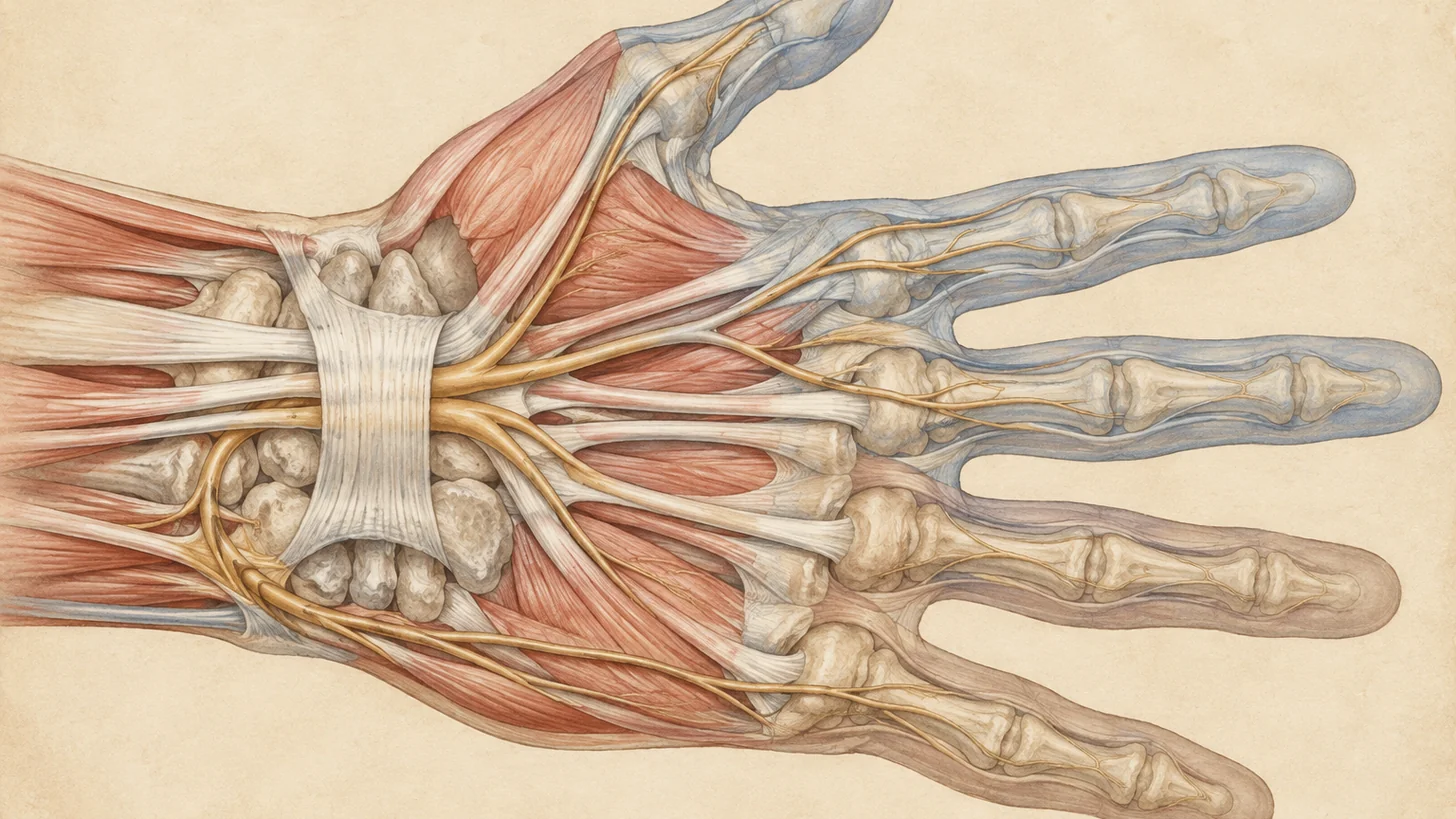
The signature is time of day. The median nerve passes through a tight channel at the wrist, the wrist curls during sleep, and pressure in that channel rises. People wake with the hand asleep and shake it out, a gesture doctors ask about on purpose. During the day, symptoms come with a bent wrist held still: a phone, a steering wheel, a book. The little finger stays normal, because it belongs to a different nerve.
Doctors combine six findings to judge how likely carpal tunnel is: numbness in that pattern, numbness that wakes you, weakness or wasting at the base of the thumb, the Phalen and Tinel tests, and dulled two-point sensation in the fingertips [3]. Our carpal tunnel syndrome page explains each test, when a nerve study adds something, and how a steroid injection both treats it and tells a surgeon what a release is likely to do.
Ring and little finger: the ulnar nerve, at the elbow or the wrist
Numbness in the little finger and the half of the ring finger next to it belongs to the ulnar nerve. The usual place it gets squeezed is the elbow, behind the bony bump on the inner side, where hitting your “funny bone” sends a zing into the same two fingers. This cubital tunnel syndrome is the second most common nerve entrapment, after carpal tunnel [4].
The clue is the elbow position. Long calls with the phone at the ear, sleeping with the arm folded under a pillow, and leaning on a desk or a car door all bend the elbow and press the nerve. The most sensitive bedside test holds the elbow fully bent while pressing on the nerve, and it brought on symptoms within 30 seconds in 91 percent of patients with proven cubital tunnel [5].
The ulnar nerve can also be pinched at the wrist, in a short channel called Guyon’s canal. The difference shows on the back of the hand. The branch that supplies the back of the hand leaves the nerve above the wrist, so it goes numb with an elbow problem and stays normal with a wrist one. Guyon’s canal is more often caused by something structural, such as a ganglion cyst, a fracture or long hours of handlebar pressure, and it often keeps company with carpal tunnel: 71 percent of patients in one surgical series had both [6]. Our cubital tunnel syndrome page covers both levels.
When the neck is the source
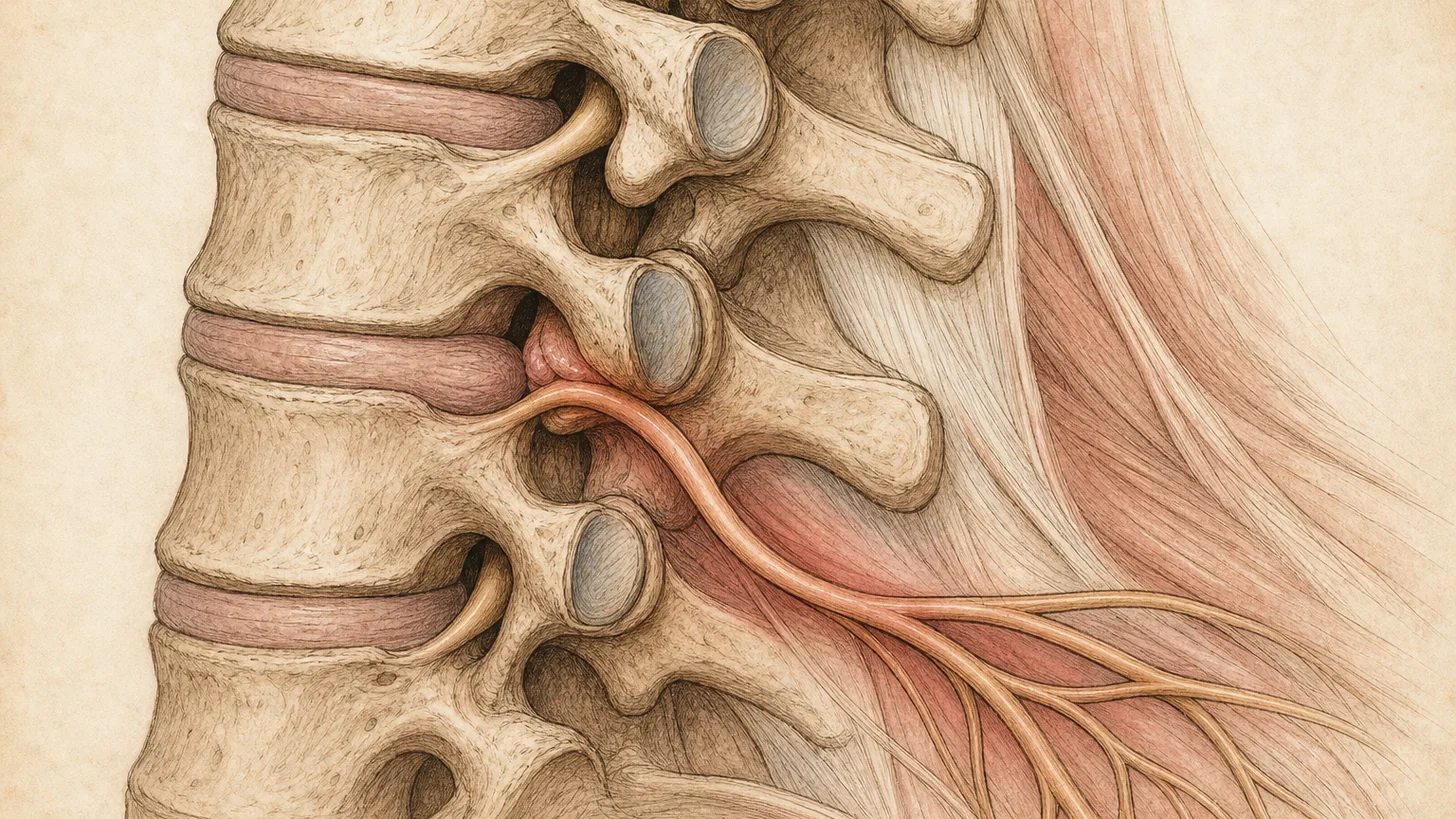
A nerve root pinched where it leaves the spine in the neck can numb fingers too. As a rough guide, C6 reaches the thumb and index finger, C7 the middle finger, and C8 the ring and little fingers. The giveaways are neck or shoulder-blade pain, tingling that runs down the forearm rather than starting at the wrist, and symptoms that change when you turn or tilt the head.
The finger map is less reliable here than for the wrist and elbow. In a series of patients whose single pinched root was confirmed at surgery, only 54 percent had the textbook pattern for that root [7]. Weakness and changes in reflexes localize better than which finger tingles. And the neck and the wrist can be involved at the same time, which is one of the clearer reasons to do a nerve conduction study and EMG. Our guide to a pinched nerve in the neck goes through each level, and the radiculopathy page covers treatment.
Burning on the back of the hand
Burning, electric pain on the back of the hand and the back of the thumb, with the palm left alone, is not carpal tunnel. It is usually the superficial radial nerve, pinched where it surfaces in the lower forearm, often after a tight watch, a fitness band, a cast or a wrist injury. Night splints for carpal tunnel do nothing for it. Our guide to Wartenberg’s syndrome explains how it is confirmed with a diagnostic block.
Numb fingertips in both hands: think about the whole body
When every fingertip is numb in both hands, a squeezed nerve at one spot is unlikely to explain it. The pattern usually started in the toes, crept up the feet, and only then reached the fingers. That is a peripheral neuropathy, and the causes are whole-body ones: diabetes and prediabetes, low vitamin B12, an underactive thyroid, heavy alcohol use, some chemotherapy drugs and a few rarer conditions.
Low B12 deserves a specific mention because one common medicine causes it. In the long-term follow-up of the Diabetes Prevention Program, people taking metformin had more low and borderline-low B12 levels than those on placebo, the risk rose with each year of use, and neuropathy was more common in the metformin group with low B12 [8]. Anyone on metformin with new numb fingers or feet should ask for a B12 level.
This pattern is a job for blood work with your primary care doctor, not a wrist injection.
Fingers that turn white in the cold
Fingers that go white, then blue, then red and throbbing in the cold or under stress are a circulation problem, not a nerve one. In Raynaud’s phenomenon the small arteries of the fingers clamp down too hard, and the numbness comes from the drop in blood flow [9]. Most cases are a harmless overreaction that runs in families and starts young. Raynaud’s that begins after about age 40, affects only one hand, or comes with sores on the fingertips, joint pain, tight skin or trouble swallowing needs a primary care doctor or a rheumatologist, because it can be the first sign of a connective tissue disease.
Why hands go numb at night
“Hands falling asleep at night” is mostly carpal tunnel. If it is the thumb-side fingers and shaking the hand brings them back, a splint that holds the wrist straight overnight is the usual first step. If it is the ring and little fingers, the elbow is the likely culprit, folded tight under a pillow or a partner. A towel wrapped loosely around the elbow keeps it from bending fully during sleep. Sleeping on the arm can numb any nerve for a few minutes, and that alone is not a disease. Numbness that wakes you most nights for weeks, or lingers into the morning, is worth an exam.
When finger numbness cannot wait
Most numb fingers can wait for an appointment. These cannot:
- Sudden numbness or weakness of the face, arm or leg, especially on one side, trouble speaking or understanding, or a drooping face. These are signs of a stroke.
- Chest pressure, shortness of breath or sweating with arm or jaw pain.
- Numbness in both hands with clumsiness, a change in walking or balance, or new trouble with the bladder or bowels, which can mean the spinal cord in the neck is being compressed.
- Rapidly worsening numbness and swelling after a wrist or elbow fracture, a crush injury or a tight cast.
For any of these, call 911 or go to the nearest emergency room.
How we sort it out in one visit
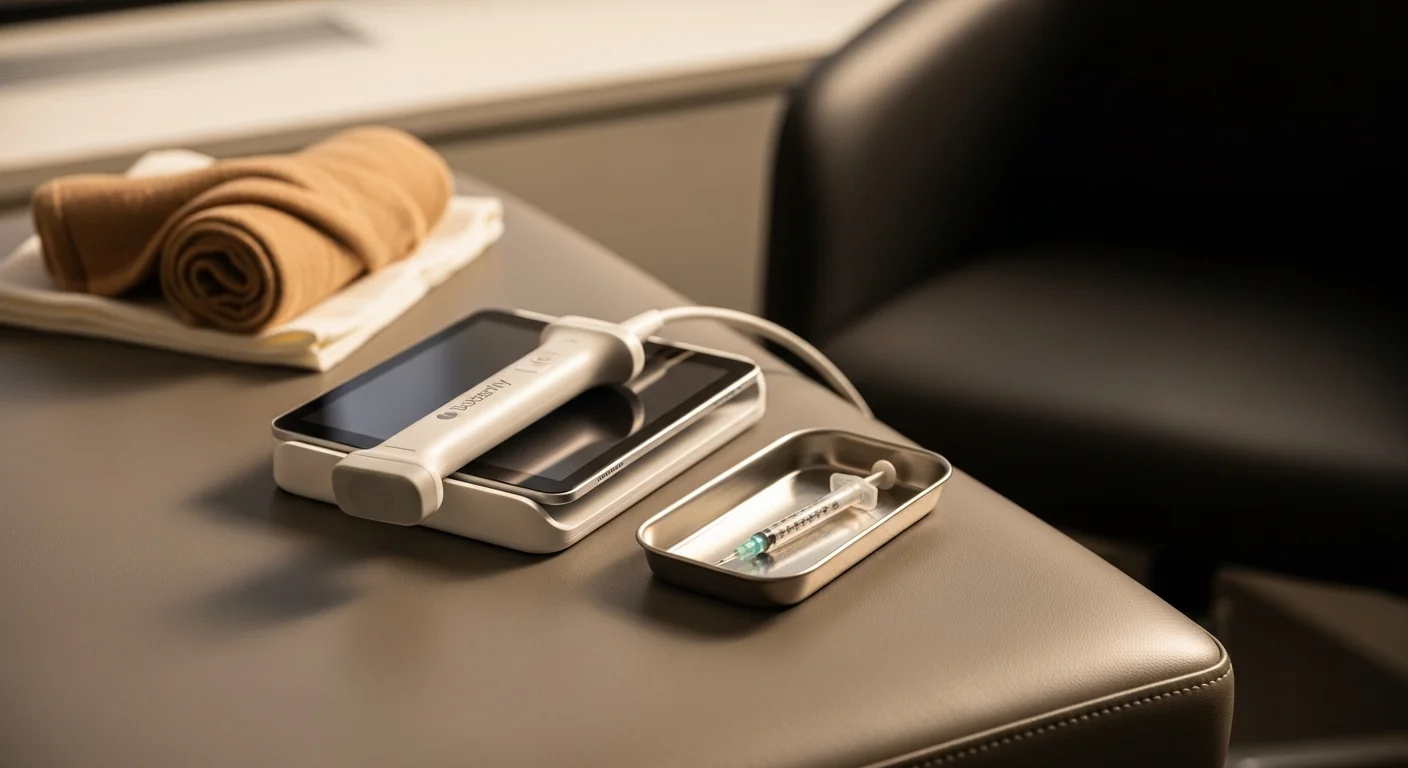
Dr. Movshis starts with where the numbness is and when it happens, then examines the neck, the elbow and the wrist together, because the common mistake is checking only one of them. An ultrasound in the exam room shows whether the median or ulnar nerve is swollen at the point of compression, and whether something like a cyst is pressing on it. When the exam leaves the level uncertain, the hand is weak, or surgery is on the table, a nerve conduction study and EMG is done in the same office: a certified technologist performs the nerve conduction portion, and Dr. Movshis performs the needle EMG and reads the study.
What we document before you see a surgeon
Most numb fingers settle without an operation. When they do not, Dr. Movshis refers you to a hand or spine surgeon with your exam, ultrasound, nerve testing and injection results, along with dated records of the care you have tried. Each surgeon and each insurance plan asks for slightly different things, so we fill in whatever they request.
References
This article is reviewed against the peer-reviewed literature. Citations retrieved from PubMed.
- Atroshi I, Gummesson C, Johnsson R, Ornstein E, Ranstam J, Rosén I. Prevalence of carpal tunnel syndrome in a general population. JAMA. 1999. doi:10.1001/jama.282.2.153 · PubMed
- Padua L, Coraci D, Erra C, Pazzaglia C, Paolasso I, Loreti C, Caliandro P, Hobson-Webb LD. Carpal tunnel syndrome: clinical features, diagnosis, and management. The Lancet Neurology. 2016. doi:10.1016/S1474-4422(16)30231-9 · PubMed
- Graham B, Regehr G, Naglie G, Wright JG. Development and validation of diagnostic criteria for carpal tunnel syndrome. The Journal of Hand Surgery. 2006. · PubMed
- Caliandro P, La Torre G, Padua R, Giannini F, Reale G, Padua L. Treatment for ulnar neuropathy at the elbow. Cochrane Database of Systematic Reviews. 2025. doi:10.1002/14651858.CD006839.pub5 · PubMed
- Novak CB, Lee GW, Mackinnon SE, Lay L. Provocative testing for cubital tunnel syndrome. The Journal of Hand Surgery. 1994. doi:10.1016/0363-5023(94)90193-7 · PubMed
- Murata K, Shih JT, Tsai TM. Causes of ulnar tunnel syndrome: a retrospective study of 31 subjects. The Journal of Hand Surgery. 2003. doi:10.1016/s0363-5023(03)00147-3 · PubMed
- McAnany SJ, Rhee JM, Baird EO, Shi W, Konopka J, Neustein TM, Arceo R. Observed patterns of cervical radiculopathy: how often do they differ from a standard, "Netter diagram" distribution? The Spine Journal. 2019. doi:10.1016/j.spinee.2018.08.002 · PubMed
- Aroda VR, Edelstein SL, Goldberg RB, Knowler WC, Marcovina SM, Orchard TJ, Bray GA, Schade DS, Temprosa MG, White NH, Crandall JP. Long-term Metformin Use and Vitamin B12 Deficiency in the Diabetes Prevention Program Outcomes Study. The Journal of Clinical Endocrinology and Metabolism. 2016. doi:10.1210/jc.2015-3754 · PubMed
- Wigley FM, Flavahan NA. Raynaud's Phenomenon. The New England Journal of Medicine. 2016. doi:10.1056/NEJMra1507638 · PubMed
Frequently Asked Questions
It depends on which fingertips. The thumb, index and middle fingertips going numb, especially at night, is most often carpal tunnel syndrome, the median nerve squeezed at the wrist. The ring and little fingertips point to the ulnar nerve at the elbow or wrist. All ten fingertips, in both hands, usually means a whole-body cause such as diabetes or low vitamin B12, especially if the feet went numb first. Fingertips that turn white or blue in the cold are a circulation problem (Raynaud's phenomenon), not a nerve one. Mapping the exact fingers is the fastest way to the right answer.
Most finger numbness comes from a nerve squeezed at the wrist, the elbow or the neck. It is not dangerous in the short term, but it deserves an exam if it lasts more than a few weeks, keeps waking you at night, or comes with weakness or dropping things. Weakness and muscle wasting mean the nerve is losing fibers, and recovery is less complete the longer that goes on. Sudden numbness with weakness of the face or arm, trouble speaking or a drooping face is a possible stroke. Call 911.
Yes. A pinched C6 root tends to numb the thumb and index finger, C7 the middle finger, and C8 the ring and little fingers, usually with neck or shoulder-blade pain and tingling that runs down the forearm. Those maps are rough. In a surgical series, only 54 percent of patients had the textbook pattern for the root that turned out to be pinched [7]. A neck problem and carpal tunnel can also happen at once. An exam that checks the neck, the elbow and the wrist, and a nerve conduction study and EMG when needed, sorts out which nerve is involved.
The most common reason is carpal tunnel syndrome. The wrist curls during sleep, pressure in the carpal tunnel rises, and you wake with the thumb, index and middle fingers asleep, then shake the hand to bring them back. If it is the ring and little fingers instead, the elbow is usually bent under a pillow, pressing the ulnar nerve. A splint that keeps the wrist straight, or a towel wrapped loosely around the elbow, often settles each one. If waking with numb hands is happening most nights for more than a few weeks, it is worth an exam.
Someone who can examine the neck, the elbow and the wrist in the same visit, and test the nerves when the exam is not conclusive. Dr. Movshis does the exam, an ultrasound of the nerve and, when it changes the plan, a nerve conduction study and EMG in the same office. When the cause is a squeezed nerve that needs an operation, he refers to a hand surgeon or a spine surgeon with the findings attached. When the pattern points to diabetes, B12 or thyroid, the next step is blood work with your primary care doctor.
Numb fingers on their own are almost always a nerve problem, not the heart. A heart attack usually brings chest pressure or tightness, shortness of breath, sweating or nausea, sometimes with pain or heaviness spreading into the left arm or jaw. If you have any of those, or numbness that came on suddenly with weakness, a drooping face or trouble speaking, call 911. Numbness that comes and goes with how you hold the wrist or elbow, or that wakes you at night and shakes out, points to a nerve at the wrist, elbow or neck.