A software engineer comes in with a story Dr. Alex Movshis hears often. For three months his right little finger has tingled through the afternoon. It is worst on long calls with the phone at his ear, and he wakes with the ring and little fingers numb, his arm folded under the pillow. Lately the hand feels clumsy on the keyboard. He was told it was carpal tunnel and bought a wrist brace. It changed nothing, because the problem is not at the wrist. It is the ulnar nerve at the elbow.
What cubital tunnel syndrome is
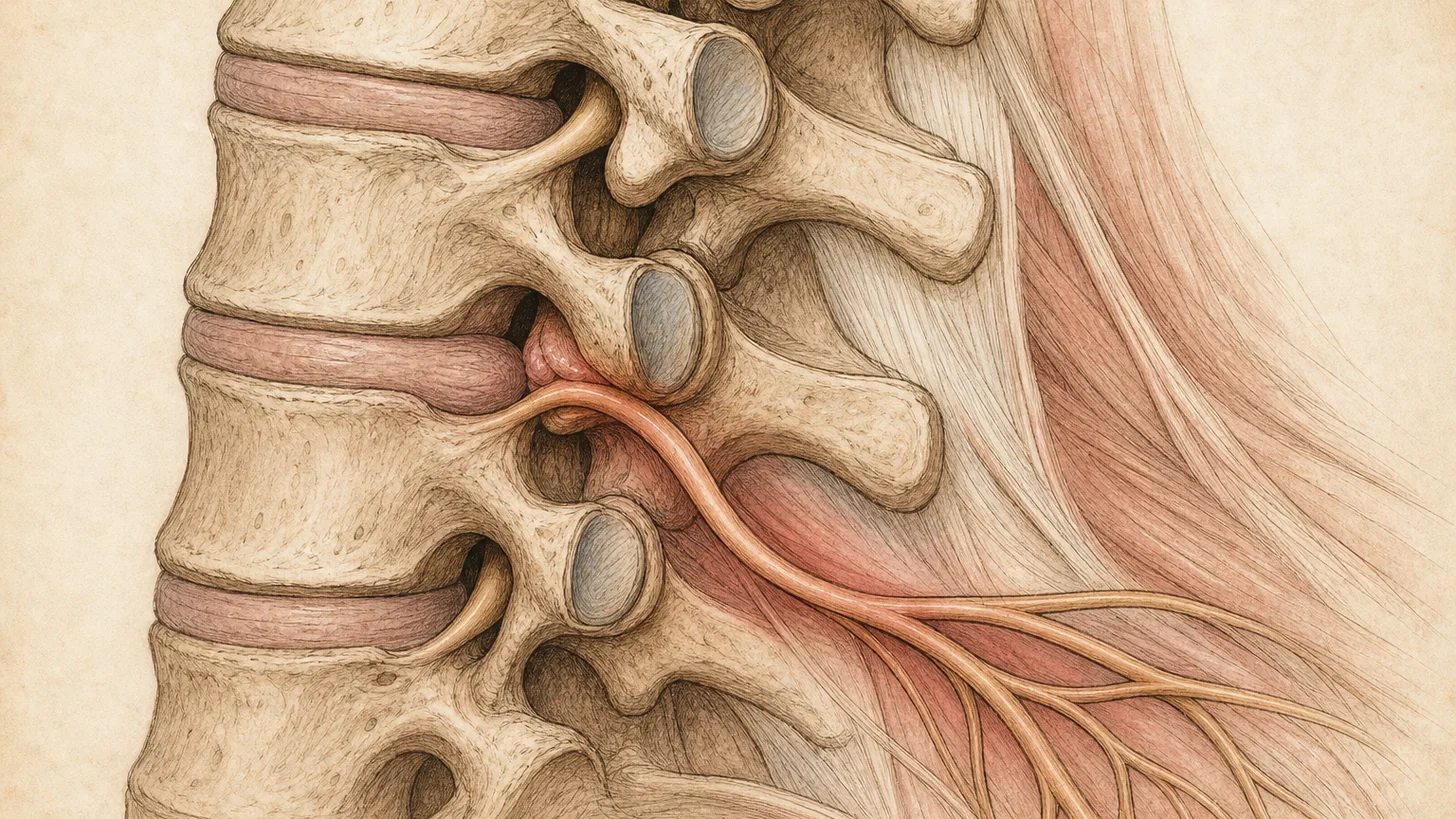
Cubital tunnel syndrome is pressure and stretch on the ulnar nerve as it passes behind the medial epicondyle, the bony bump on the inner elbow. This is the “funny bone”: the nerve runs in a groove there, covered by a band of tissue (Osborne’s ligament) and the start of the forearm muscle that bends the wrist toward the little finger.
Bending the elbow does two things to the nerve. It stretches it, because the nerve runs behind the joint’s axis, and it tightens the roof of the tunnel over it. Leaning on the elbow adds direct pressure. Hours a day of a bent elbow, at a desk, on a phone or curled in sleep, are enough to irritate it. In some people the nerve also slides over the bump each time the elbow bends, which adds friction. Cubital tunnel is the second most common nerve entrapment, after carpal tunnel (Caliandro 2025).
The ulnar nerve carries feeling from the little finger, half of the ring finger, and the little-finger side of the hand, front and back. It also runs most of the small muscles inside the hand, the ones that spread the fingers, pinch and fine-tune grip. That is why advanced cubital tunnel shows up as clumsiness and weak pinch, not just numbness.
Symptoms of cubital tunnel syndrome
Early symptoms come and go with position:
- Tingling or numbness in the little finger and the adjacent half of the ring finger
- Numbness along the little-finger side of the hand, including the back of the hand
- Symptoms that build with the elbow bent, on the phone, driving, or overnight
- An ache on the inner elbow, and a sharp zing when the elbow is bumped
When the nerve has been squeezed longer:
- Numbness that does not go away when the arm straightens
- Dropping things, fumbling buttons and keys, weaker typing or playing
- A weak pinch between the thumb and index finger
- Hollowing in the web between the thumb and index finger, and in more advanced cases a curl of the ring and little fingers
The muscle changes are what matter most. Numbness alone can wait for position changes to work. Weakness and wasting are the signal to test the nerve and talk about surgery.
Cubital tunnel, or something else?
The ring and little fingers can go numb from several places, so the first job is finding the level. Our guide to numbness in the fingers maps every finger to its nerve. The alternatives to check here are:
- Guyon’s canal at the wrist. The same nerve, compressed at the little-finger side of the palm. The back of the hand stays normal. It has its own section below.
- A pinched C8 nerve root in the neck. Numbness runs along the inner forearm as well as the little finger, often with neck or shoulder-blade pain. The forearm skin is supplied by a different nerve from the hand, so numb forearm skin points above the elbow. See our radiculopathy page.
- Carpal tunnel syndrome. The median nerve numbs the thumb, index and middle fingers and spares the little finger. The two often occur together. See our carpal tunnel syndrome page.
- Golfer’s elbow. Inner elbow pain from the tendons that bend the wrist, sore with gripping, without numbness in the fingers. It sits right next to the nerve, so the two can overlap.
- Thoracic outlet syndrome and other problems at the shoulder. Numbness along the inner arm that changes with arm position overhead.
- Peripheral neuropathy. Numbness in both hands that started in the feet is usually diabetes, B12 deficiency or another whole-body cause, and needs blood work.
Our peripheral nerve entrapment page covers the other nerves in the arm that get trapped.
How cubital tunnel syndrome is diagnosed
The cubital tunnel tests in the exam
The exam starts with where the numbness is, including the back of the hand and the inner forearm, then provokes the nerve at the elbow:
- Pressure-flexion test. The elbow is held fully bent while the examiner presses on the nerve behind the medial epicondyle. In patients with nerve-test-proven cubital tunnel, it brought on symptoms within 30 seconds in 91 percent, and control subjects rarely tested positive (Novak 1994).
- Tinel sign at the elbow. Tapping the nerve sends tingling into the little finger. It was positive in 70 percent in the same study, and elbow bending alone in only 32 percent at 30 seconds (Novak 1994).
- Froment’s sign. Pinching a sheet of paper between the thumb and the side of the index finger. When the ulnar-supplied pinch muscle is weak, the thumb tip bends to compensate.
- Wartenberg’s sign. The little finger drifts away from the ring finger and cannot be pulled back in.
- Muscle bulk and finger spread. The web between the thumb and index finger is checked for hollowing, and the fingers are spread against resistance.
The neck, the wrist and the median nerve are examined in the same visit, because those are the usual mimics.
When we do a nerve conduction study and EMG
For the ulnar nerve, the study carries more weight than it does for carpal tunnel. It shows whether the slowing is at the elbow, the wrist or the neck, and the needle EMG shows whether the hand muscles have lost nerve supply. The study is done in our office. A certified technologist performs the nerve conduction portion, and Dr. Movshis performs the needle EMG and reads the study. Our EMG and nerve conduction study page explains what each part measures.
It is still not needed for everyone at the first visit. In a randomized trial of mild and moderate cases, 76 percent of patients with typical symptoms had normal nerve studies, and the authors judged routine testing unnecessary at that stage (Svernlöv 2009). The study earns its place when the hand is weak or wasted, when numbness persists after the position changes below, when the level is unclear, or when surgery is on the table.
Ultrasound of the ulnar nerve
Dr. Movshis scans the elbow at the first visit. A swollen ulnar nerve at the medial epicondyle is the key finding, and an evidence-based guideline published in Muscle & Nerve recommends offering ultrasound measurement to confirm the diagnosis and locate the compression (Shook 2022). In healthy people the nerve rarely measures more than 10 mm² there, and with that cutoff ultrasound had a pooled sensitivity of 85 percent and specificity of 91 percent (Chang 2018). Watching the elbow bend on the screen also shows whether the nerve slides over the bump, and at the wrist ultrasound looks for a ganglion cyst in Guyon’s canal.
Guyon’s canal syndrome
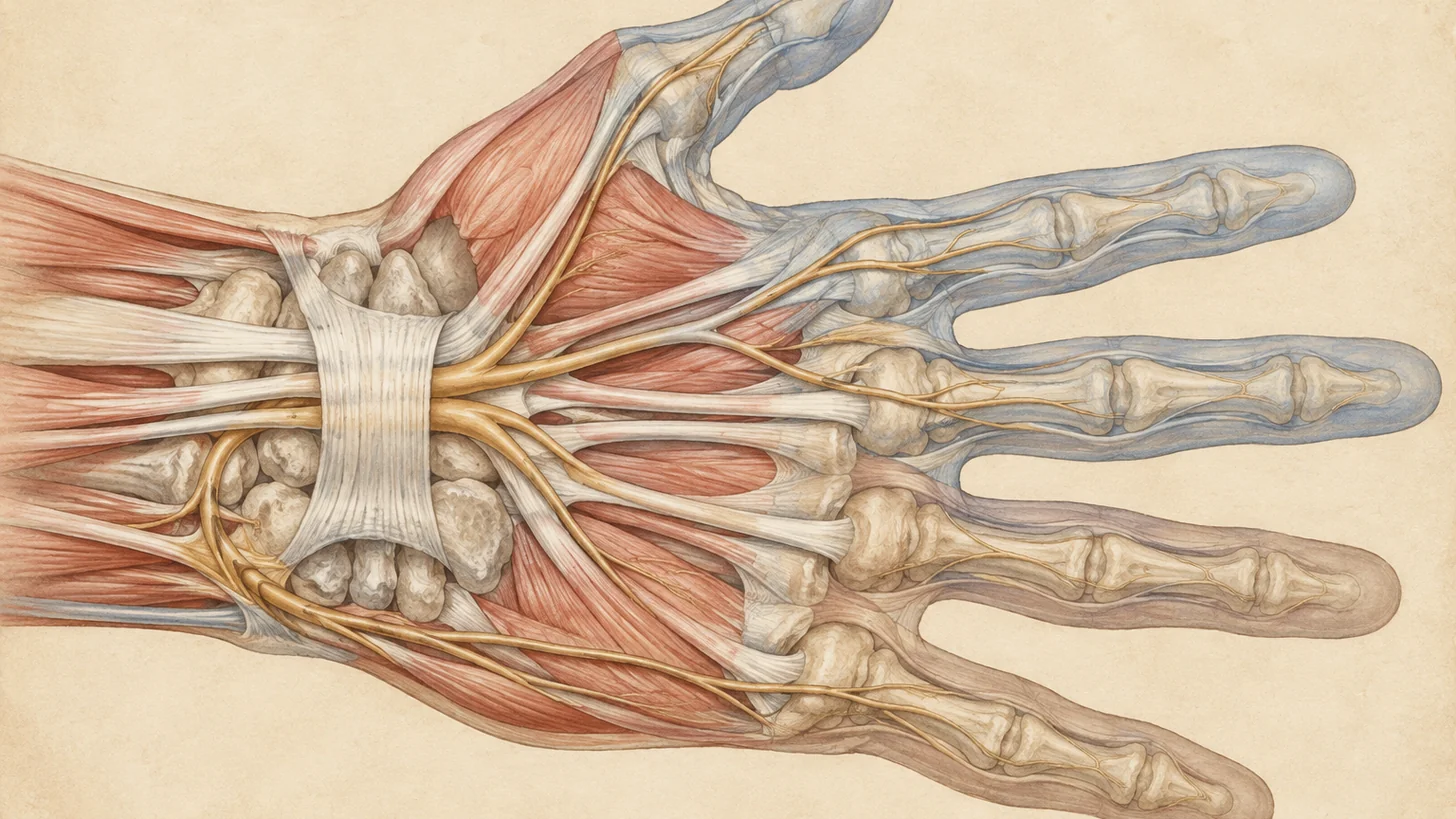
Guyon’s canal, also called the ulnar tunnel, is a short channel at the base of the palm on the little-finger side, between two small wrist bones (the pisiform and the hook of the hamate). The ulnar nerve splits there into a branch for feeling in the little and ring fingers and a deep branch for the hand muscles. Depending on which part is squeezed, Guyon’s canal syndrome can cause numbness alone, weakness alone, or both.
Two features separate it from cubital tunnel. The back of the hand keeps normal feeling, because that branch leaves the nerve above the wrist. And the long muscle that bends the tips of the ring and little fingers keeps its strength, because it is supplied at the forearm.
The causes are more often structural than at the elbow. In a surgical series of 31 patients, causes included trauma, a ganglion cyst, a thrombosed artery, a prominent hook of the hamate and a nerve tumor, though the largest group had no single cause found, and 71 percent also had carpal tunnel syndrome (Murata 2003). Cyclists are a known group: after a six-day, 420-mile tour, the deep motor branch of the ulnar nerve conducted more slowly in riders’ hands (Akuthota 2005). Padded gloves, changing hand position on the bars and a proper bike fit are the first steps. A ganglion or a hamate fracture pressing on the nerve is a surgical problem, and the referral goes out with the imaging.
Cubital tunnel treatment, step by step
Step 1: Change the positions that squeeze the nerve
For mild and moderate cubital tunnel, this is the treatment, and the evidence supports it. In a randomized trial of 70 patients, everyone was taught what compresses the nerve and how to avoid it. Of those followed, 89.5 percent were better at six months, and adding a night splint or nerve-gliding exercises made no difference (Svernlöv 2009). In an earlier follow-up, about half of the patients managed without surgery had improved at one year, with measurable recovery on their nerve studies. Most had changed how they held the arm (Padua 2002).
In practice that means:
- Keeping the elbow straighter at night. A towel wrapped loosely around the elbow, or an elbow pad worn backward, stops it folding sharply during sleep.
- Taking calls on a headset or speaker instead of holding the phone to the ear.
- Not leaning on the inner elbow at a desk, an armrest or a car door.
- Raising the chair or lowering the keyboard so the elbows sit open, not sharply bent.
Give it six to twelve weeks unless the hand is weakening. Our physical therapists can help set up the workstation and the sleep position.
Why we do not inject steroid for cubital tunnel
A corticosteroid injection helps carpal tunnel for a while. It has not been shown to help cubital tunnel. In a double-blind trial, an ultrasound-guided injection of methylprednisolone and lidocaine around the ulnar nerve did no better than a placebo injection at three months, 30 percent against 28 percent (van Veen 2015). The 2025 Cochrane review judged any effect of steroid injection uncertain, and the evidence on dextrose injections rests on two small trials with mixed results (Caliandro 2025). Dr. Movshis does not offer either for this condition.
The lidocaine-only diagnostic block
Some patients have more pain than numbness: an ache on the inner elbow and down the forearm, with tenderness over the nerve but also over the tendons of golfer’s elbow, and sometimes a neck that hurts as well. When the exam and the nerve study leave it unclear whether that pain comes from the nerve at the elbow, Dr. Movshis can place a small amount of lidocaine next to the nerve at the cubital tunnel under ultrasound. No steroid goes in, because steroid adds nothing here (van Veen 2015).
The test is read in the hour that follows. The little finger going numb confirms the anesthetic reached the nerve. The useful question is whether the usual pain, and the pain brought on by the pressure-flexion test before the injection, goes away. It is only interpretable when the pain is present before the needle goes in. No trial has studied this block for the ulnar nerve, so it is used as one piece of evidence alongside the exam, the ultrasound and the nerve study, not as a verdict on its own. Our nerve blocks page describes how diagnostic blocks are done.
Referral for cubital tunnel release
Surgery comes up when the hand is getting weaker, when there is wasting or motor fiber loss on the EMG, or when symptoms persist despite months of position changes. The usual operation is simple decompression: the band over the tunnel is released and the nerve stays where it is. In the largest randomized trial, 152 patients were assigned to simple decompression or to moving the nerve in front of the elbow (anterior transposition). Good or excellent results were similar, 49 of 75 against 54 of 77, but complications ran 9.6 percent against 31.1 percent, and the authors advised simple decompression even when the nerve slides over the bump (Bartels 2005). A meta-analysis of randomized trials found no difference in outcome scores or nerve conduction between the two (Zlowodzki 2007), and the 2025 Cochrane review reached the same conclusion, including for severe cases (Caliandro 2025).
Endoscopic release produced similar results to open release in trials, with less scar tenderness but more postoperative hematomas (Buchanan 2018, Caliandro 2025). Coverage is less settled: at least one Blue Cross plan still classes endoscopic cubital tunnel release as investigational (BCBSM 2026). The referral is for open release, with transposition left to the surgeon’s judgment.
Modal does not perform the operation. Dr. Movshis refers to hand surgeons once the level is confirmed and the conservative care is on record.
When arm and hand numbness needs urgent care
- Sudden numbness or weakness of an arm, the hand or the face, trouble speaking, or a drooping face. These are signs of a stroke. Call 911.
- Numbness or weakness in the hand after an elbow fracture or dislocation. This needs to be seen the same day. Call 911 or go to the nearest emergency room.
- Weakness that worsens week by week, or hollowing between the thumb and index finger. Not an emergency, but book promptly.
Cubital tunnel care with Dr. Movshis in Midtown
The first visit covers the history, the exam at the elbow, wrist and neck, and an ultrasound of the ulnar nerve. If a nerve study is needed, it is done in the office, usually at a separate visit. Treatment follows the steps above. Most people start with position changes and are rechecked in six to twelve weeks. Anyone with weakness goes straight to testing and, when the study supports it, to a surgical referral.
What we document before you see a surgeon
If you are headed for surgery, Dr. Movshis sends the surgeon your exam, ultrasound, nerve testing and injection results, along with dated records of the care you have tried. Each surgeon and each insurance plan asks for slightly different things, so we fill in whatever they request.
Most commercial PPO plans cover the evaluation, ultrasound, nerve testing and diagnostic block. Check your insurance before your first visit, at no cost.
Same-week appointments are available. Book online or call (646) 290-6660.
References
- Caliandro P, La Torre G, Padua R, et al. Treatment for ulnar neuropathy at the elbow. Cochrane Database Syst Rev. 2025;4(4):CD006839. doi:10.1002/14651858.CD006839.pub5 · PubMed
- Novak CB, Lee GW, Mackinnon SE, Lay L. Provocative testing for cubital tunnel syndrome. J Hand Surg Am. 1994;19(5):817–20. doi:10.1016/0363-5023(94)90193-7 · PubMed
- Svernlöv B, Larsson M, Rehn K, Adolfsson L. Conservative treatment of the cubital tunnel syndrome. J Hand Surg Eur Vol. 2009;34(2):201–7. doi:10.1177/1753193408098480 · PubMed
- Padua L, Aprile I, Caliandro P, et al. Natural history of ulnar entrapment at elbow. Clin Neurophysiol. 2002;113(12):1980–4. doi:10.1016/s1388-2457(02)00295-x · PubMed
- Shook SJ, Ginsberg M, Narayanaswami P, et al. Evidence-based guideline: Neuromuscular ultrasound for the diagnosis of ulnar neuropathy at the elbow. Muscle Nerve. 2022;65(2):147–153. doi:10.1002/mus.27460 · PubMed
- Chang KV, Wu WT, Han DS, Özçakar L. Ulnar Nerve Cross-Sectional Area for the Diagnosis of Cubital Tunnel Syndrome: A Meta-Analysis of Ultrasonographic Measurements. Arch Phys Med Rehabil. 2018;99(4):743–757. doi:10.1016/j.apmr.2017.08.467 · PubMed
- Murata K, Shih JT, Tsai TM. Causes of ulnar tunnel syndrome: a retrospective study of 31 subjects. J Hand Surg Am. 2003;28(4):647–51. doi:10.1016/s0363-5023(03)00147-3 · PubMed
- Akuthota V, Plastaras C, Lindberg K, et al. The effect of long-distance bicycling on ulnar and median nerves: an electrophysiologic evaluation of cyclist palsy. Am J Sports Med. 2005;33(8):1224–30. doi:10.1177/0363546505275131 · PubMed
- van Veen KE, Alblas KC, Alons IM, et al. Corticosteroid injection in patients with ulnar neuropathy at the elbow: A randomized, double-blind, placebo-controlled trial. Muscle Nerve. 2015;52(3):380–5. doi:10.1002/mus.24551 · PubMed
- Bartels RH, Verhagen WI, van der Wilt GJ, et al. Prospective randomized controlled study comparing simple decompression versus anterior subcutaneous transposition for idiopathic neuropathy of the ulnar nerve at the elbow: Part 1. Neurosurgery. 2005;56(3):522–30. doi:10.1227/01.neu.0000154131.01167.03 · PubMed
- Zlowodzki M, Chan S, Bhandari M, Kalliainen L, Schubert W. Anterior transposition compared with simple decompression for treatment of cubital tunnel syndrome. A meta-analysis of randomized, controlled trials. J Bone Joint Surg Am. 2007;89(12):2591–8. doi:10.2106/JBJS.G.00183 · PubMed
- Buchanan PJ, Chieng LO, Hubbard ZS, Law TY, Chim H. Endoscopic versus Open In Situ Cubital Tunnel Release: A Systematic Review of the Literature and Meta-Analysis of 655 Patients. Plast Reconstr Surg. 2018;141(3):679–684. doi:10.1097/PRS.0000000000004112 · PubMed
- BCBSM (Blue Cross Blue Shield of Michigan). Joint Medical Policy: novel methods for carpal tunnel and peripheral nerve entrapment release, including endoscopic release of the ulnar nerve for cubital tunnel syndrome. Effective September 1, 2026. bcbsm.com