A graphic designer comes in with a story Dr. Alex Movshis hears every week. For two months she has woken at 3 a.m. with her right hand asleep. She hangs it off the bed and shakes it until the pins and needles fade. By day, the thumb, index and middle fingers feel thick when she buttons a shirt, and twice this month she has dropped her coffee cup. Her little finger is fine. Her friends told her it is carpal tunnel. They are probably right, and the useful questions are how sure we are, how badly the nerve is affected, and what to do about it.
What carpal tunnel syndrome is
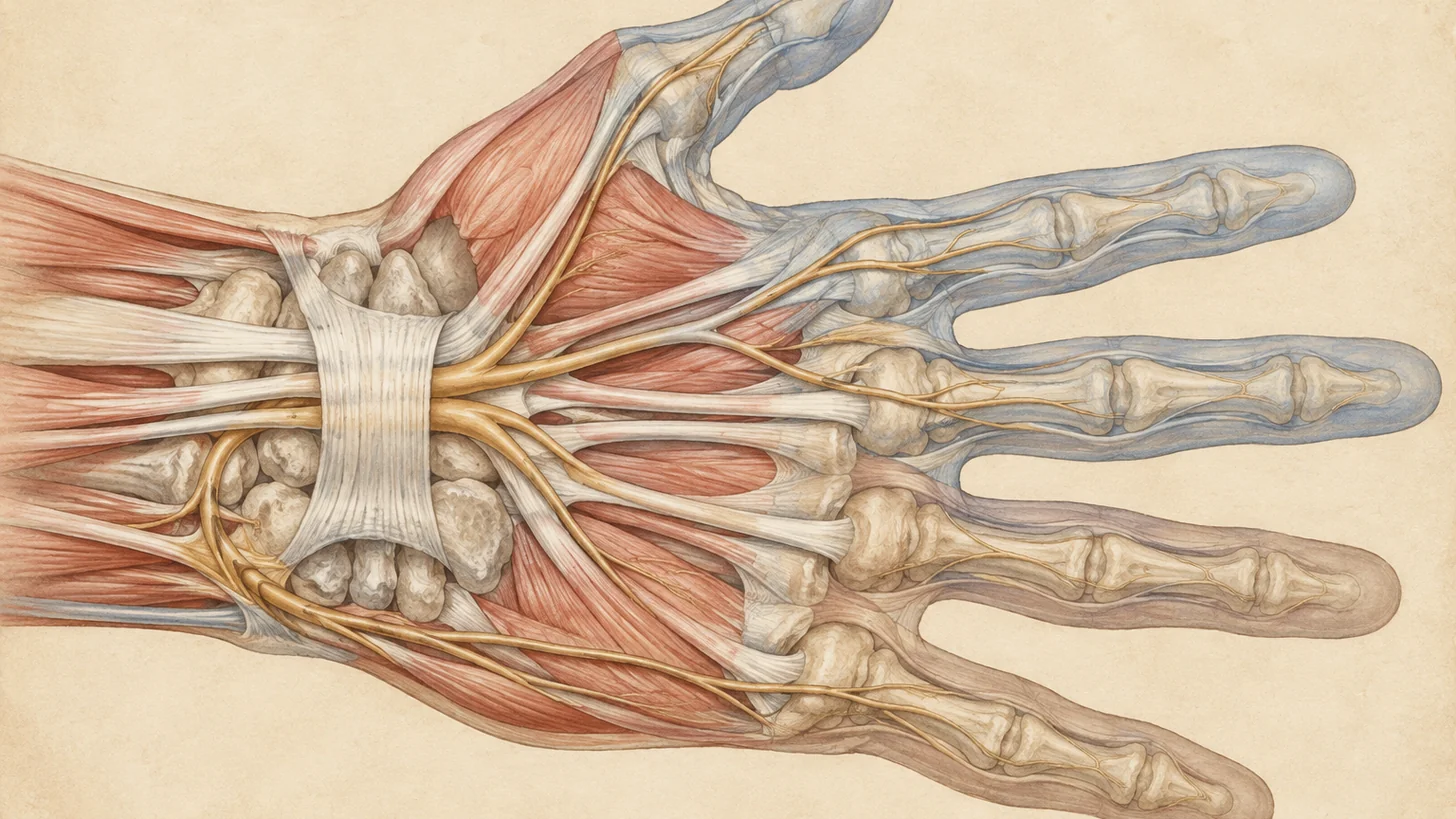
Carpal tunnel syndrome is pressure on the median nerve where it passes through the wrist. The carpal tunnel is a narrow channel with bone on three sides and a tough band, the transverse carpal ligament, across the top. Nine flexor tendons share it with the nerve. When the space gets tighter, from swollen tendon linings, fluid, or the wrist held bent for hours, the nerve is squeezed and its blood supply drops. It is the most common nerve entrapment in the body (Padua 2016).
The median nerve carries feeling from the thumb, index and middle fingers and half of the ring finger, and it powers the muscles at the base of the thumb. That map explains the symptoms. It also explains what carpal tunnel does not do. It does not numb the little finger, which belongs to the ulnar nerve, and it spares the skin of the palm near the wrist, because the branch supplying that skin leaves the nerve before the tunnel.
Some people are more likely to get it. Risk rises with age, pregnancy, diabetes, an underactive thyroid, rheumatoid arthritis, higher body weight and an old wrist fracture, and it is more common in women. Work that combines force, vibration and a bent wrist adds to the load. Typing alone is a weaker factor than most people assume.
Symptoms of carpal tunnel syndrome
The early symptoms come and go:
- Numbness, tingling or burning in the thumb, index and middle fingers, sometimes half the ring finger
- Waking at night with the hand asleep, and relief from shaking it out
- Tingling while holding a phone, a steering wheel or a book with the wrist bent
- Aching that can spread into the forearm
As the nerve is squeezed longer, symptoms change:
- Numbness that is there all day, not just at night
- Clumsiness with buttons, earrings and coins, and dropping things
- A weak pinch and grip, and a flattened area at the base of the thumb
That flattening, wasting of the thenar muscles, means the nerve has lost motor fibers. It is the finding that most changes the plan, and it should not wait months for an appointment.
Carpal tunnel, or something else?
Hand numbness has several sources, and a wrong label is the most common reason treatment fails. Our guide to numbness in the fingers maps each finger to its nerve. These are the mimics Dr. Movshis checks for at the first visit:
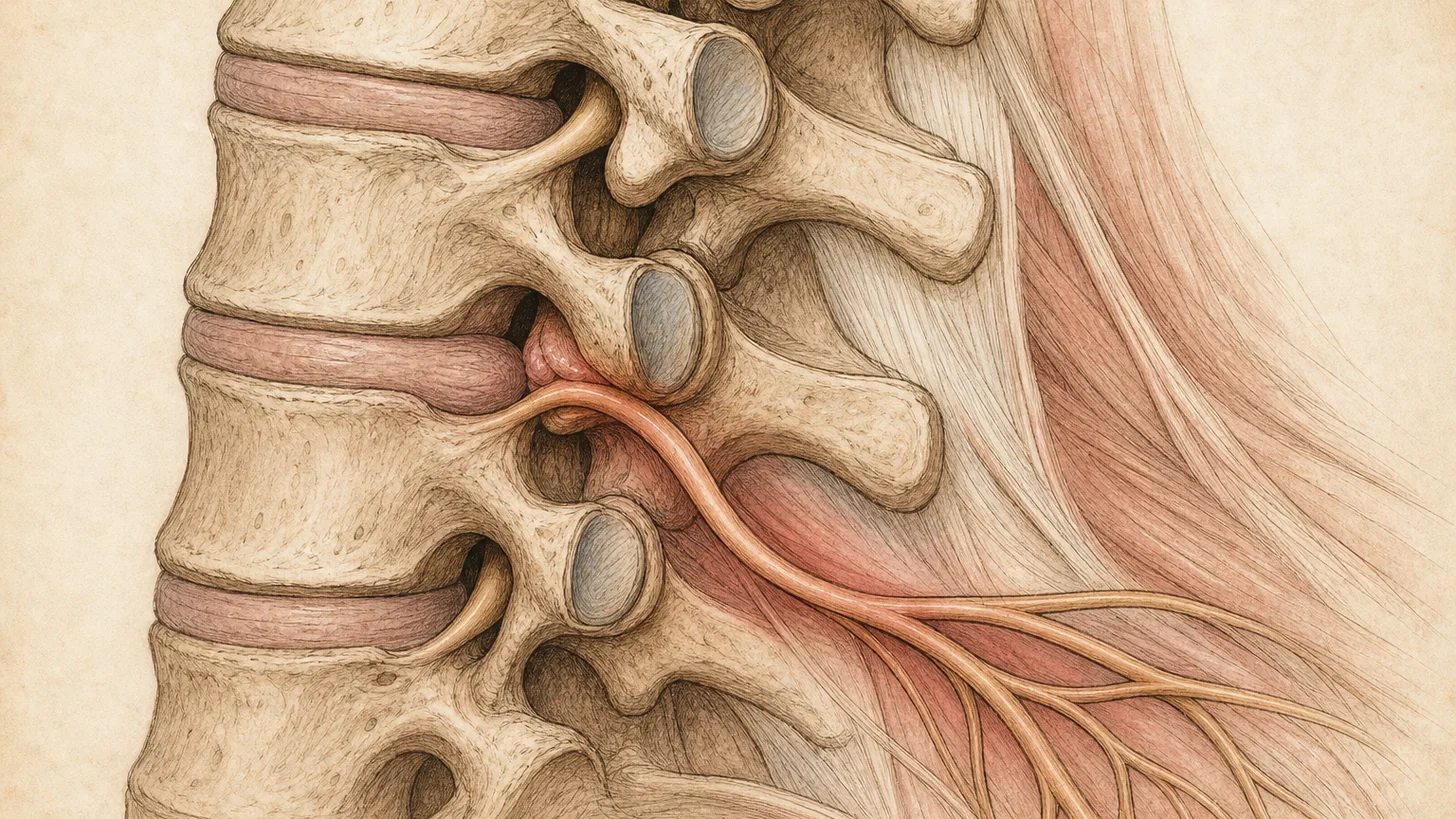
- A pinched nerve in the neck. A C6 or C7 root sends tingling into the thumb and index or middle finger too, but usually with neck pain, symptoms down the forearm and reflex changes. The neck and the wrist can both be involved at once. See our radiculopathy page.
- Cubital tunnel syndrome. The ulnar nerve at the elbow numbs the ring and little fingers, worse with the elbow bent. See our cubital tunnel syndrome page, and the peripheral nerve entrapment page for the other upper-limb entrapments.
- Wartenberg’s syndrome. Burning on the back of the hand and the thumb, not the palm, from the superficial radial nerve. Our Wartenberg’s guide explains the difference.
- Median nerve compression in the forearm. Pronator syndrome numbs the same fingers plus the palm near the wrist, and the forearm aches with use rather than at night.
- Peripheral neuropathy. Numbness in both hands that started in the feet first is usually diabetes, B12 deficiency or another whole-body cause, and needs blood work rather than a wrist injection.
- Thumb-base arthritis and de Quervain’s tendinitis. Both hurt at the thumb side of the wrist, without numbness.
How carpal tunnel syndrome is diagnosed
The carpal tunnel tests in the exam
Carpal tunnel is a clinical diagnosis. The 2024 American Academy of Orthopaedic Surgeons guideline, written with the American Society for Surgery of the Hand, recommends a validated clinical tool, the CTS-6, for typical cases, and reserves nerve testing and ultrasound for diagnostic doubt or recurrence (Shapiro 2025, Wright 2026). The CTS-6 weighs six findings (Graham 2006):
- Numbness mainly in the thumb, index and middle fingers (3.5 points)
- Numbness that wakes you at night (4 points)
- Wasting or weakness at the base of the thumb (5 points)
- A positive Phalen test: holding the wrists fully bent for up to a minute brings on the tingling (5 points)
- A positive Tinel sign: tapping over the nerve at the wrist sends tingling into those fingers (4 points)
- Loss of two-point discrimination in those fingertips, measured with a caliper (4.5 points)
A total of 12 or more out of 26 makes carpal tunnel likely (Graham 2008). In patients whose score already made the diagnosis likely, a nerve conduction study barely moved the probability, and the large changes happened in patients whose exam was uncertain (Graham 2008). So a strong exam is enough to start treatment, and the study is aimed at the cases where it changes something.
When we do a nerve conduction study and EMG
When the study is needed, it is done in our office. A certified technologist performs the nerve conduction portion, and Dr. Movshis performs the needle EMG and reads the study. Our EMG and nerve conduction study page explains what each part measures. For the hand, it earns its place when:
- The exam is mixed, or the CTS-6 score sits below 12
- The neck could be part of the problem, or the ulnar nerve is in play too
- There is weakness or wasting, and the question is how much the nerve has lost
- Surgery is being planned and the surgeon or the insurance plan asks for it
- Symptoms have come back after a release
That fourth point is common in practice. In a statewide telephone survey, 57 percent of surgeons who perform carpal tunnel release required a diagnostic test before the first consultation, and 85 percent of the surgeons who asked for a test wanted a nerve study (Sears 2017). Insurance plans set their own criteria for approving a release. Anthem’s guideline for New York members asks for a diagnosis confirmed by the history and exam, with or without a nerve study, and symptoms that persisted despite conservative care such as six weeks of splinting or a steroid injection (Anthem 2025). Another Blue Cross plan accepts either a nerve study or a CTS-6 score above 12 (Premera 2026).
A normal study does not end the question. Some people with typical symptoms and a normal study still have carpal tunnel. In a cohort of 36 hands with normal studies that went on to release, 86 percent improved after surgery (Katt 2022).
Ultrasound of the median nerve
Dr. Movshis scans the wrist at the first visit. A swollen median nerve at the entrance of the tunnel is the key finding. Pooled across 25 studies, nerve cross-sectional area at the tunnel inlet had a sensitivity of 88 percent and a specificity of 84 percent, with different cutoffs for Asian and non-Asian patients (Luo 2025). Ultrasound also shows what a nerve study cannot: a ganglion cyst or a thickened tendon lining crowding the tunnel, a split median nerve, and an extra artery running with it. And it guides the needle when an injection is the next step.
Carpal tunnel treatment, step by step
The plan depends on severity. Mild, intermittent symptoms start with a splint. Constant numbness, wasting or a severe nerve study moves straight to a surgical referral, with an injection only if it fits the timing.
Step 1: A night splint and fewer bent-wrist hours
A splint that holds the wrist straight overnight is the usual first step. The evidence is modest. A 2023 Cochrane review of 29 trials could not conclude whether splinting helps, found that night splints may improve the chance of overall improvement in the short term, and called the possible benefits small (Karjalainen 2023). It is cheap and has no lasting harms, so it is worth six weeks. During the day, the useful changes are keeping the wrist straight on the keyboard and mouse, breaking up long grips, and taking a phone call on a headset. In a trial of people with confirmed carpal tunnel, release outperformed splinting at 3 and 18 months, and 41 percent of those assigned to a splint had surgery by 18 months (Gerritsen 2002).
Step 2: Ultrasound-guided corticosteroid injection
When a splint is not enough, Dr. Movshis injects a corticosteroid with a local anesthetic into the carpal tunnel under ultrasound. The picture lets him place the medication around the nerve without putting the needle into it, and the joint and soft tissue injections page describes the visit.
The evidence is better than for most injections, with clear limits. A Cochrane review found that a steroid injection improved symptoms more than placebo at one month, though benefit beyond that was not shown in the pooled trials (Marshall 2007). The best trial since then, a blinded comparison of 80 mg and 40 mg of methylprednisolone with placebo, found better symptom scores at 10 weeks, and fewer releases at one year: 73 percent in the 80 mg group, 81 percent in the 40 mg group, and 92 percent with placebo (Atroshi 2013). At five years, 84, 92 and 97 percent had had surgery, and the injection pushed surgery back by about two months on average (Hofer 2021). So for most people with established carpal tunnel, an injection buys time rather than a cure. A minority never need surgery.
Two injections close together have not beaten one (Marshall 2007). Dr. Movshis does not repeat the injection within three months, and when a second one fades as fast as the first, the next step is a surgical referral rather than a third.
The injection as a test before surgery
The injection does a second job, and it is the main reason it sits on this ladder. Relief from the shot predicts relief from release. In 233 patients injected by one surgeon, 81 percent had good or complete relief, and a good response proved an excellent diagnostic and prognostic sign. A poor response did not mean someone was a poor candidate for surgery (Green 1984). In a later cohort of 57 patients who had a release, surgery succeeded in 87 percent of those who had some relief from a prior injection against 54 percent of those who had none (Edgell 2003). The test matters most when the nerve study is normal. Of 32 hands with normal studies that improved after the injection, 29 also improved after release (Katt 2022).
Two limits apply. A poor response is not a reason to deny surgery to someone with a convincing exam and study (Green 1984). And when carpal tunnel comes back after a release, the injection alone did not significantly predict revision success, though combined with the exam it screened well (Beck 2012).
Treatments we do not offer for carpal tunnel
The 2024 guideline found no evidence of benefit for oral steroids, anti-inflammatory pills, therapeutic ultrasound or platelet-rich plasma injections, and does not recommend them (Wright 2026). We do not offer them for this condition.
We also do not perform the newer minimally invasive releases done with a needle under ultrasound. Anthem, which since 2024 includes the former Empire Blue Cross Blue Shield in New York, classes thread carpal tunnel release and ultrasound-guided percutaneous needle release as not medically necessary (Anthem 2025), and other plans call them investigational (Premera 2026). A patient who had one of these and was then denied coverage would be the one left with the bill. When release is needed, the referral is for open or endoscopic release, which are covered.
Referral for carpal tunnel release
Carpal tunnel release cuts the transverse carpal ligament to open the tunnel. A 2024 guideline synopsis lists the usual indications as moderate to severe symptoms, wasting at the base of the thumb, and failed nonoperative treatment (Wright 2026). Open and endoscopic release give similar relief. In a Cochrane review of 28 trials, endoscopic release returned people to work or daily activities about eight days sooner, with fewer minor complications such as wound problems and scar tenderness but more temporary nerve irritation, and recurrence rates were comparable (Vasiliadis 2014). The choice is the surgeon’s and yours.
Modal does not perform the operation. Dr. Movshis refers to hand surgeons once the diagnosis is confirmed and the conservative care is on record, and sends the findings with the referral.
When hand numbness needs urgent care
Most carpal tunnel can be booked as a routine visit. Some symptoms cannot wait:
- Sudden numbness or weakness of the arm, hand or face, trouble speaking, or a drooping face. These are signs of a stroke. Call 911.
- Rapidly worsening numbness and swelling after a wrist fracture or a crush injury. Pressure in the tunnel can rise fast, and this needs to be seen the same day. Call 911 or go to the nearest emergency room.
- Weakness that is getting worse week by week, or wasting at the base of the thumb. Not an emergency, but book promptly rather than waiting on a splint.
Carpal tunnel care with Dr. Movshis in Midtown
The first visit covers the history, the CTS-6 exam, a check of the neck and the elbow, and an ultrasound of the median nerve. If a nerve study is needed, it is done in the office, usually at a separate visit. Treatment follows the steps above, with the injection when it adds something and a referral when the hand needs surgery.
What we document before you see a surgeon
If you are headed for surgery, Dr. Movshis sends the surgeon your exam, ultrasound, nerve testing and injection results, along with dated records of the care you have tried. Each surgeon and each insurance plan asks for slightly different things, so we fill in whatever they request.
Most commercial PPO plans cover the evaluation, ultrasound, nerve testing and injection. Check your insurance before your first visit, at no cost.
Same-week appointments are available. Book online or call (646) 290-6660.
References
- Padua L, Coraci D, Erra C, et al. Carpal tunnel syndrome: clinical features, diagnosis, and management. Lancet Neurol. 2016;15(12):1273–1284. doi:10.1016/S1474-4422(16)30231-9 · PubMed
- Shapiro LM, Kamal R, Brault J, et al. American Academy of Orthopaedic Surgeons/ASSH Clinical Practice Guideline Summary Management of Carpal Tunnel Syndrome. J Am Acad Orthop Surg. 2025;33(7):e356–e366. doi:10.5435/JAAOS-D-24-01179 · PubMed
- Wright JL, Kamal RN, Shapiro LM, et al. AAOS Clinical Practice Guidelines for Carpal Tunnel Syndrome: Synopsis and Practice Implications. J Gen Intern Med. 2026. doi:10.1007/s11606-026-10968-5 · PubMed
- Graham B, Regehr G, Naglie G, Wright JG. Development and validation of diagnostic criteria for carpal tunnel syndrome. J Hand Surg Am. 2006;31(6):919–24. PubMed
- Graham B. The value added by electrodiagnostic testing in the diagnosis of carpal tunnel syndrome. J Bone Joint Surg Am. 2008;90(12):2587–93. doi:10.2106/JBJS.G.01362 · PubMed
- Sears ED, Lu YT, Wood SM, et al. Diagnostic Testing Requested Before Surgical Evaluation for Carpal Tunnel Syndrome. J Hand Surg Am. 2017;42(8):623–629.e1. doi:10.1016/j.jhsa.2017.05.006 · PubMed
- Katt BM, Imbergamo C, Padua F, et al. Diagnostic Value of a Carpal Tunnel Corticosteroid Injection in Patients with Negative Electrodiagnostic Studies. J Hand Microsurg. 2022;14(4):292–297. doi:10.1055/s-0040-1717830 · PubMed
- Luo YT, Huang YT, Chiu V, Chang YW, Horng YS. Diagnostic meta-analysis of the efficacy of ultrasonography for diagnosing carpal tunnel syndrome: A comparison between Asian and non-Asian populations. J Formos Med Assoc. 2025;124(7):666–674. doi:10.1016/j.jfma.2024.06.026 · PubMed
- Karjalainen TV, Lusa V, Page MJ, et al. Splinting for carpal tunnel syndrome. Cochrane Database Syst Rev. 2023;2(2):CD010003. doi:10.1002/14651858.CD010003.pub2 · PubMed
- Gerritsen AA, de Vet HC, Scholten RJ, et al. Splinting vs surgery in the treatment of carpal tunnel syndrome: a randomized controlled trial. JAMA. 2002;288(10):1245–51. doi:10.1001/jama.288.10.1245 · PubMed
- Marshall S, Tardif G, Ashworth N. Local corticosteroid injection for carpal tunnel syndrome. Cochrane Database Syst Rev. 2007;(2):CD001554. doi:10.1002/14651858.CD001554.pub2 · PubMed
- Atroshi I, Flondell M, Hofer M, Ranstam J. Methylprednisolone injections for the carpal tunnel syndrome: a randomized, placebo-controlled trial. Ann Intern Med. 2013;159(5):309–17. doi:10.7326/0003-4819-159-5-201309030-00004 · PubMed
- Hofer M, Ranstam J, Atroshi I. Extended Follow-up of Local Steroid Injection for Carpal Tunnel Syndrome: A Randomized Clinical Trial. JAMA Netw Open. 2021;4(10):e2130753. doi:10.1001/jamanetworkopen.2021.30753 · PubMed
- Green DP. Diagnostic and therapeutic value of carpal tunnel injection. J Hand Surg Am. 1984;9(6):850–4. doi:10.1016/s0363-5023(84)80065-9 · PubMed
- Edgell SE, McCabe SJ, Breidenbach WC, et al. Predicting the outcome of carpal tunnel release. J Hand Surg Am. 2003;28(2):255–61. doi:10.1053/jhsu.2003.50031 · PubMed
- Beck JD, Brothers JG, Maloney PJ, et al. Predicting the outcome of revision carpal tunnel release. J Hand Surg Am. 2012;37(2):282–7. doi:10.1016/j.jhsa.2011.10.040 · PubMed
- Vasiliadis HS, Georgoulas P, Shrier I, Salanti G, Scholten RJ. Endoscopic release for carpal tunnel syndrome. Cochrane Database Syst Rev. 2014;(1):CD008265. doi:10.1002/14651858.CD008265.pub2 · PubMed
- Anthem Blue Cross Blue Shield (New York). Clinical UM Guideline CG-SURG-112: Carpal Tunnel Decompression Surgery. Published January 30, 2025. anthem.com
- Premera Blue Cross. Medical Policy 7.01.595: Carpal Tunnel Release Surgical Techniques. Effective June 5, 2026. premera.com