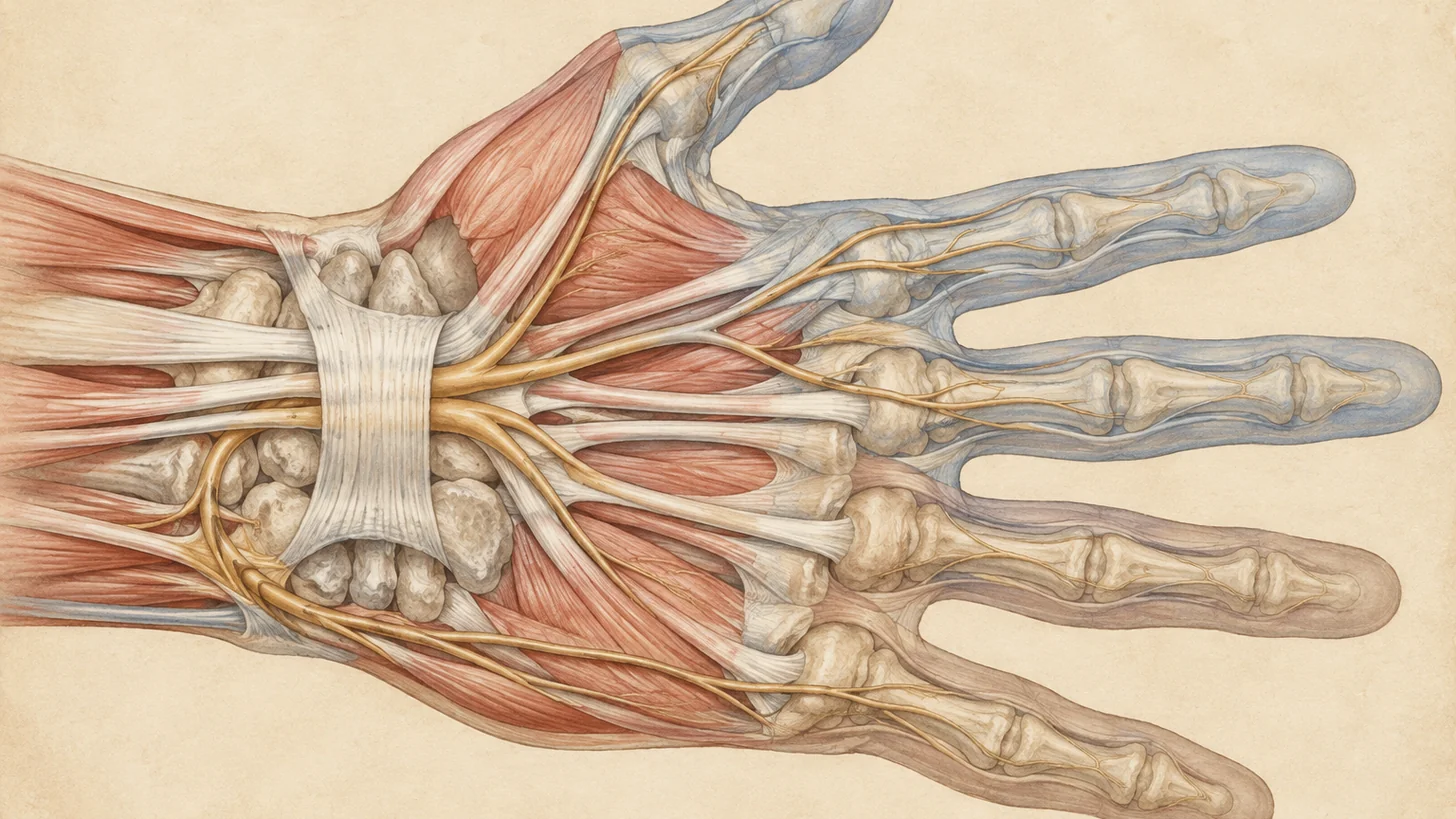
Numb fingers at night can come from the wrist or from the neck. A foot that slaps on the sidewalk can come from a nerve pinched at the outside of the knee or from a disc in the lower back. The exam narrows it down. When it does not settle the question, the nerve study usually does, and it shapes which operation, if any, makes sense.
At Modal Pain Management NYC the study happens in the same office as your exam. A certified technologist performs the nerve conduction portion, and Dr. Movshis performs the needle EMG and reads the full study, so the person interpreting it has also examined you.
What each part measures
The nerve conduction study tests the nerve itself. Small electrodes are taped to the skin, and a brief electrical pulse is applied along the nerve. The machine records how fast the signal travels and how large it is when it arrives. A signal that slows at one spot, such as the median nerve crossing the wrist, marks where the nerve is compressed.
The needle EMG tests the muscles. A fine needle electrode records each muscle at rest and while you tighten it. A healthy muscle is quiet at rest. A muscle that has lost part of its nerve supply shows a characteristic pattern, and which muscles show it tells us whether the problem sits at a peripheral nerve or at a nerve root.
The two answer different questions, which is why they are done together.
What the study settles before a surgeon sees you
- Where the nerve is pinched. Carpal tunnel versus a C6 or C7 root in the neck. The ulnar nerve at the elbow versus the wrist (Guyon’s canal) versus a C8 root. The tibial nerve at the inner ankle (tarsal tunnel) versus an S1 root. The common peroneal nerve at the fibular head versus an L5 root.
- Whether two problems are stacked. A nerve squeezed at the neck and again at the wrist (a “double crush”) changes what surgery can be expected to fix.
- How severe it is. Slowing alone means the insulation around the nerve is affected. Loss of signal size and changes in the muscles mean nerve fibers themselves are being lost, which raises the urgency of decompression.
- The documentation. Surgeons and insurers reviewing a prior authorization for carpal or cubital tunnel release often ask for the study. Having it done here, alongside the exam and ultrasound findings, means the referral goes out complete.
When we don’t order it
Nerve testing is not part of every nerve-pain visit. A typical Morton’s neuroma is diagnosed by the exam and ultrasound. Small sensory nerves such as the lateral femoral cutaneous nerve in meralgia paresthetica are better tested with a diagnostic nerve block. Numbness in both feet that starts at the toes and climbs is usually a peripheral neuropathy, and the workup starts with blood work through your primary care physician.
The study answers a specific question about a specific nerve. If the history and exam don’t raise one, it isn’t done.
Conditions it helps sort out
- Numb or tingling fingers, and weakness in the hand: carpal tunnel, cubital tunnel, or a pinched nerve in the neck (radiculopathy).
- Burning across the sole of the foot or numbness into several toes: tarsal tunnel or an S1 root. See also our guide to ball-of-foot pain.
- Foot drop or weakness lifting the foot: the common peroneal nerve at the knee or an L5 root.
Insurance
Most commercial PPO plans cover a nerve conduction study and EMG when there is a clinical reason for it. We verify your benefits before the visit at no cost. Modal Pain Management NYC does not accept Medicare, Medicaid, HMO plans, or workers’ compensation.
References
- Wright JL, Kamal RN, Shapiro LM, et al. AAOS Clinical Practice Guidelines for Carpal Tunnel Syndrome: Synopsis and Practice Implications. J Gen Intern Med. 2026. doi:10.1007/s11606-026-10968-5 · PubMed
- Aetna. Clinical Policy Bulletin 0502: Electrodiagnostic Testing. Last reviewed October 26, 2026. aetna.com