A nurse in her fifties comes in after a year of twelve-hour shifts with a story Dr. Alex Movshis hears often. By mid-afternoon the sole of her left foot burns, and by the end of the shift her toes tingle. At night it is worse, a hot, electric sole that wakes her when she rolls over. She was told it was plantar fasciitis and spent four months stretching her calf and wearing a heel cup. Her heel never hurt on the first step out of bed, which is the plantar fasciitis signature. When he taps just behind and below her inner ankle bone, the tingle shoots into her arch. That pattern points to the tibial nerve at the tarsal tunnel.
What tarsal tunnel syndrome is
Tarsal tunnel syndrome is pressure on the tibial nerve as it passes behind the medial malleolus, the bony bump on the inner ankle. There the nerve runs under a band of tissue called the flexor retinaculum, together with three tendons that move the foot and toes and the main artery and veins of the sole. It is the foot’s version of carpal tunnel, with one difference that matters: the tunnel at the ankle is roomier and its contents are more varied, so the cause is less predictable.
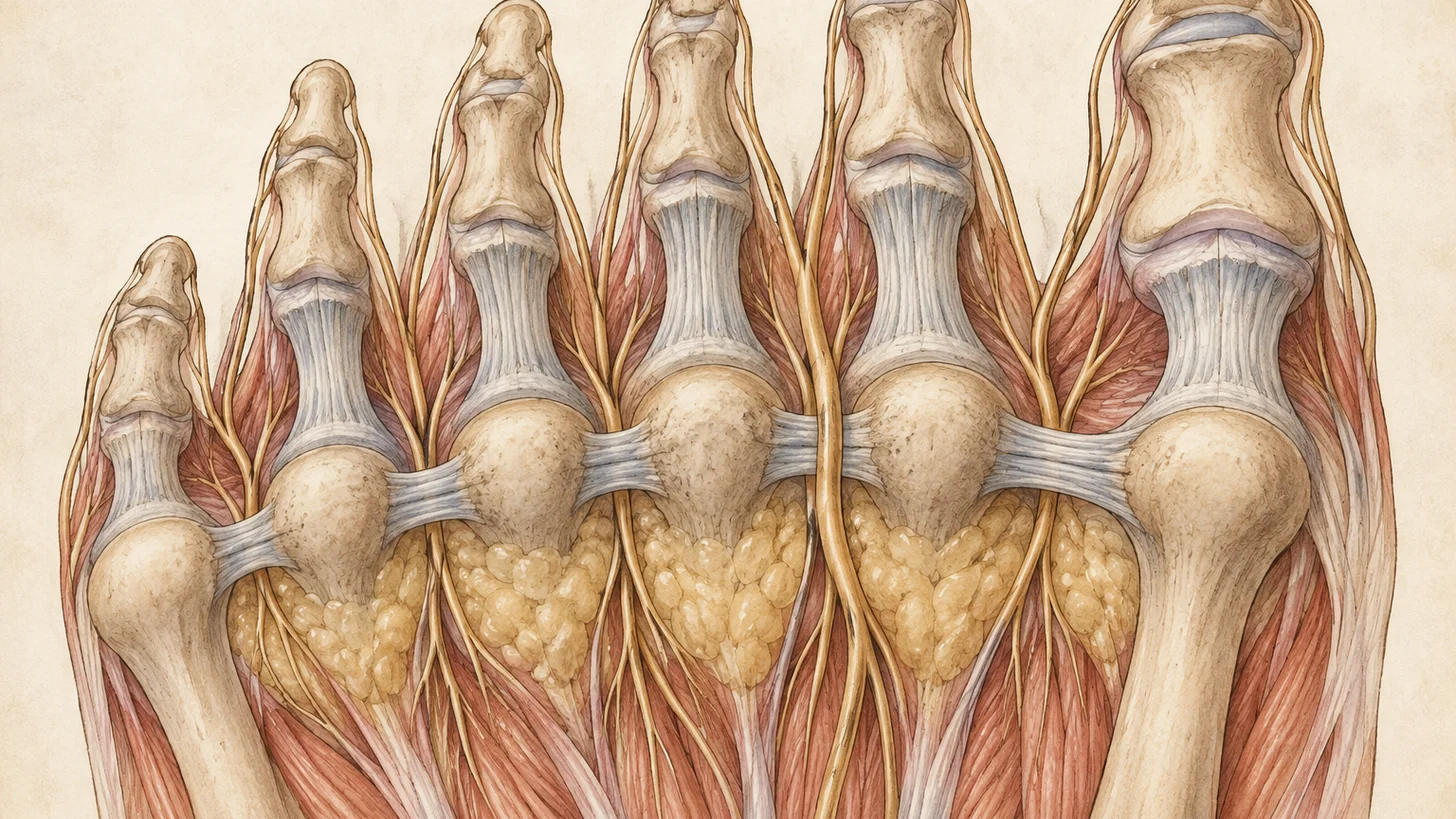
Inside or just past the tunnel the nerve splits into three: the medial plantar nerve to the inner sole and the first three toes, the lateral plantar nerve to the outer sole and the last two toes, and a calcaneal branch to the skin of the heel. The first branch of the lateral plantar nerve, often called Baxter’s nerve, runs to the muscle under the heel. Pressure can fall on the main nerve in the tunnel or on any one branch further down, which is why the burning map differs from person to person.
The causes fall into three groups (Rodríguez-Merchán 2021, de Souza Reis Soares 2022):
- Something taking up room in the tunnel. A ganglion cyst, swollen or tangled veins, an inflamed tendon sheath, an extra muscle that some people are born with, a bony prominence or a fused joint at the back of the foot.
- Something changing the shape of the tunnel. A flat foot with the heel rolling inward, swelling after an ankle sprain or fracture, scar after surgery, and long hours standing on hard floors.
- No cause found. These are labeled idiopathic.
How often a cause is found depends on who is counting. In a Japanese surgical series of 50 feet, ganglion cysts accounted for 18 and a bony coalition at the back of the foot for 15, and only 9 had no obvious cause (Takakura 1991). A 2021 review put idiopathic cases at about 20 percent (Rodríguez-Merchán 2021), while a 2025 clinical review from Japan describes most cases as idiopathic (Yoshida 2025). Surgical series see the feet that went to surgery, where a mass is more likely, so the true share without a cause is probably higher than those series suggest.
Symptoms of tarsal tunnel syndrome
- Burning, tingling or pins and needles across the sole, sometimes into the toes or along the inner heel.
- Numbness in part of the sole. Inner sole and big toe when the medial plantar nerve is involved, outer sole and little toes for the lateral plantar nerve.
- Symptoms that build the longer you stand or walk and ease with rest. Walking makes it worse in most patients (Yoshida 2025).
- Night burning. Many people feel it most after they lie down, which is a nerve pattern rather than a tendon pattern.
- A tender spot behind and below the inner ankle bone, where pressing or tapping sends a tingle into the sole.
- The top of the foot is spared. It belongs to the peroneal nerve. Burning on top of the foot points somewhere else.
- Late signs: thinning of the small muscles of the sole, weakness spreading the toes, and toes that start to curl.
Tarsal tunnel, or something else?
A burning sole has a long differential, and getting this step right matters more than any test. A review of the condition lists plantar fasciitis, an S1 root in the lower back, rheumatologic disease, metatarsal stress fracture and Morton’s neuroma as the main look-alikes (Rodríguez-Merchán 2021). In practice the questions are:
- Plantar fasciitis. Sharp pain under the heel on the first steps after rest, focal tenderness where the fascia meets the heel bone, and no tingling. Our plantar fasciitis page has the details.
- Baxter’s nerve. A burning inner heel that behaves like plantar fasciitis but has a nerve quality to it. One review puts it at up to a fifth of chronic heel pain (Tedeschi 2025). It is tested the same way as the tibial nerve, with an exam and a targeted block.
- Morton’s neuroma. Burning in the ball of the foot that shoots into two neighboring toes, with the rest of the sole normal. See our Morton’s neuroma page and the guide to ball-of-foot pain.
- An S1 nerve root in the back. Pain from the low back or buttock down the back of the leg into the sole or little toe, often with a weaker calf push-off and a reduced ankle reflex. See radiculopathy and sciatica.
- Peripheral neuropathy. Both feet, starting at the toes and climbing, with a stocking-shaped numb zone. Diabetes is the usual cause, followed by low vitamin B12, thyroid disease, alcohol and chemotherapy. The symptoms overlap enough with tarsal tunnel that clinical history decides a lot of cases (Yoshida 2025).
- Posterior tibial tendon problems. An ache along the inner ankle with an arch that is slowly flattening. The tendon sits in the same tunnel and can inflame the nerve next to it.
How tarsal tunnel syndrome is diagnosed
There is no single test that settles it (Rodríguez-Merchán 2021). The diagnosis rests on the story and the exam, with nerve testing and imaging used to rule out the look-alikes and to find a cause.
The tarsal tunnel tests in the exam
Dr. Movshis maps the burning and the numb skin on the sole, taps the nerve behind the inner ankle (Tinel’s sign) and along its branches, and checks the small muscles of the foot. A positive Tinel’s sign with numbness in the tibial nerve’s territory is the most useful combination (Nelson 2021).
The dorsiflexion-eversion test adds a provocation. The ankle is held bent up and turned out with all the toes pulled back for five to ten seconds, which stretches the nerve under the retinaculum. In 44 feet that later had tarsal tunnel surgery, it brought on or worsened the symptoms in 36, increased local tenderness in 42 of 43, and produced nothing in 100 normal feet (Kinoshita 2001). The study had no comparison group with other foot conditions, so it shows the test is sensitive in surgical cases, not how well it separates tarsal tunnel from a look-alike.
The rest of the exam is about the look-alikes: the heel and fascia, the web spaces, a straight-leg raise, reflexes, calf strength, and the other foot.
When we do a nerve conduction study and EMG
An EMG and nerve conduction study is done in our office. A certified technologist performs the nerve conduction portion, and Dr. Movshis performs the needle EMG and reads the study.
Be clear about what it can and cannot do here. An evidence review for the electrodiagnostic society found only Class III studies, with sensory conduction more often abnormal than motor, and could not determine sensitivity or specificity. It gave nerve conduction a Level C recommendation for confirming tibial neuropathy at the ankle (Patel 2005). A normal study does not rule out tarsal tunnel.
So the study is ordered for specific questions: to rule out an S1 root or a generalized neuropathy, to measure how much the nerve has lost before a surgical referral, or when the surgeon or the insurance plan asks for it. Slow conduction through the tibial nerve predicts that conservative care is less likely to work (Rodríguez-Merchán 2021).
Ultrasound, and when MRI helps
Ultrasound of the tarsal tunnel is done at the first visit when the exam calls for it. It shows a ganglion cyst, swollen or tangled veins, an inflamed tendon sheath, an extra muscle or scar pressing on the nerve, and it is quick and inexpensive (de Souza Reis Soares 2022). MRI is ordered when a mass needs to be characterized or ultrasound leaves the cause unclear, and it helps a surgeon plan the release (Khodatars 2022). It can show the nerve compressed, but pinning down the cause is harder, and false positives are a known problem (Yoshida 2025).
Tarsal tunnel treatment, step by step
Step 1: Take load off the nerve
Conservative care usually gives good results (Rodríguez-Merchán 2021), and it targets the mechanism:
- Support a flat or rolling-in foot. A firm shoe with a structured heel counter, plus an orthotic that holds the heel upright, reduces the stretch on the nerve.
- Cut long stretches on hard floors where you can, and change position or sit through part of a shift.
- Check what presses on the inner ankle. Tight high-top boots, skate boots and ankle straps can sit right over the tunnel.
- Treat the swelling after a sprain or fracture.
- Physical therapy. Our in-house physical therapy team works on foot and ankle mechanics and nerve gliding.
- Nerve pain medicine such as gabapentin or a topical lidocaine patch can take the edge off night burning while the mechanical changes work.
Give it six to twelve weeks unless numbness is spreading or the foot is getting weaker. If a cyst or other mass is pressing on the nerve, the plan moves to imaging and referral sooner, because those cases do best with early surgery (Takakura 1991).
Why we do not inject steroid at the tarsal tunnel
Reviews list corticosteroid injection into the tarsal tunnel among the conservative options, to reduce swelling around the nerve (Rodríguez-Merchán 2021). No controlled trial has tested it, so there is no way to say how often it helps or for how long. Carpal tunnel is different: there, steroid has trial evidence behind it, and Dr. Movshis uses it.
There is also an anatomic reason for caution. The tarsal tunnel carries the tibialis posterior tendon, the main support of the arch, and corticosteroid placed into a weight-bearing tendon is not recommended because it raises the risk of rupture (Wilcox 2026). A torn tibialis posterior tendon can leave the arch collapsing. Without evidence of benefit, that risk is not worth taking.
The lidocaine-only diagnostic block
When the exam and nerve study leave it unclear whether the burning comes from the tibial nerve, Dr. Movshis can place a small amount of lidocaine around the nerve in the tunnel under ultrasound. No steroid goes in. The block is one of our nerve blocks.
The test is read in the hour that follows. Numbness in the sole confirms the anesthetic reached the nerve. The useful question is whether the usual burning goes away, along with any pain brought on before the injection by tapping the nerve or the dorsiflexion-eversion test. It is only interpretable when symptoms are present before the needle goes in, so it works best at the end of a day on your feet.
The evidence behind it is thin but supportive. In a prospective study of 61 patients with idiopathic tarsal tunnel, an ultrasound-guided lidocaine injection around the tibial nerve improved both symptoms and nerve conduction, and the authors propose it as a way to confirm the diagnosis before decompression (Iborra 2023). There was no control group, so the block is used as one piece of evidence alongside the exam, the ultrasound and the nerve study, not as a verdict on its own.
Referral for tarsal tunnel release
Surgery comes up when a structure is pressing on the nerve, when numbness or weakness is getting worse, or when months of conservative care have failed in someone with a solid diagnosis. The operation releases the retinaculum from its attachment near the inner ankle bone down to the bony shelf under the ankle, the sustentaculum tali (Rodríguez-Merchán 2021).
The results are less predictable than for carpal tunnel, and the published series show it:
- Across studies, success ranged from 44 to 96 percent (Rodríguez-Merchán 2021).
- A scoping review of 32 studies found good or excellent results in 75 percent and fair or poor in 25 percent, with age, symptom duration, cause, other illness and nerve scarring all linked to outcome (Haq 2024).
- Feet with a bony coalition or a tumor did better than idiopathic or post-injury cases, and early surgery for a definite lesion gave excellent results (Takakura 1991).
- A positive Tinel’s sign before surgery is a strong predictor of relief afterward (Rodríguez-Merchán 2021).
- Carpal tunnel surgery gives better outcomes and higher satisfaction than tarsal tunnel surgery (Yoshida 2025).
That is why the workup matters before the referral. A clear cause on ultrasound or MRI, a positive Tinel’s sign and a clean answer from the diagnostic block are the profile that does well.
Modal does not perform the operation. Dr. Movshis refers to foot-and-ankle surgeons once the diagnosis is supported and conservative care is on record.
Tarsal tunnel surgery for diabetic neuropathy
Some clinics offer decompression of the tarsal tunnel and other leg nerves as a treatment for diabetic neuropathy in both feet. A Cochrane review found no randomized trial or well-controlled study showing that it works (Chaudhry 2008). Aetna classes surgical decompression for diabetic neuropathy as experimental, while still allowing it for a true entrapment in someone who also has diabetes (Aetna CPB 0729). Dr. Movshis refers for release when the findings point to a focal entrapment at the ankle, not as a treatment for generalized neuropathy.
When foot burning or numbness needs urgent care
- Sudden weakness of a leg or foot with numbness between the legs, or new trouble controlling the bladder or bowels. These are signs of nerve root compression in the spine. Call 911 or go to the nearest emergency room.
- Sudden weakness or numbness of one side of the body, a drooping face or trouble speaking. These are signs of a stroke. Call 911.
- A cold, pale or blue foot that hurts. This can mean a blocked artery. Call 911 or go to the nearest emergency room.
- A hot, red, swollen foot in someone with diabetes or numb feet, or a wound you cannot feel. This needs to be seen the same day.
- Numbness or weakness that is spreading week by week. Not an emergency, but book promptly.
Tarsal tunnel care with Dr. Movshis in Midtown
The first visit covers the history, the exam of both feet, the back and the legs, and an ultrasound of the tarsal tunnel when the exam calls for it. If a nerve study is needed, it is done in the office, usually at a separate visit. Most people start with the steps above and are rechecked in six to twelve weeks. A cyst or other mass, spreading numbness or weakness moves the plan to imaging and a surgical referral sooner.
What we document before you see a surgeon
If you are headed for surgery, Dr. Movshis sends the surgeon your exam, ultrasound, nerve testing and block results, along with dated records of the care you have tried. Each surgeon and each insurance plan asks for slightly different things, so we fill in whatever they request.
Most commercial PPO plans cover the evaluation, ultrasound, nerve testing and diagnostic block. Check your insurance before your first visit, at no cost.
Same-week appointments are available. Book online or call (646) 290-6660.
References
- Aetna. Diabetic Neuropathy: Selected Treatments. Clinical Policy Bulletin 0729. Reviewed 2026-10-21. aetna.com
- Chaudhry V, Russell J, Belzberg A. Decompressive surgery of lower limbs for symmetrical diabetic peripheral neuropathy. Cochrane Database Syst Rev. 2008;(3):CD006152. doi:10.1002/14651858.CD006152.pub2 · PubMed
- de Souza Reis Soares O, Duarte ML, Brasseur JL. Tarsal Tunnel Syndrome: An Ultrasound Pictorial Review. J Ultrasound Med. 2022;41(5):1247–1272. doi:10.1002/jum.15793 · PubMed
- Haq II, Banerjee AA, Arshad Z, et al. The management of tarsal tunnel syndrome: A scoping review. J Clin Orthop Trauma. 2024;54:102489. doi:10.1016/j.jcot.2024.102489 · PubMed
- Iborra Á, Villanueva M, Barrett SL, Vega-Zelaya L. The role of ultrasound-guided perineural injection of the tibial nerve with a sub-anesthetic dosage of lidocaine for the diagnosis of tarsal tunnel syndrome. Front Neurol. 2023;14:1135379. doi:10.3389/fneur.2023.1135379 · PubMed
- Khodatars D, Gupta A, Welck M, et al. An update on imaging of tarsal tunnel syndrome. Skeletal Radiol. 2022;51(11):2075–2095. doi:10.1007/s00256-022-04072-y · PubMed
- Kinoshita M, Okuda R, Morikawa J, Jotoku T, Abe M. The dorsiflexion-eversion test for diagnosis of tarsal tunnel syndrome. J Bone Joint Surg Am. 2001;83(12):1835–9. doi:10.2106/00004623-200112000-00011 · PubMed
- Nelson SC. Tarsal Tunnel Syndrome. Clin Podiatr Med Surg. 2021;38(2):131–141. doi:10.1016/j.cpm.2020.12.001 · PubMed
- Patel AT, Gaines K, Malamut R, et al. Usefulness of electrodiagnostic techniques in the evaluation of suspected tarsal tunnel syndrome: an evidence-based review. Muscle Nerve. 2005;32(2):236–40. doi:10.1002/mus.20393 · PubMed
- Rodríguez-Merchán EC, Moracia-Ochagavía I. Tarsal tunnel syndrome: current rationale, indications and results. EFORT Open Rev. 2021;6(12):1140–1147. doi:10.1302/2058-5241.6.210031 · PubMed
- Takakura Y, Kitada C, Sugimoto K, Tanaka Y, Tamai S. Tarsal tunnel syndrome. Causes and results of operative treatment. J Bone Joint Surg Br. 1991;73(1):125–8. doi:10.1302/0301-620X.73B1.1991745 · PubMed
- Tedeschi R. Baxter’s nerve: the hidden culprit of chronic heel pain. Neurol Sci. 2025;46(9):4685–4689. doi:10.1007/s10072-025-08253-0 · PubMed
- Wilcox J, Silver S, Zahn K. Injections of the Foot and Ankle. Am Fam Physician. 2026;113:431–439. PubMed
- Yoshida H, Kim K, Tajiri T, et al. Tarsal Tunnel Syndrome: A Clinical Review. J Nippon Med Sch. 2025;92(2):132–137. doi:10.1272/jnms.JNMS.2025_92-206 · PubMed